
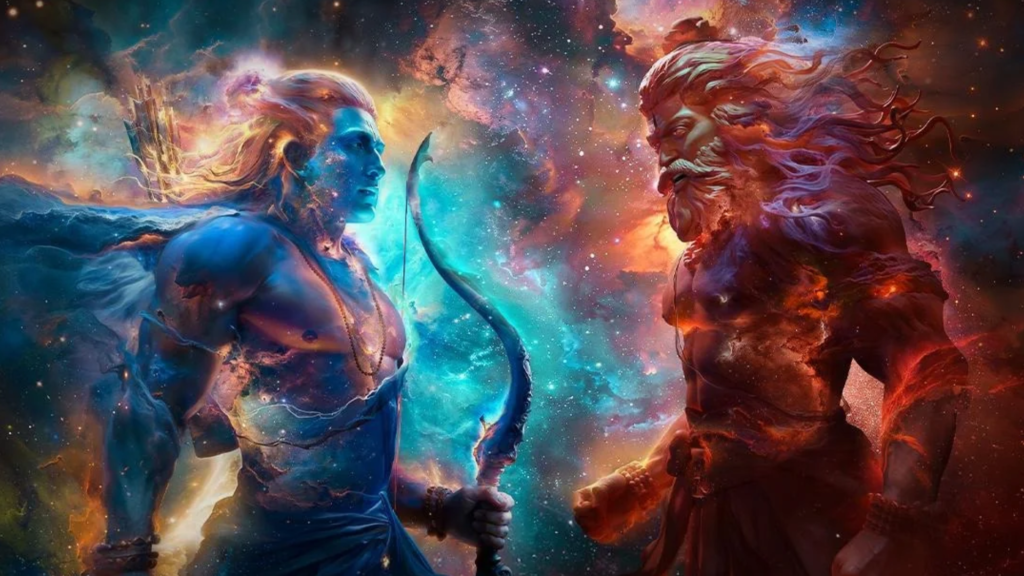
Nitesh Tiwari’s Ramayana: Part One has crossed the ₹100 crore mark in advance bookings, with its all-days-on-sale gross collection in India reaching ₹101.94 crore ahead of its November 5 theatrical release. The film has sold 27.01 lakh tickets across its advance-booking window, with bookings recorded across 86,402 shows. The total includes blocked seats; excluding them, the gross stands at ₹81.13 crore, with 21.59 lakh tickets booked. The reported occupancy is 14 per cent, or 11 per cent when blocked seats are excluded.
The latest figures place Ramayana: Part One among the select Indian films to record advance bookings exceeding ₹100 crore before release. The scale of the pre-sales reflects the anticipation surrounding the two-part adaptation of the Ramayana, produced by Namit Malhotra and directed by Nitesh Tiwari. The film stars Ranbir Kapoor as Lord Rama, Sai Pallavi as Sita and Yash as Ravana.
The advance-booking report also records 185 housefull shows, including 49 shows marked as fully sold. The figures cover all days on sale and should be distinguished from opening-day collections or actual box-office revenue after the film begins its theatrical run.
Hindi is the largest contributor to the domestic advance-booking total, accounting for ₹83.30 crore, including blocked seats, and ₹65.09 crore without them. The Hindi version has sold 18.68 lakh tickets, or 14.41 lakh excluding blocked seats, across 76,564 shows. Its average ticket price stands at ₹446, considerably higher than the figures recorded for the other language versions.
Within the Hindi market, 3D screenings have generated ₹44.31 crore, including blocked seats, from 9.77 lakh tickets across 34,122 shows. The standard 2D version has contributed ₹23.26 crore from 7.31 lakh tickets across 40,952 shows. The figures indicate that 3D screenings account for a substantial share of Hindi advance bookings, while 2D screenings continue to provide a larger number of shows.
The Telugu version has recorded ₹8.41 crore in advance bookings, including blocked seats, and ₹7.22 crore without them. It has sold 5.01 lakh tickets across 4,980 shows. The Kannada version has collected ₹7.56 crore, or ₹6.55 crore excluding blocked seats, from 2.04 lakh tickets across 2,851 shows. Tamil bookings stand at ₹2.15 crore, including blocked seats, and ₹1.82 crore without them, with 1.03 lakh tickets sold across 1,399 shows. The Malayalam version has registered ₹51.92 lakh, or ₹45.97 lakh excluding blocked seats, from 25,010 tickets across 607 shows.
Overseas advance bookings have also contributed to the film’s pre-release momentum, with North America emerging as the leading international market. Pre-sales in the United States and Canada have reached USD 4.24 million, approximately ₹35–38 crore, including more than USD 1.20 million from paid previews alone. The United Kingdom and Ireland rank second among the overseas markets, with strong advance-booking momentum, while Australia and New Zealand are also reporting high demand. These figures indicate that the film’s advance interest extends beyond India, with North America currently accounting for the strongest reported international pre-sales.
Premium formats have made a significant contribution despite accounting for a relatively small share of the total screenings. IMAX, 4DX, Dolby Cinema, ScreenX, EPIQ, ICE and HDR by Barco together have generated ₹16.82 crore, including blocked seats, and ₹15.51 crore without them, across 1,526 shows. These formats account for approximately 17 per cent of the overall gross from around 2 per cent of the shows.
IMAX is the largest contributor among the premium formats, with ₹12.63 crore in bookings, including blocked seats, and ₹11.78 crore without them, from 708 shows. 4DX has generated ₹2.37 crore, while Dolby Cinema has recorded ₹1.20 crore. ScreenX, EPIQ, ICE and HDR by Barco have also registered bookings, although their contributions are smaller in comparison.
The premium-format performance is part of a wider push to position the film as a large-format theatrical experience. IMAX and other premium screens have a limited share of the total show count, but their higher ticket prices have helped them account for a disproportionately large share of the advance-booking gross. The all-format average ticket price across India is ₹377, while the Hindi version has a higher average of ₹446.
The film’s advance bookings have also been accompanied by reports of high-priced premium seating. Selected luxury recliner tickets in Mumbai have reportedly been listed at ₹3,170. Such prices reflect the premium end of the exhibition market and should not be taken as representative of the film’s overall ticket pricing.
The scale of the pre-sales follows an extensive promotional campaign and growing interest in the film’s visual presentation. One of the production’s major sequences, the battle between Ravana and Jatayu, reportedly took approximately six and a half years to develop from the initial briefing to completion, according to director Nitesh Tiwari. The design development for the Pushpak Vimaan also reportedly extended over nearly two years, with 40 to 50 iterations considered during the process.
The film’s music brings together Hans Zimmer and A. R. Rahman, marking Zimmer’s first collaboration on an Indian film. The visual effects are being handled by DNEG, the company known for its work on films including Dune and Interstellar. The production’s emphasis on large-scale visual effects, elaborate environments and premium-format exhibition is central to its theatrical positioning.
Ramayana: Part One is the first instalment of a planned two-part cinematic adaptation. The combined budget of the two films has been reported at approximately ₹4,000 crore, although the figure should be treated as a reported production estimate rather than a confirmed final cost. The project is being produced by Namit Malhotra, with the scale of the undertaking making it one of the most ambitious Indian film productions currently in development and release.
There has also been trade discussion around the film’s digital rights. Reports have claimed that Netflix made an offer of approximately ₹700 crore for the digital rights, which was allegedly turned down as the producers expected a higher valuation. Neither the reported offer nor the decision has been officially confirmed, and the claim remains unverified.
With the domestic all-days-on-sale advance-booking gross now at ₹101.94 crore, Ramayana: Part One has entered the final stretch before its November 5 release with substantial pre-release ticket sales. The Hindi version remains the principal contributor, while 3D and premium-format screenings have added to the overall total. The film’s opening weekend will establish how these advance bookings translate into actual theatrical collections.
Data Source: Sacnilk