
There is, of course, a universal truth in our midst. But often, it is a truth that only the universe can see.
Akira Kurosawa’s Rashomon, adapted from the short stories “In a Grove” and “Rashomon” by Japanese writer Ryūnosuke Akutagawa, is a film that asks what happens to truth once it passes through human beings.

Released in 1950, the film follows three men taking shelter from heavy rain beneath the ruined Rashomon gate. One of them, a woodcutter, has just returned from the trial of a samurai’s murder, and what troubles him is not only the murder itself, but the fact that everyone seems to have a different version of what happened.
And so, through the film, we hear four different versions of the same story, told by four different people who were either participants in or witnesses to the event.
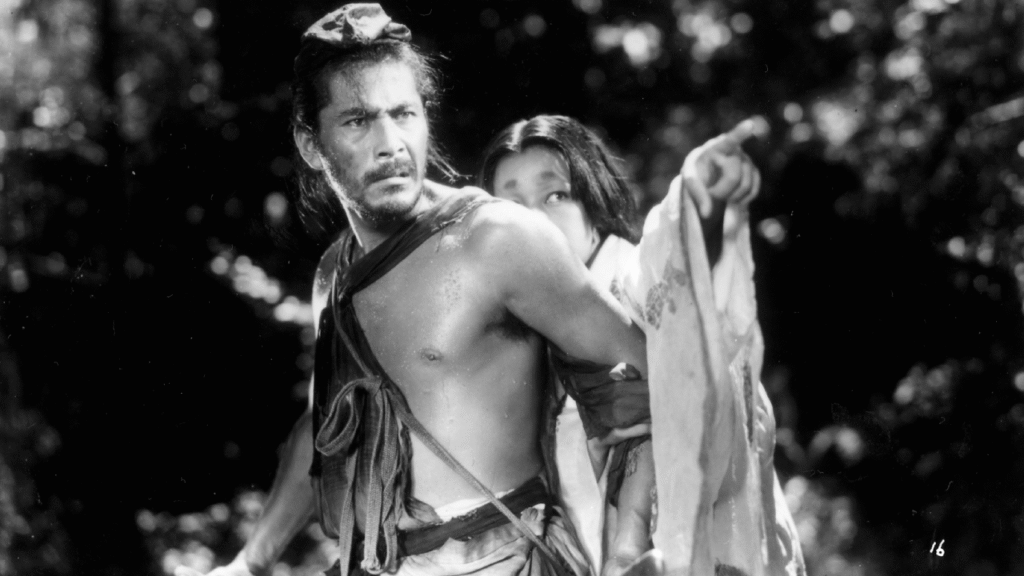
A bandit spots a samurai and his wife passing through the forest. He attacks the samurai, ties him up and assaults his wife. What follows is where the accounts begin to separate. By the end of the incident, the samurai is dead, but how he died depends entirely on whom we choose to believe.
The bandit says that he tied the samurai up, took his woman in front of him and later fought him in a long and difficult duel, eventually killing him. His version makes him look brave. The wife says that the bandit leaves immediately after bringing her to her husband, and when she goes closer to her husband, he looks at her with such cruelty that his gaze frightens her more than the bandit could have by hurting them. Overcome by what has happened and by her husband’s rejection of her, she eventually kills him with a dagger. Her version makes her look less like a murderer and more like a woman pushed into an unbearable situation. Then we hear from the murdered husband himself, speaking through a medium. He claims that both the bandit and his wife were cruel and foul-minded, his wife more than the bandit. According to him, the bandit follows the wife after she runs away, having told him to kill her husband, leaving the samurai alone with what has happened. Once the samurai is released by the bandit, and told that his wife got away, he then takes his own life. His version allows him to remain noble even in death. He is not defeated by another man. He chooses his own death.
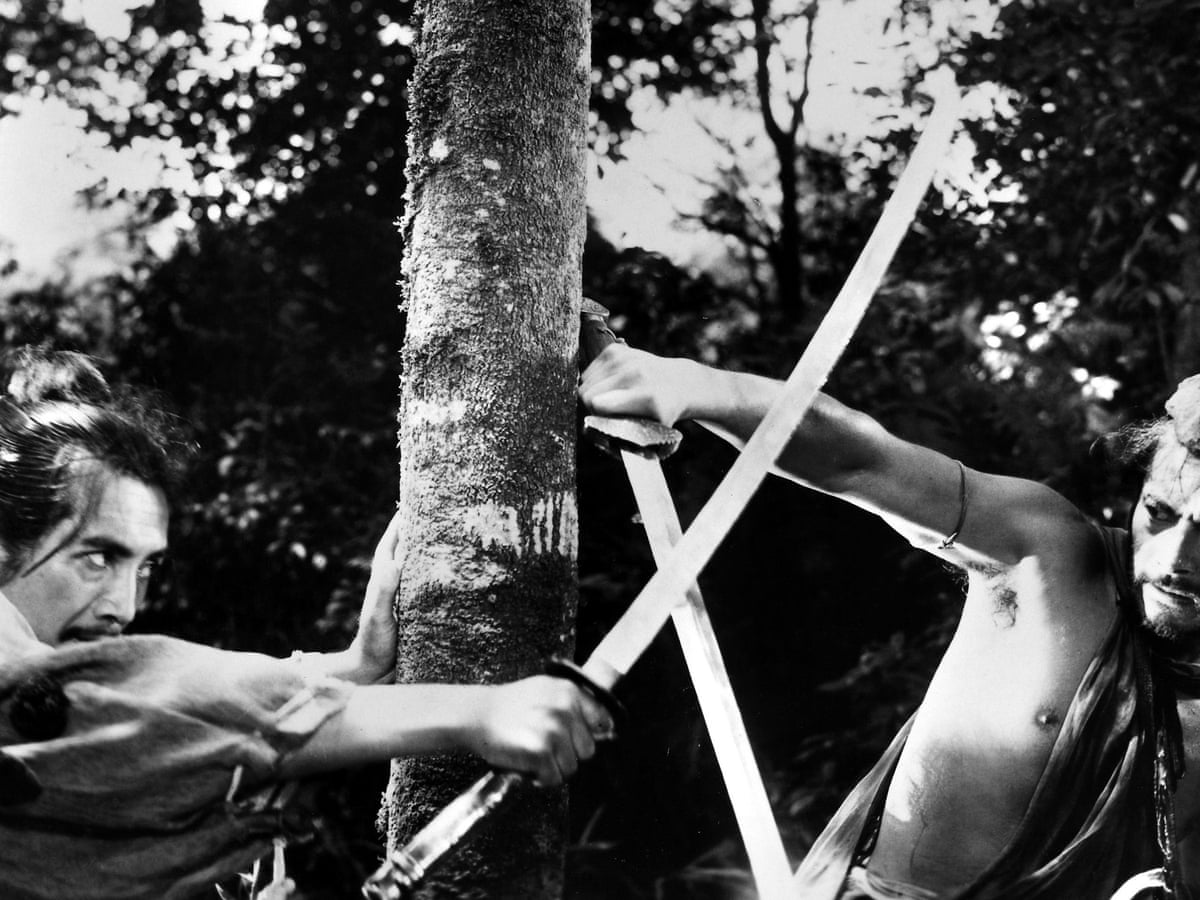
And then, towards the end, we hear the story from the woodcutter, who had initially claimed only to have discovered the body. He later admits that he had actually witnessed the murder. His account is different from all the others. The wife, in his telling, ignites the fight by calling both men weak, questioning their manhood, and asking why neither of them will fight properly for her. The bandit and the samurai then fight, but there is nothing glorious about the duel. It is clumsy, frightened and prolonged, until the bandit eventually kills the samurai.
None of these accounts come close to completely matching the other. And this is where the film begins to confuse the audience because the truth becomes increasingly difficult to locate.
One could assume that the witness’s story is the closest to the truth. After all, he was not one of the participants and would seemingly have nothing to gain from lying. But even he has something to hide. He had stolen the samurai’s dagger from the scene, and had kept that part of the story to himself. And so, even when we think we have finally found the truth, another doubt appears.
Everyone seems to have fabricated the truth according to their needs and according to how the event would make each one of them look better. The bandit needs to be brave. The wife needs to retain her dignity. The husband needs to remain noble. Even the witness has his own guilt to conceal.
The truth itself has not changed. What has changed is the shape it takes when each person tells it.
After hearing three completely different versions of the same story, skepticism creeps into the mind. What if everyone is lying? What if there is no version we can completely trust? What if the truth exists somewhere, but every person who touches it leaves something of themselves on it, distancing it further from the actual truth?
The dialogue towards the end by the woodcutter, “It’s inevitable to be suspicious of others on a day like this,” embodies the feeling of the film. The confusion, the uncertainty, the loss of trust. The film leaves us standing in the same place as the characters, unsure of what happened, and increasingly unsure of whether another person can ever give us the truth exactly as it was.
And this is what makes truth such a fascinating thing. It does not only change when people lie about what happened. It changes in the way it is remembered, the way it is told, and the way it is presented to someone else.
A dialogue I was reminded of almost immediately after watching Rashomon was from The Newsroom, written by Aaron Sorkin. In one scene, a character presents an idea, “Are there really two sides to this story?” When someone asks what that means, the character says, “The media is biased towards success, and the media is biased towards fairness.” But how can someone be biased towards fairness? The answer, she says, simply: “There aren’t two sides to every story. Some stories have five sides, some only have one.” The example that follows by another character makes the point clearer. “Biased toward fairness means that if the entire congressional Republican caucus were to walk into the house and propose a resolution stating that the Earth was flat, The Times would lead with, ‘Democrats and Republicans can’t agree on shape of Earth.’”
The facts have not necessarily been invented. They have been arranged. And this is how truth gets manipulated, not in one way but in many. The media can manipulate facts by serving them to people in a way that attracts viewers. The best possible form of the argument can be turned into the most attracting form of the argument in a way that multiplies clicks. Something that might have several sides can be reduced to the side that creates the strongest headline, the most views, the most attention.
People do something similar with their own lives as well.
“Whatever helps you sleep at night” is a common response to someone lying to themselves. Because sometimes the argument is no longer about convincing somebody else. It is about making your own version of reality bearable.
People telling lies do not just say them to others. They tell them to themselves too.
One could argue that they are weak, or that they are not capable of handling the truth, or rather, of handling what the truth makes them. For example, if the truth is that I committed a crime, that I stole something, and in all facts I did, but I do not want to be labelled a thief because I never thought of myself as one, I can tell myself that I did not do it. And so the lie takes the shape of truth. Not just for others, but for me as well. I cannot be lying if I do not believe I am.
There is also a more tender lie we tell ourselves.
When someone hurts us, badly, so much so that we carry some part of that hurt with us every day. Over time, or sometimes immediately after the incident, the mind can erase parts of the memory so that the everyday pain is diminished. Sometimes, we even speak about someone who is gone in the present tense to avoid lamenting their loss because it hurts all that much.
It is still a lie, sure. But it is one created to survive the truth, and not with the intention of spreading lies.
And maybe this is why Rashomon continues to feel so familiar. The phenomenon itself did not come from Rashomon. People have been doing this forever. They lie to others, they lie to themselves, they remember things differently, they conceal what makes them ashamed, and hold onto what makes them feel better about who they are.
What Rashomon did was give this a face.
It gave a common human phenomenon a platform where it could be made visible, questioned, and placed into the conscience of people. It made cinema notice that truth does not always have to be shown through one clear account. Sometimes, the absence of certainty can say more than certainty ever could.
The idea became so closely associated with the film that the term “Rashomon effect” came to describe situations where different people give contradictory accounts of the same event, with no easy way of establishing which version is true.

Films over the years have returned to this form of storytelling following in the footsteps of the film Rashomon. David Fincher’s Gone Girl (2014), Kamal Haasan’s Virumaandi (2004), Meghna Gulzar’s Talvar (2015), Bryan Singer’s The Usual Suspects (1995), Ridley Scott’s The Last Duel (2021), and many others have played with conflicting perspectives, unreliable accounts, and the question of what really happened. Some eventually give us an answer. Some leave us with another question.
But what makes Rashomon so enduring is that it does not make the uncertainty feel like a trick. It makes it feel human. Because the subject itself, however interesting and layered, is a common occurrence. People are lying every day. People are changing the meaning of truth every day. And that is precisely what makes it layered.
You do not have to look far to find cinematic subjects that will later become cultural. More often than not, they are somewhere near us, within us, in every human life. Humans themselves are layered and multi-faceted. And that is what makes cinema layered.
Maybe truth has always existed in one form, untouched somewhere beyond us. But once it passes through a human being, it carries their fear, pride, shame, memory, and need to believe that they are still the person they thought they were, and hence, that one form is no longer just one.
The real truth remains somewhere underneath all of it. Humans just keep giving it different faces.