
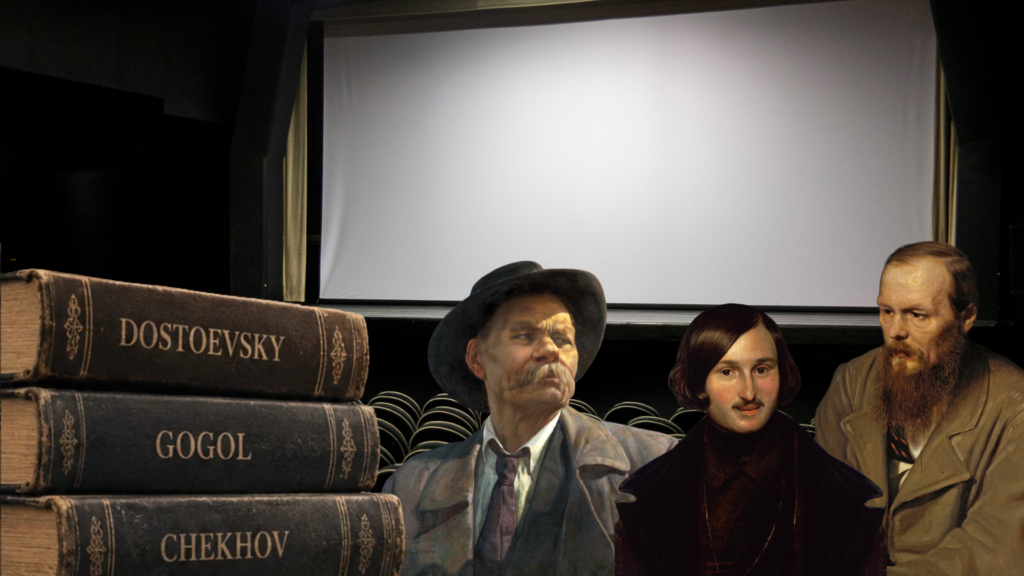
There was a time when Russian books were not difficult to find in Indian homes. They were translated into Indian languages, sold at affordable prices, and read by children and adults who may have never travelled beyond their own towns.
It is interesting to think about what happens when a story travels this far. The people, the places and the circumstances it describes may belong to another country, but the feelings at its centre can still find a home elsewhere. This is one of the reasons Russian literature found its way into Indian cinema. Sometimes filmmakers borrowed an entire story. At other times, they carried only a character, a conflict or a feeling into a different world. What emerged was not always a faithful retelling. It was often a story being understood through another culture.
One of the most familiar examples is Fyodor Dostoevsky’s White Nights, which has inspired several Indian films. The story follows a lonely dreamer who meets a young woman waiting for the man she loves. They spend a few nights together, speaking about their lives and finding a kind of closeness neither may have expected. But the relationship they share does not necessarily lead where the dreamer hopes it will. What makes the story so moving is that, for a brief period, someone who has spent much of his life alone is allowed to feel that he belongs in another person’s world.

This feeling has travelled through Indian cinema in different forms. In Tamil, S. P. Jananathan’s Iyarkai (2003) places the story in the coastal town of Rameswaram, among sailors and people whose lives are shaped by the sea. In Hindi, Ahista Ahista (2006), directed by Shivam Nair and written by Imtiaz Ali, brings it into Delhi. The locations are different, but the emotional situation remains recognisable: a person who has been lonely for a long time begins to imagine a life with someone who may not be able to offer the same future.
What is captivating is how differently these films can make us feel about that longing. The sea in Iyarkai becomes part of the lives of people who are waiting for something, while the city in Ahista Ahista gives its characters a different kind of isolation. They are surrounded by people, and yet the distance between what they want and what they can have remains.
The story does not need to remain in the streets of nineteenth-century St. Petersburg to make sense. Its central emotion can fairly exist in a coastal town or a crowded city, too.
The journey becomes even more interesting with Velutha Rathrikal (2015), a Malayalam film directed by Razi Muhammed. Its connection to White Nights is a looser, more creative one, with the story moving into the world of tribal and forest settlements in Attappadi. The film also explores female bisexuality, taking the story in a different direction through the relationships and desires of its characters. Instead of following the original work closely, it uses it as a starting point to tell a different story. The change in setting and relationships also changes what the film has to say, especially about women and the expectations placed on them.
Sanjay Leela Bhansali’s Saawariya (2007) offers another version of the same story, though its elaborate sets and heightened visual style make it feel very different from the other adaptations. Its connection to Dostoevsky’s novella also feels like coming through the tradition of adaptations such as Luchino Visconti’s Le Notti Bianche (1957). The dreamlike world of Saawariya reflects the way its protagonist sees the woman he loves, almost as though the world around him has been built from his own hopes.
Loneliness, however, is not the only feeling Russian literature brought into Indian cinema.
Some of its strongest influences can be found in films about poverty, social injustice, and people struggling to live with the choices they have made. These concerns were particularly relevant to Indian filmmakers working in the years around Independence, when questions of class and inequality were central to much of the country’s social and political life.

Chetan Anand’s Neecha Nagar (1946) is a telling example, an Indian adaptation of Maxim Gorky’s The Lower Depths, scripted from a story by Hayatullah Ansari. The divide between the wealthy settlement on the hill and the poor people living below it gives the film a physical expression of inequality. The distance between the two communities is not merely geographical. It determines whose needs matter and whose suffering can be ignored.
Dostoevsky’s Crime and Punishment found a different kind of expression in Hindi film Phir Subah Hogi (1958), directed by Ramesh Saigal. Raj Kapoor plays a poor law student whose circumstances and moral struggles bring the story into conversation with Dostoevsky’s novel. The film is not simply concerned with whether a person is right or wrong. It also asks what poverty and an unjust society can do to someone who is trying to find his way through life.
This is where the influence of Russian literature becomes more than a matter of adapting a particular book. The questions these writers asked about society, morality, and human suffering found an audience among Indian filmmakers who were looking at similar problems around them. The stories did not have to describe the same country to speak to the same concerns.
The influence could also be found in films that looked at ordinary people without turning their lives into grand tragedies. In Hindi film Garam Coat (1955), directed by Amar Kumar, which is an adaptation of Nikolai Gogol’s short story The Overcoat. Balraj Sahni plays a poorly paid post office clerk who struggles to provide for his family. Set in post-partition North India, the film takes Gogol’s story into a society facing economic hardship and a breakdown of trust between people and institutions. While the original follows a clerk whose life changes after he acquires a new overcoat, the film reshapes the story around the circumstances of his own time and gives it a more hopeful ending.
That focus on ordinary people also brings us to Anton Chekhov, whose stories often find something meaningful in lives that may seem unremarkable from the outside. His characters are not always able to change their circumstances, and their unhappiness does not necessarily lead to a dramatic resolution. They continue to live, hope, endure, and make mistakes. It is a kind of storytelling that leaves room for the feelings people do not always know how to express.
Jayaraj’s Malayalam film Ottaal (2015), based on Chekhov’s short story Vanka, takes one such story into the world of a young boy facing exploitation and loneliness. The child writes a letter to his grandfather, hoping to be rescued from the life he is living. The original story’s emotional centre remains, but the circumstances surrounding it belong to a different place and time. The film’s setting and its treatment of child labour make the boy’s helplessness immediate to an Indian audience.
Kumar Shahani’s Kasba (1991), inspired by Chekhov’s In the Ravine, approaches human suffering from another direction. Instead of dividing people into good and evil, the film looks at how people get caught up in their own desires. The local setting, including its visual influences from Kangra painting, gives the story a distinctly Indian identity without removing the uncomfortable questions at its centre.
There’s something fitting about Chekhov finding a place in Indian cinema. His stories often depend on the small details of a person’s life, on what they want but cannot say, or on the distance between the life they imagined and the one they have ended up living. Those details do not belong to Russia alone. They can be found anywhere.
Other adaptations have taken Russian literature into the world of labour and politics.

Tamil film Ilaignan (2011), directed by Suresh Krissna, draws from Maxim Gorky’s Mother. The novel follows a working-class woman whose understanding of her son’s political struggle gradually changes her own relationship with the world around her. In the film, the story is relocated to a shipyard in the 1940s, bringing its concerns about workers’ rights and collective struggle into a different historical setting. A novel shaped by the Russian revolutionary movement becomes a story that can speak through Tamil Nadu’s own political and industrial history.
Gorky’s work was never only about the politics of a particular place. It was also about the people who came to recognise the injustice around them, and what that recognition demanded of them. In moving the story to India, the film brings those questions into another context rather than asking Indian characters to simply imitate their Russian counterparts.
The influence of Russian writing could also be found in comedy.
Nikolai Gogol’s The Government Inspector, a satire of corruption and bureaucracy, was adapted into the Hindi film Afsar (1950), directed by Chetan Anand, who later remade the story as Sahib Bahadur (1977). Gogol’s story works because of the absurdity of a society in which officials are so afraid of being exposed that they become easy to deceive. The comedy may arise from their panic and foolishness, but beneath it is an unmistakable criticism of people who use their positions for personal gain.
The fact that such a story could be adapted for Indian cinema is not surprising. Bureaucratic corruption does not need to look exactly the same in every country to be recognisable. The details may change, but the behaviour being mocked remains familiar.
For decades, Russian books reached Indian readers through affordable translations, including those published by Progress Publishers. They could be found in homes, schools and bookshops, making writers who lived far away part of the reading lives of people here. The collapse of the Soviet Union disrupted much of that publishing network, and the easy availability of these books became less common. Yet, some of the stories had already travelled beyond the printed page.
It is worth remembering that these films did not all approach their sources in the same way. Some followed a novel or short story closely, while others borrowed an idea and made it their own. Some retained the original work’s emotional centre; others changed its relationships, setting or politics in ways that created something new. Their connection to Russian literature is not always a straightforward one, and it would be a mistake to treat every resemblance as proof of direct adaptation.
What remains appealing is the way these stories have been received and reimagined. A lonely dreamer in St. Petersburg could find himself on the coast of Tamil Nadu. A story about a child writing to his grandfather could become a film about child labour in India. A novel about a working-class mother in Russia could be retold through the struggles of workers in a Tamil shipyard.
These books travelled through languages, generations and different forms of storytelling, finding a place in the lives of people far removed from the world in which they were written. Through Indian cinema, they continued to tell their stories, not quite as they were first imagined, but in ways that allowed them to be understood all over again.