
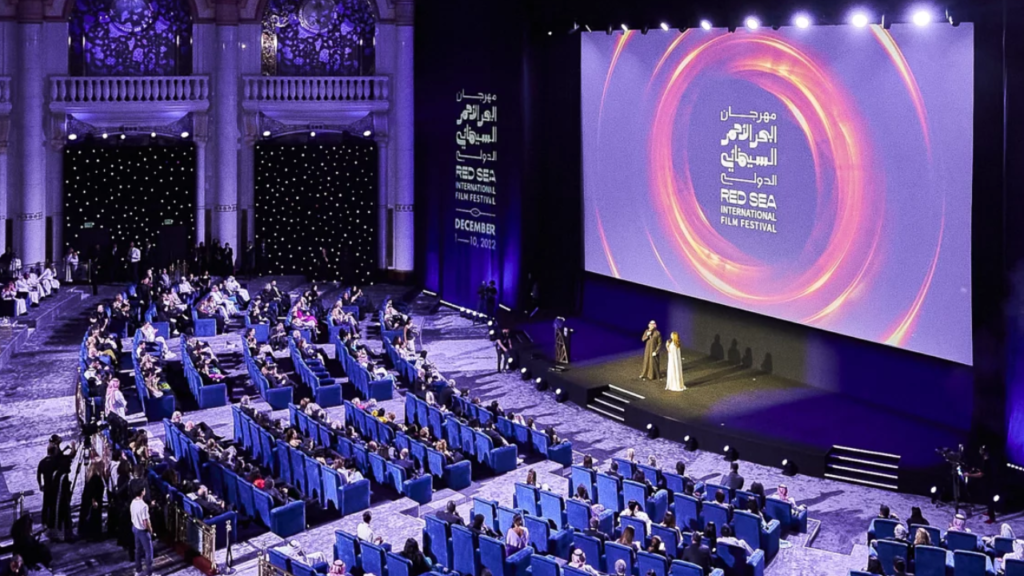
For a country that had no public cinemas for 35 years, Saudi Arabia has moved remarkably fast.
There was a time when watching a film in a theatre was not a part of everyday life in the country. Today, Saudi Arabia has hundreds of cinema screens, growing production infrastructure, local films finding audiences at home and abroad, and a film festival that brings some of the biggest names in world cinema to Jeddah. The transformation is not only about the number of cinemas that have opened or the amount of money being invested into filmmaking. It is about how cinema has slowly become a part of the country’s cultural identity.
And at the centre of that transformation sits the Red Sea International Film Festival.
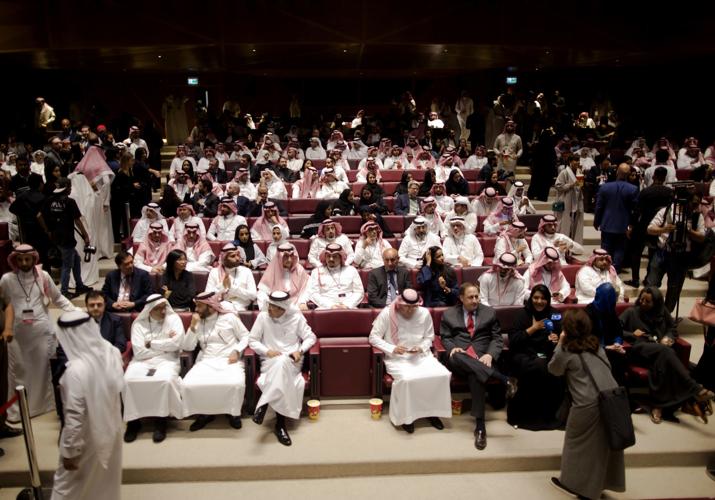
For roughly 35 years, cinema had no place in the country’s public cultural life. The real change came in 2018. In April that year, Saudi Arabia reopened public cinemas after a 35-year absence, with the first cinema opening in Riyadh and screening Black Panther. The reopening was part of Crown Prince Mohammed bin Salman’s Vision 2030 programme, which aimed at diversifying the country’s economy while expanding its cultural and entertainment sectors.
For cinema, this was much more than the opening of a theatre. It meant that films could now exist publicly again. Audiences could buy tickets, exhibitors could build theatres, producers could think about theatrical releases, and filmmakers could finally imagine a domestic industry rather than a collection of isolated projects.
The speed of the development since then has been unbelievable. The Saudi Film Commission was established in 2020 to develop the country’s film sector, support local talent and build the infrastructure required for a sustainable industry. Studios began coming up, production companies emerged and Saudi Arabia started positioning itself as a destination for international productions as well. Saudi Arabia also began attracting filmmakers to locations like Al-Ula and Riyadh, while the reopening of cinemas helped create a growing audience for films. By 2024, the country had 64 cinema locations with 630 screens, along with more production companies and studios. The scale of the audience has grown alongside the infrastructure. Saudi cinemas sold 17.5 million tickets in 2024, generating 845.6 million Saudi riyals in box-office revenue. A country that had spent decades without public cinema was suddenly building the infrastructure for an entire industry.
But infrastructure alone cannot create a cinema culture. You need filmmakers. You need stories. You need producers willing to take risks, investors willing to support them, distributors willing to release them and audiences willing to watch them. You also need a space where all of these people can meet. This is where the Red Sea International Film Festival becomes important.
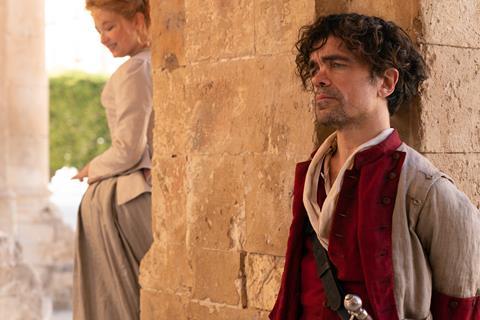
The Red Sea International Film Festival was established in 2019 as part of the wider effort to revive and accelerate Saudi cinema. Its first edition was originally planned for 2020 but was postponed because of the COVID-19 pandemic. It finally held its inaugural edition in Jeddah in December 2021, with Joe Wright’s Cyrano as its opening film. From the beginning, the festival was designed to do more than simply screen films. It was created as a meeting point between Arab, African, Asian and international cinema, bringing filmmakers and the global industry into a country that was only beginning to build its own cinematic ecosystem.
Even the location says something about what the festival is trying to do. The festival takes place in Jeddah’s historic Al Balad district, a place that has existed for centuries as a centre of trade and cultural exchange. Putting an international film festival there creates an interesting meeting between the history of the country and the cultural transformation taking place around it. The festival is not trying to erase what existed before. Rather, it is placing cinema inside it.
The Red Sea Film Festival is not only showcasing the growth of Saudi cinema, but also helping create that growth. The Red Sea Film Foundation operates several initiatives around the festival, including the Red Sea Fund, the Red Sea Souk and various labs and development programmes. Together, they create an ecosystem that supports films before they ever reach a festival screen.
The Red Sea Fund, in particular, has become an important part of this process. It supports filmmakers and projects from the Arab world, Africa and Asia through different stages of development and production, giving films access to funding that can otherwise be difficult to find. Hundreds of projects have now passed through the wider Red Sea ecosystem, with supported films reaching major international festivals, this matters because a film industry cannot survive only on finished films. It needs to constantly produce the next one.
The Red Sea Souk works in a similar way. It brings producers, financiers, distributors and filmmakers together, giving them a space to pitch projects and find people to work with. For an emerging industry, this can be as important as the festival itself. A young filmmaker may have a story, but without someone willing to finance it, produce it or distribute it, the story remains an idea. The Souk creates the possibility of turning that idea into a film.
This is why the Red Sea Film Festival has gradually become part of the machinery of Saudi cinema rather than simply an annual celebration of it. The festival screens films, but the larger system that runs around it helps make films. It introduces international producers to Saudi filmmakers, gives emerging directors access to global industry professionals and creates opportunities for Saudi stories to move beyond their domestic audience.
The growth of the festival reflects the growth of the industry around it. Its inaugural edition was already an important cultural moment for a country that had only recently reopened its cinemas. By its fifth edition in 2025, the festival had showcased more than 520 films from 85 countries, including more than 130 Saudi films.
It had moved from being a new festival trying to establish itself to becoming a serious international destination on the film calendar.
Then there are the famous names that arrive with it. Viola Davis, Spike Lee, Michelle Yeoh, Emily Blunt, Brendan Fraser, Vin Diesel, Catherine Zeta-Jones, Priyanka Chopra Jonas and several other international stars have walked its red carpet or participated in its events. It would be easy to look at this purely as the glamour surrounding the festival. But the celebrity presence also represents something else. It tells the global film industry that Saudi Arabia is no longer just a country that has recently reopened cinemas. It is becoming a place where cinema itself is happening.
Saudi Arabia is not only trying to import cinema. It is trying to build a cinema of its own.
And the stories coming out of the country are beginning to show what that could look like. Films such as The Perfect Candidate, Scales, The Tambour of Retribution, Sattar and Mandoob represent different sides of a young industry trying to understand itself. They deal with identity, family, tradition, ambition, class, social change and the contradictions that come with a society changing at an extraordinary speed. There is an increasing presence of women filmmakers and performers as well, with Saudi women increasingly becoming part of the filmmaking process both in front of and behind the camera.
This is where Saudi cinema becomes more than an economic success story. Cinema has always been a way for countries to understand themselves, and Saudi Arabia is now going through a period of enormous cultural change. Films can document that change in a way that statistics never can. They can show what happens inside homes, families and relationships as a society changes around them. They can preserve a version of the country that may look completely different a decade from now.
The Red Sea Film Festival plays a role in making those stories visible. It gives Saudi filmmakers a space at home while simultaneously putting them in conversation with filmmakers from the rest of the world. A Saudi film can sit alongside an African film, an Indian film, a Korean film or a Hollywood production. The local story does not have to remain local simply because it comes from a new industry.
There is still a long way to go, of course.
The industry is young, and building studios and cinemas is only one part of the process. Saudi Arabia still needs more experienced crews, writers, producers, technicians, and distributors. It needs films that can sustain themselves commercially and filmmakers who can build long-term careers. And as the industry grows, questions around censorship and creative freedom will remain important because the evolution of cinema is not only about whether a country has the resources to make films. It is also about what its filmmakers are allowed to say once they have those resources.
But the scale of the transformation cannot be ignored.
The story of Saudi Arabian cinema is not simply a story about what happened after the ban was lifted. It is about what happened when a country decided that cinema could become part of its future. The Red Sea International Film Festival brings the world to Saudi Arabia, but more importantly, it gives Saudi Arabia a way of taking its own stories to the world.
For decades, Saudi cinema had to exist around the absence of a public film culture. Today, it is trying to create one of its own. And the Red Sea International Film Festival, in many ways, has become the place where that evolution can be seen most clearly, not as something that has already happened, but as something that is still being built, film by film.
Read More: