
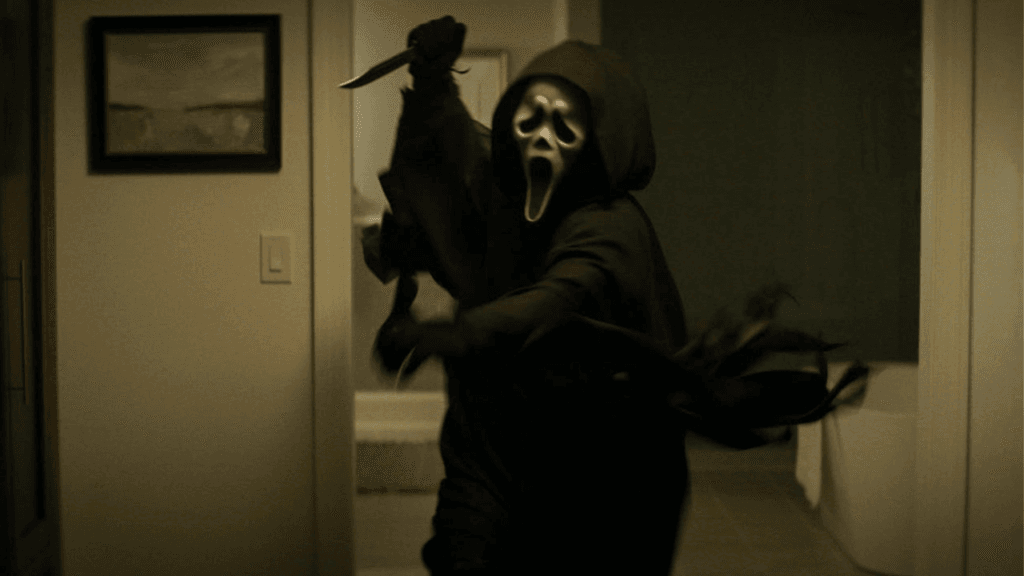
The US domestic box office roared back to life this weekend as Scream 7 blew past expectations with a franchise-best $64.1 million opening. The Paramount and Spyglass sequel not only debuted at No. 1 but also delivered the biggest horror launch ever for the month of February and the largest domestic opening of 2026 so far.
Overseas, the slasher added $33.1 million, bringing its worldwide debut to $97.2 million. For a production budget reportedly around $45 million, the film has already positioned itself on a fast track to profitability.
The opening significantly surpassed Scream VI’s $44.4 million debut and demonstrated that horror — particularly recognizable IP — remains one of the most reliable theatrical genres. Premium formats played a decisive role. Forty percent of the gross came from PLFs, with IMAX alone accounting for 9 percent — an unusually high footprint for a horror title. A sparse early-2026 tentpole pipeline allowed the film to dominate premium screens, elevating it beyond a traditional genre play.
Demographically, the turnout was strong and balanced. Gen Z and younger Millennials drove the majority of ticket sales, with the 18–34 cohort leading attendance. The gender split was relatively even, another positive sign for franchise durability. Despite a low critics’ score, the audience response proved solid, with a B- CinemaScore — a healthy grade for horror — reinforcing the idea that genre titles are largely review-proof when brand loyalty is intact.
In second place, Sony’s GOAT continued its steady run, earning $12 million in its third weekend, down just 29 percent. The animated title has now reached $73.9 million domestically and $130.5 million worldwide, including $56.5 million overseas. The hold was the strongest among the top three films, underscoring the consistent strength of family programming even in competitive frames.
Animation continues to function as a stabilizing force in the marketplace — less volatile than horror, less front-loaded than adult dramas, and capable of maintaining mid-level momentum across multiple weekends.
Warner Bros.’ Wuthering Heights placed third with $6.95 million, falling 50 percent in its third weekend. The film’s domestic total now stands at $72.3 million. Internationally, however, the picture is performing at a much stronger clip, adding $15.6 million overseas this weekend alone for a foreign total of $119.7 million and a worldwide haul north of $192 million.
The global performance highlights an important trend: prestige romantic dramas are finding their strongest audience abroad. While domestic momentum has cooled, international markets are driving the film toward the $200 million milestone.
Elsewhere in the Top 10, Neon’s EPiC: Elvis Presley in Concert expanded nationwide and climbed to fourth place with $3.5 million, up 9 percent. The concert documentary’s expansion strategy — beginning with a strong IMAX-driven launch before scaling — continues to pay off. With a $7.8 million 10-day domestic total and an A+ CinemaScore, the film proves that nostalgia-fueled event programming remains a viable theatrical lane.
Among other holdovers, Amazon MGM’s Crime 101 added $3.4 million, down 38 percent, for a $30 million domestic total. Lionsgate’s I Can Only Imagine 2 fell sharply by 60 percent in its second outing, earning $3.1 million for a $13.2 million total. The steep decline reinforces the increasingly front-loaded nature of mid-budget adult titles in 2026, where word-of-mouth impact is immediate and unforgiving.
Meanwhile, long-tail performers continue to anchor the market. Disney’s Zootopia 2 added another $1.4 million in weekend fourteen, pushing its domestic total to $425.8 million. And James Cameron’s Avatar: Fire and Ash crossed $401.2 million domestically in its eleventh weekend, further cementing its sustained box office endurance.
Taken together, the weekend paints a clear picture of the current theatrical landscape. Horror IP can still explode out of the gate. Family animation provides stability. Prestige dramas increasingly rely on international markets. Concert and event programming can punch above their weight with smart rollouts. And mid-tier adult titles face shrinking margins for error.
If this frame proves anything, it’s that 2026’s box office is becoming more polarized — driven by recognizable brands, premium formats, and audience loyalty rather than broad-based experimentation.
-Box office figures are based on studio estimates and data reported by The Numbers. Final totals may shift as updated actuals are released.
Read More: