
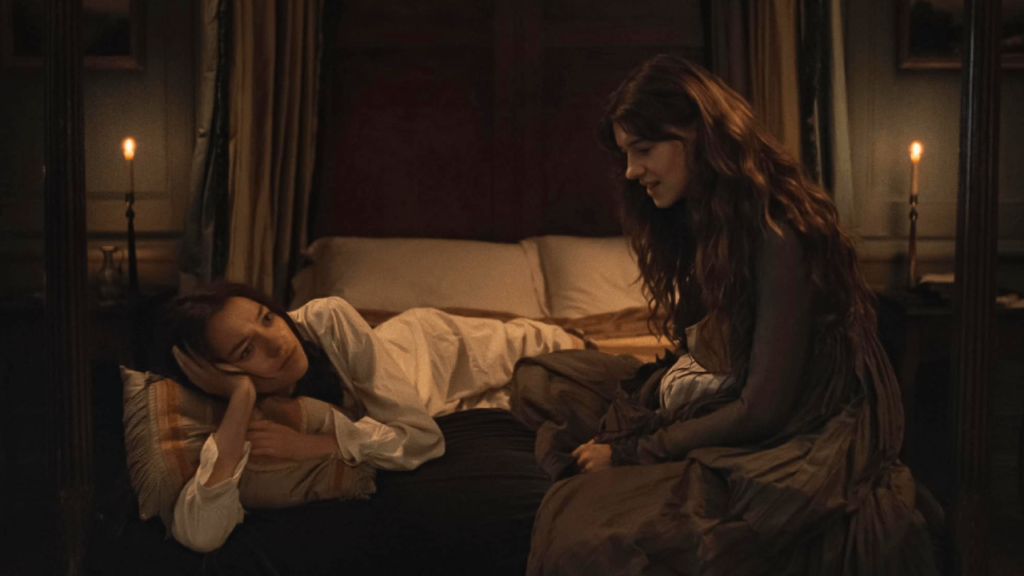
Georgia Oakley’s Sense and Sensibility, a new adaptation of Jane Austen’s classic novel, stars Daisy Edgar-Jones and Esmé Creed-Miles as sisters Elinor and Marianne Dashwood. Following their father’s death, the Dashwood women lose their home and face financial uncertainty, making marriage closely tied to their future security. The film explores their contrasting approaches to love, heartbreak and the expectations placed on women.
The adaptation has received a mixed response from critics. While Peyton Robinson of RogerEbert.com and Gissane Sophia of Lady Geeks Media praise its emotional warmth, emphasis on sisterhood and visual storytelling, Peter Bradshaw of The Guardian finds the film more restrained and feels it lacks some of the charm of the 1995 adaptation.
The performances of the two leads are among the film’s strongest elements. Edgar-Jones plays Elinor, whose reserved nature often keeps her feelings hidden, while Creed-Miles portrays Marianne, who approaches love and heartbreak with greater openness.
In her review for RogerEbert.com, Robinson praises Edgar-Jones for conveying Elinor’s emotions through subtle expressions and restrained reactions. She singles out Creed-Miles as the film’s standout, noting how naturally she moves between Marianne’s quieter moments and her more intense emotional outbursts.
Sophia of Lady Geeks Media also praises the casting, particularly the chemistry among the actresses playing the Dashwood family. Caitríona Balfe portrays their mother, Mrs. Dashwood, while Bodhi Rae Breathnach plays their younger sister, Margaret. Sophia feels their interactions create a convincing sense of sisterhood and provide much of the film’s emotional warmth.
Bradshaw offers a more mixed assessment in The Guardian. Although he appreciates aspects of the casting, he is less convinced by Herbert Nordrum’s portrayal of Colonel Brandon. He feels the character lacks the emotional engagement needed to make his affection for Marianne fully convincing. Bradshaw is more enthusiastic about Fiona Shaw as Mrs. Jennings, praising the energy and humour she brings to the role.
Although romance remains central to Sense and Sensibility, Oakley’s adaptation gives considerable attention to the relationship between the Dashwood sisters. Robinson describes the film as a story about love, heartbreak and growing up, with sisterhood providing its emotional foundation. She appreciates how the sisters respond differently to romantic uncertainty, allowing their contrasting personalities to shape the narrative.
Sophia similarly believes Oakley understands that the bond between the Dashwood women is just as important as their romantic relationships. She praises the warmth of their shared scenes and the chemistry that makes them feel like a genuine family.
The romantic storylines remain an important part of the film. Elinor develops feelings for Edward Ferrars, played by George MacKay, while Marianne is drawn to John Willoughby, portrayed by Frank Dillane. Colonel Brandon, played by Nordrum, also hopes to win Marianne’s affection.
Sophia appreciates the smaller romantic moments, particularly the glances and pauses that communicate feelings the characters cannot openly express. Bradshaw, however, finds that not every pairing is equally effective, with his criticism of Brandon’s portrayal standing out among his reservations.
The film’s visual presentation is another major point of praise. Working with cinematographer Arnaud Potier, Oakley creates a period setting shaped by natural landscapes, movement and carefully composed images.
Sophia describes the film as a visual triumph, praising its picturesque settings and the way its imagery reflects the depth of Austen’s writing. She believes Oakley’s approach gives the adaptation a distinct identity while retaining the heart of the original story.
Robinson also highlights the film’s physical storytelling, pointing to details such as the characters’ clothing, their movement through the woods and the surrounding landscape. She believes these elements communicate emotions beyond the dialogue, allowing the visuals to contribute meaningfully to the characters’ inner lives.
Bradshaw is more reserved about the overall effect. He describes the adaptation as cooler, more austere and more contemplative than the 1995 film directed by Ang Lee and written by Emma Thompson. Although he acknowledges that the new version looks and sounds polished, he feels some of the original story’s charm and spirit are missing.
The reviews present Oakley’s Sense and Sensibility as an adaptation with clear strengths, particularly its central performances, visual storytelling and emphasis on sisterhood. Robinson and Sophia respond positively to its emotional warmth and understated romantic details, while Bradshaw takes issue with its subdued tone and certain casting choices.
Rather than simply recreating the celebrated 1995 adaptation, Oakley offers a different interpretation of Austen’s novel, placing the Dashwood sisters’ relationship at the heart of the story. For some critics, this approach provides a fresh emotional perspective; for others, its restraint comes at the expense of the charm and liveliness expected from the material.
Watch Trailer:

Film Details: Sense and Sensibility
- Director: Georgia Oakley
- Screenplay: Diana Reid
- Cast: Daisy Edgar-Jones, Esmé Creed-Miles, Caitríona Balfe, Bodhi Rae Breathnach, George MacKay, Frank Dillane, Herbert Nordrum and Fiona Shaw
- Cinematography: Arnaud Potier
- Based on: Jane Austen’s novel Sense and Sensibility
- Genre: Drama, Romance
- Runtime: 132 minutes
- Rating: PG
- US Release Date: October 16, 2026