
“How do you say no to God?”
A priest asking you something is, in many ways, much like God asking you something. For a person of faith, saying no is difficult. Especially when you have not seen enough of life to fully differentiate between good and bad. You are only just developing your brain, learning from the things and people around you, and one of those learning experiences is often a priest.
But what happens when that learning experience becomes a malicious one? What happens when the stature, trust, and pedestal of priesthood become predatory?
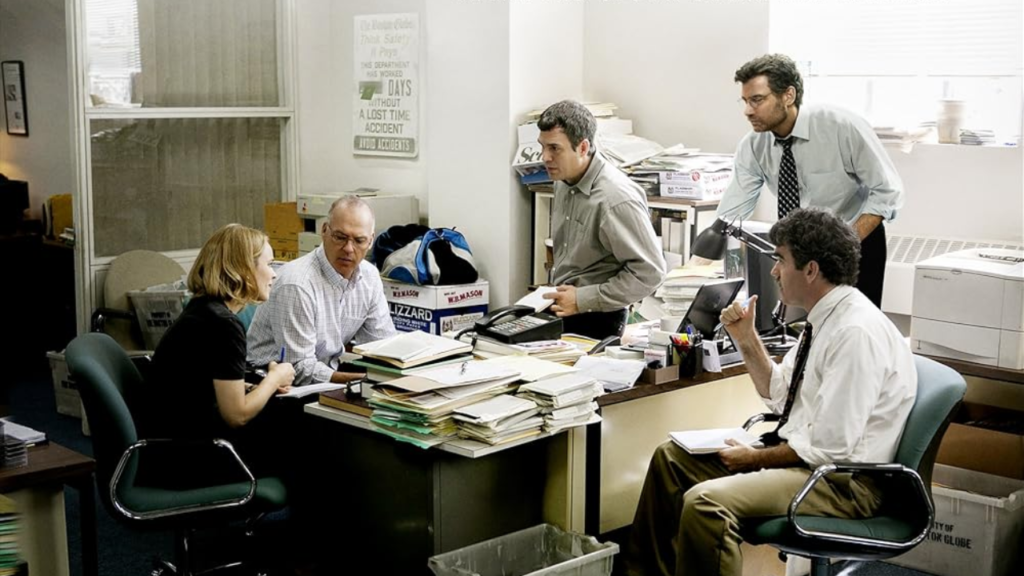
Released in 2015, Spotlight is an Oscar-winning American biographical investigative drama directed by Tom McCarthy and co-written by McCarthy and Josh Singer. Based on the true story of The Boston Globe’s Spotlight team, the film follows their 2001 investigation into the widespread child sexual abuse scandal within the Catholic Church and the systemic cover-up that protected abusive priests for decades. The film won the Oscar for Best Picture and Best Original Screenplay, and remains one of the most celebrated depictions of investigative journalism in cinema.
What makes Spotlight such a compelling film is that it is not merely about priests molesting children. It is about power. More specifically, it is about what happens when power becomes so embedded within a community that questioning it itself feels wrong.
One of the most interesting things throughout the film is how everybody seems to think that because the Spotlight team is investigating priests who molested children, they are somehow investigating the Church itself, or even God. Throughout the initial stages of the investigation, people repeatedly frame it as Spotlight “suing the Church.” The distinction between investigating priests who committed crimes and attacking faith itself almost disappears. Even merely snooping around the Church and its priests for wrongdoing is seen as a huge thing and is never received in a welcoming manner.
The resistance the Spotlight team faces comes from almost everywhere. What is interesting is that it does not always come from people trying to hide the truth. Sometimes it comes from people who simply do not want the truth to be true.
Even Ben Bradlee Jr., himself a journalist, appears skeptical. Not because he opposes the investigation, but because he understands what such a story would mean if it were true. There is a sense that he wants to dismiss it if it takes too long because accepting the possibility itself is difficult. The allegations are so massive, and the institution involved is so important to the community, that disbelief almost becomes easier than acceptance.
The arrival of Martin Baron is what changed everything.
Throughout the film there is an underlying awareness that Baron is an outsider. He is Jewish, not Catholic, and that fact quietly shapes many interactions. Attorney Jim Sullivan, who had helped the Church with a number of cases, looks at Marty Baron with suspicion when Robbie starts asking questions about the settlements. It feels like one of those situations where if Marty had been another Catholic man, there still may have been resistance, but perhaps less of it. Because when someone outside a faith starts questioning one of its most powerful institutions, things become much more sensitive.
This idea appears again later when Mitchell Garabedian, the lawyer representing all sexual abuse victims in the Boston area, talking about why it’s different this time when in truth this is a decade-old problem, simply says, “It takes an outsider.”
The contrast between Cardinal Law and Marty Baron perfectly captures two different understandings of institutions. Cardinal Law tells him, “I find that the city flourishes when its great institutions work together.” In this case, the institutions are the Church and the press. Marty’s response I find is one of the defining ideas of the film, and journalism at large, “Personally I’m of the opinion that for a paper to best perform its function, it really needs to stand alone.”
Those two statements almost summarize the entire conflict of Spotlight. One believes institutions should protect one another. The other believes institutions should be held accountable.
The film also repeatedly returns to the question posed at the beginning; how do you say no to God?
It’s Phil Saviano, another survivor who has been in the fight for a long time, who says, “It’s like God asking for help… how do you say no to God?” This line perhaps explains more than any legal document or court record ever could. For many victims, priests were not merely authority figures. They were representatives of God. A priest asking something of you is, in many ways, much like God asking something of you.
This becomes even more devastating through Joe, a gay survivor, who explains that when you’re a child and gay and a priest asks you to do a bunch of weird sex stuff, you do it because you’re young, you don’t know any better, and it’s a priest telling you through all this that it’s okay to be gay. The abuse is not simply physical. It is emotional, psychological, and spiritual manipulation. Later, Sasha asks him, “Did you try telling anyone?” His response, “Who? A priest?”
The answer captures the impossible position many victims found themselves in.
Richard Sipe, an ex-priest and a psychotherapist, calls it “a recognizable psychiatric phenomenon.” The significance of that statement becomes clearer as the investigation unfolds. The deeper Spotlight digs, the less this looks like isolated incidents and the more it looks like a pattern.
The film also addresses why so many victims were boys. It had nothing to do with the priests’ sexual orientation. Boys carried more shame. Boys were less likely to talk. Society already conditions boys to remain silent about vulnerability and victimization, making them easier targets. “Boys don’t cry.” “Boys don’t complain.” And broken family situations often made things even worse.
Legally, many victims were already at a disadvantage. There are specific time limits for proper indictments, yet many survivors do not come forward until much later in life. Trauma does not work according to legal deadlines. The result is that many victims are effectively screwed by the system before they even are ready to tell their story.
As the investigation progresses, the film slowly moves away from individual priests and towards the system protecting them. Sasha confronts Eric MacLeish, the attorney who settled many cases for the victims. In an internal discussion of the team about Eric MacLeish, Sasha says, “How many victims do you represent and profit from before you say something?… Operating the way MacLeish has all but guarantees that the abuse stays under wraps.”
That idea becomes central to the film. The abuse did not continue simply because priests committed crimes. It continued because institutions, lawyers, officials, and communities helped ensure those crimes remained hidden.
Mitchell Garabedian states it best, “If it takes a village to raise a child, it takes a village to abuse one.” This line expands responsibility beyond the priests themselves. The Church reassigned offenders. Lawyers settled cases quietly without a paper trail. Communities looked away. Journalists missed stories. People knew pieces of the truth but rarely enough, or cared enough, to confront the whole picture.
One scene that particularly stood out to me, and I’m sure to everyone, is when Mike finally bursts out, “It’s time, Robbie. It’s time! They knew and they let it happen. To kids! … We gotta show these people that nobody can get away with this! Not a priest or a cardinal, or a freaking Pope!” There is something consuming about the urgency in that moment. By then, the dialogue almost feels like it is speaking for the audience as much as it is speaking for Mike. The deeper the investigation goes, the harder it becomes to see this as merely a story about the Church. It becomes about power and whether anyone, regardless of position, should be allowed to escape accountability.

That idea would later become one of the themes Tom McCarthy repeatedly returned to while discussing the film. He described being fascinated not only by the investigation but by “institutional evil, cover-up, societal complicity and deference.” He spoke about how there were many ways to approach the story, but ultimately what interested him most was the question, “How does this happen on such a systemic level without people knowing about it? And seemingly looking the other way.”
That question is at the heart of Spotlight.
Mark Ruffalo later reflected on why this was so difficult for communities to confront. He explained, “Coming from a Catholic background, what you have to remember is that a priest is literally the direct lineage from God to the community… you’re destroying someone’s faith. If you’re a Catholic, the priest is a direct manifestation to God. They’re sacrosanct. They’re infallible.”
That perception is exactly what made the abuse so devastating and the investigation so difficult.
Ruffalo also praised the film because “It felt so honest and it left out the salacious part of the story and went directly to the investigation.” The film is not interested in sensationalizing abuse. It is interested in understanding how abuse was allowed to continue for so long.
Tom McCarthy similarly noted that when you sit down with survivors, “You realize it’s not something people ever fully recover from. They can find a way to deal with it and cope and move forward, but it’s always with them.” That reality hangs over the entire film. Behind every document, every sealed file, every court settlement is a life permanently altered.
One of the most significant aspects of the Spotlight investigation is that it did not end with Boston. And the more people looked, the more they found. After the Boston Globe report was published, similar stories began surfacing across cities, and countries around the world. What initially appeared to be a Boston story proved to be something much larger. The investigation opened the door for countless victims elsewhere to come forward, exposing patterns of abuse and cover-up that extended far beyond a single archdiocese.
In many ways, it proved Richard Sipe right. This was not a collection of isolated incidents. It was a phenomenon.
At its heart, Spotlight is about making injustice heard in a world of supreme power. It is about journalism holding the powerful accountable. It is about exposing an institution that many believed could never be challenged. But more than that, it is about the systems of silence that allow abuse to survive.
The film’s greatest achievement is that it refuses to place responsibility solely on a handful of priests. Instead, it forces us to confront a much harder truth, injustice on this scale survives because entire systems, communities, and institutions allow it to.
And that is precisely why the Spotlight investigation mattered. It did not just expose abusive priests. It exposed the structures that protected them and, in doing so, helped the unheard be heard.
Read More:
- How much does responsibility seep into filmmaking? Or does it at all?
- From Water to Fire: How Avatar’s Visual Language Is Evolving
- Roger Corman: The King of Cult Cinema and His Enduring Legacy
- The Vanishing Art of Literary Adaptation in Indian Films