
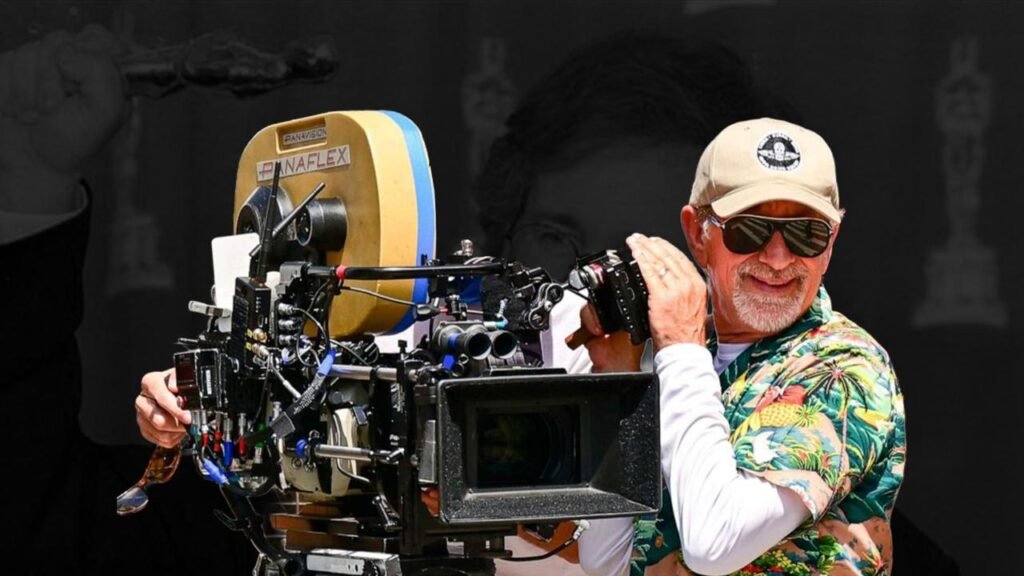
Every filmmaker has recurring themes. Some revisit the same genre. Others refine the same style over decades. Steven Spielberg did something much rarer. He kept changing the subject.
There have been so many directors. Some who are writer-directors, others who choose a subject to direct. Steven is one such director. He chooses his subjects. Oftentimes he has provided a story or an idea, or even co-written the screenplay, like on The Fabelmans, but rarely has he been the sole writer. What has always remained consistent, however, is his remarkable ability to find stories that interest him, regardless of genre or scale.
There are so many different ways to talk about Steven’s films. Because there’s just so much to talk about. One could write, not a book, but books. About his use of production design. About his use of lighting. About his use of cinematography. About his use of sound design. And so much more, of course.
What I find most fascinating, however, is his choice of subject. His vast range of different kinds of films. Each made in a unique way, different from the last. He has made science fiction, historical dramas, fantasies, adventures, comedies, war dramas, autobiographical films. He has done it all. He has made it all.
Steven once said, “I have this overly active imagination. My mind instantly goes to stories that are removed from the real world.” It is an interesting statement because, looking at his filmography, it feels true even beyond fantasy. Whether his stories are rooted in history or entirely fictional, there is always something extraordinary in the way he chooses to approach them.

Sometimes that imagination takes him into worlds that are beyond existence. E.T. the Extra-Terrestrial (1982) imagines a lonely boy finding friendship in an alien. But even there, the alien is only a way into a much more human story. Steven himself described the film by saying, “The overriding theme was gonna be about how do you feel the heart of a lonely child? And what extraordinary event would it take to fill Elliot’s heart after losing his dad? It would take something as extraordinary as an extraterrestrial coming into his life.”
The same imagination resurfaces years later in Jurassic Park (1993), where extinct creatures like dinosaurs walk the Earth once again. Then in The Adventures of Tintin (2011), it becomes an adventurous animated treasure hunt. Different worlds. Different rules. Yet, each one built around the same sense of wonder, curiosity, and discovery.
And then, Spielberg leaves fiction behind, and moves into history.

One film becomes Schindler’s List (1993), confronting one of humanity’s darkest chapters of Holocaust with heartbreaking honesty. Another becomes Saving Private Ryan (1998), going right in the middle of war, where the mission to rescue one soldier becomes a story about duty, sacrifice, and the human cost of conflict. With Lincoln (2012), it’s about the journey of one great man determined to end slavery and how he maneuvers through political rooms and difficult conversations, while Bridge of Spies (2015) finds suspense not in explosions, but in diplomacy during the Cold War. The Post (2017) shifts once again, this time asking what responsibility journalism carries when truth itself is at stake.
Then there are the films that don’t fit into a specific world completely.
Jaws (1975) transforms an ordinary beach into a place of fear, proving that a simple premise can become a place of suspense with great execution. Catch Me If You Can (2002) follows a con artist with such charm and energy that the chase becomes as entertaining as the crimes themselves. The Terminal (2004) takes perhaps the smallest premise of them all, a man unable to leave an airport because of political circumstances, and quietly turns it into a story about kindness, patience, and human connection.
And after decades of telling stories about aliens, dinosaurs, soldiers, presidents, journalists, adventurers, and dreamers, Spielberg eventually chose the most personal subject he could. Himself.
The Fabelmans (2022) is not just another coming-of-age drama. It is Spielberg looking backwards, at his childhood, his family, and the moments that slowly shaped the filmmaker he would become. After spending a lifetime exploring countless worlds, he finally explored his own.
The films discussed are, of course, only a handful. In comparison, the films that Mr. Spielberg possesses are so many. More different. More special.
What makes his filmography remarkable is not simply the number of films he has directed, but how often he refuses to repeat himself. One film explores childhood loneliness through an alien. Another explores the terror of the ocean. Another recreates dinosaurs. Another examines the Holocaust. Another follows a con artist. Another tells the story of a president. Another is about journalism. Another is about his own life. They are all unmistakably Steven Spielberg films, yet none of them feel like the same film.
Spielberg has never seemed interested in mastering one genre. Instead, he appears fascinated by discovering what stories can become when viewed through entirely different worlds. That curiosity may be his greatest creative instinct.
I don’t believe in idolizing someone, putting them on a pedestal. Because while there are talented and extraordinary humans beyond the ordinary, what they are is still human. And especially because when you genuinely believe that they are humans who do great things, that’s when it pushes you as well, drives you to do better in life yourself. And that’s what it’s all about. That’s what matters.
Steven Spielberg is a great human, who has made great movies. His greatest genre has never been science fiction, history, adventure, or drama. It has always been curiosity.
Read More: