
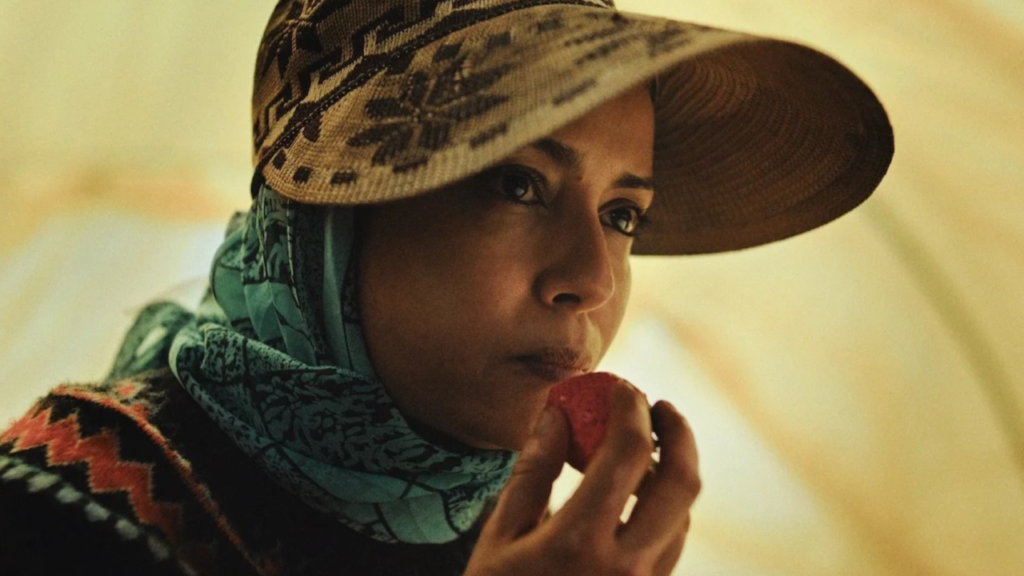
Strawberries Review Roundup: Laïla Marrakchi’s Strawberries arrived in Cannes’ Un Certain Regard section as a socially urgent drama about Moroccan women working as seasonal strawberry pickers in southern Spain. Early reviews suggest a forceful, feminist and politically engaged film that exposes migrant labour exploitation through the eyes of one young woman, even as some critics find the drama uneven in execution.
Also titled La más dulce, the film follows Hasna, played by Nisrin Erradi, who travels from Morocco to Andalusia, Spain, for seasonal strawberry-picking work. Like the other women around her, Hasna hopes the job will provide money, stability and a better future for her family. Instead, she enters a system built on dependency, silence and fear. The workers face harsh conditions, arbitrary pay practices, humiliation, poor housing and limited communication with supervisors who control nearly every part of their survival.
The story gradually moves from everyday labour indignities to darker forms of abuse. What begins as confusion over work instructions and wages slowly reveals a wider structure of exploitation, including sexual violence and the threat of being erased by a system that does not treat migrant women as fully visible human beings. A lawyer becomes involved as the women consider whether they can speak out, but the film’s tension comes from the fact that justice itself feels distant, uncertain and structurally difficult.
The overall critical mood around Strawberries is respectful and engaged. Critics are responding strongly to the film’s subject matter, its feminist anger and its focus on Moroccan migrant women rarely centered in European social dramas. Nisrin Erradi’s performance is repeatedly highlighted as the emotional anchor. At the same time, the reviews do not treat the film as flawless. Some critics find the screenplay direct, occasionally on-the-nose or uneven in dramatic construction. The consensus so far is that Strawberries is a serious, forceful film whose urgency is clear even when its storytelling does not always feel fully controlled.
Steve Pond of TheWrap frames Strawberries as a film that exposes the bleak lives of migrant workers in Spain. His review notes that the film is based on real cases and follows Moroccan women who are promised seasonal agricultural work, only to encounter brutal conditions, wage deductions and exploitation. This reading is important because it places the film within a real labour context rather than treating it as a purely fictional tragedy.
TheWrap’s response also points to one of the film’s key strengths: Marrakchi does not leave the audience only with despair. Even within a story about exploitation, the review notes the empathy and life present among the women. That balance matters. Strawberries is not simply about suffering; it is also about the inner lives, humour, bonds and survival instincts of women trapped inside a system that wants them to remain silent.
Fabien Lemercier of Cineuropa calls the film an incisive feminist work and highlights Nisrin Erradi’s charismatic presence. His review describes Strawberries as a vigorous look at modern-day slavery in Europe, while connecting the story to labour from the southern Mediterranean, patriarchal societies and women’s rights. This gives the film a wider political frame. The abuse shown in the film is not isolated. It is connected to migration, gender, class and the economic systems that depend on vulnerable labour.
Cineuropa’s response is also useful because it notes that Marrakchi treats the subject through intense fictional realism rather than as a thesis film. That distinction is important. Strawberries may have a clear political conscience, but its strongest moments appear to come when the film stays close to Hasna and the other women, allowing the audience to feel the daily pressure of their lives rather than only understand the issue intellectually.
Christian Zilko of IndieWire gives one of the strongest character-focused readings of the film. His review says Strawberries stands out because it relies heavily on Hasna’s perspective, following her journey from confusion to fear to righteous anger. Zilko also notes that Nisrin Erradi is capable of carrying that emotional load, making Hasna not just a symbol of exploitation but a fully felt point of entry into the story.
One of IndieWire’s most useful observations comes from an early strawberry-picking scene. Hasna must decide whether to pick unripe strawberries or leave them behind while trying to understand instructions in a foreign workplace. Zilko reads this moment as a “skeleton key” to the film because it shows how even simple labour becomes complicated when a worker’s survival depends on employers she can barely communicate with or challenge.
IndieWire also adds important detail about the everyday mechanics of exploitation. The review describes unpredictable pay schedules, arbitrary deductions, inflated costs for basic goods and supervisors deciding after the fact how many hours workers should be paid for. These details make the film’s world feel specific. Exploitation is not shown only through one dramatic incident; it is built into the routine of wages, housing, communication and dependency.
The same review notes that Hasna eventually uncovers a darker underbelly involving severe sexual assault and kidnapping, pushing the situation closer to modern slavery than ordinary employment. This escalation gives Strawberries its most disturbing force. The film appears to show how small indignities and bureaucratic abuses can exist alongside more extreme violence, all protected by the same silence around migrant workers.
Marc van de Klashorst of ICS Film gives one of the strongest political readings of Strawberries. His review argues that the film exposes how European prosperity depends on immigrant labour. This is one of the key ideas behind the film’s critical response. The strawberries are not just fruit; they represent a supply chain, a consumer economy and a labour structure that hides the people who make comfort possible for others.
ICS Film also praises the character drama and Nisrin Erradi’s central performance, but its review is more balanced than purely celebratory. It notes that the screenplay sometimes becomes too on-the-nose and that certain plotting issues keep the film from rising much above the genre average. This criticism is useful because it shows that the film’s political force is widely recognized, even by critics who are less convinced by every dramatic choice.
Variety also takes a balanced view, describing Strawberries as a potent but flawed Moroccan drama. Its review notes that Marrakchi tries to shake up the formula by making Hasna more flawed and less conventionally likable. That is an important point because social dramas often risk turning their protagonists into purely noble symbols. By allowing Hasna to be difficult, angry and imperfect, the film appears to give her more human complexity, even if not every critic feels the dramatic structure fully supports that choice.
One of the film’s strongest cinematic ideas is the recurring image of strawberries themselves. IndieWire notes that Marrakchi’s camera returns to strawberries in different states of dying on the vine. The fruit becomes more than a setting detail. Ripe strawberries suggest beauty, value and the promise of abundance. Unripe strawberries reflect confusion and impossible choices. Rotting strawberries suggest waste, decay and the emotional erosion of the workers whose lives are consumed by the system.
This metaphor gives Strawberries a visual language beyond its social-message structure. The film is not only saying that exploitation exists. It is showing how profit can turn natural beauty into something rotten when the people doing the labour are denied dignity. The strawberries become evidence of both abundance and cruelty: something sweet for consumers, but bitter for those forced to harvest them under abusive conditions.
The common praise across reviews is clear. Critics admire the film’s urgent subject matter, its feminist perspective, its focus on Moroccan migrant women, and its refusal to soften the violence of the labour structure. Nisrin Erradi’s performance is one of the strongest points of agreement, with several reviews treating Hasna’s point of view as the emotional engine of the film. The real-case inspiration also gives the drama added weight, while Marrakchi’s empathy prevents the story from becoming only an exercise in misery.
The common criticism is also clear. Some critics find Strawberries uneven. The screenplay can feel too direct. Certain plot turns may appear heavy-handed. The film may work better as a social indictment than as a fully shaped drama. Its moral clarity is powerful, but it may also reduce ambiguity in places. Still, these reservations do not erase the seriousness of the response. The film is being discussed as a necessary and forceful work, even when critics point to flaws in execution.
From a Planet of Films perspective, Strawberries appears to work best when it treats exploitation not as one isolated act of cruelty, but as a system. The women are vulnerable not only because of individual abusers, but because labour, migration, gender, poverty and silence combine to make them easy to exploit. The film’s strongest critical value lies in showing how ordinary economic systems can become violent when the people inside them are denied voice, protection and visibility.
That is why Hasna’s perspective matters so much. A broader political film could have explained the system from the outside. Strawberries instead seems to make the audience experience that system through uncertainty, fear and anger. Hasna does not arrive with full knowledge of what she is entering. She learns it through mistakes, withheld wages, unclear rules, older women’s warnings and the slow realization that the workplace is designed to keep her powerless.
The final consensus of this Strawberries Review Roundup is that Strawberries is a serious and socially urgent drama with a strong feminist conscience. Critics praise Laïla Marrakchi’s anger, Nisrin Erradi’s performance and the film’s focus on migrant women trapped inside a brutal labour system. At the same time, some reviews note that the film can be direct, uneven or dramatically imperfect. It may not be flawless, but it is forceful, necessary and difficult to ignore.
Film: Strawberries
Original Title: La más dulce
Director: Laïla Marrakchi
Writers: Laïla Marrakchi, Delphine Agut
Cast: Nisrin Erradi, Hind Braik, Fatima Attif, Hajar Graigaa, Larbi Mohammed, Itsaso Arana
Festival: Cannes Film Festival
Section: Un Certain Regard
Genre: Social drama
Runtime: 101 minutes
Countries: France, Morocco, Spain, Belgium
Languages: Arabic, Spanish
Premise: Moroccan women travel to southern Spain for seasonal strawberry-picking work, but harsh conditions, wage theft, abuse and harassment force them to confront a system built on their silence.
Read More Review Roundups on POF