
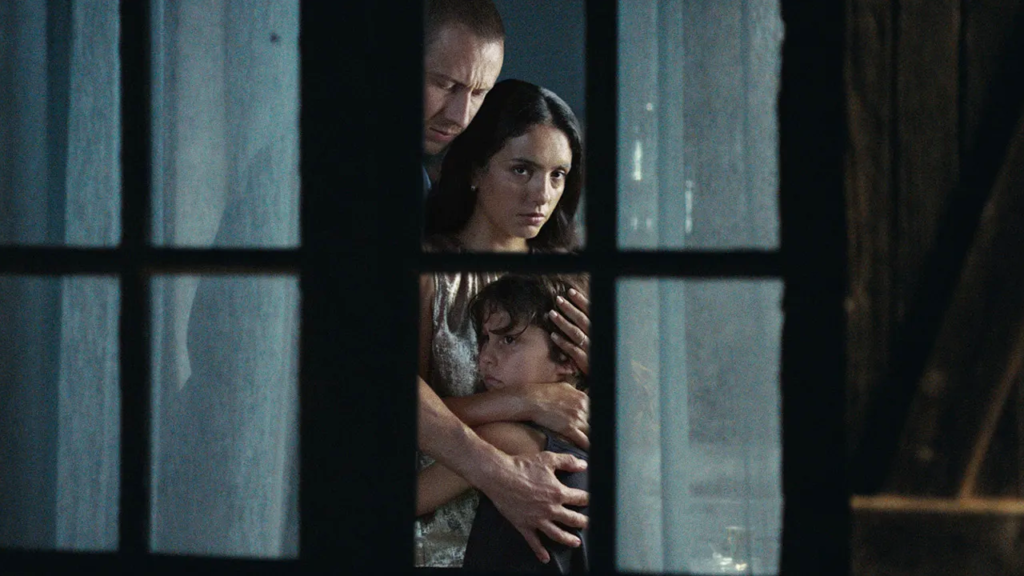
The Birthday Party Cannes Review Roundup: Léa Mysius returns to Cannes Competition with a psychologically tense family drama led by Hafsia Herzi, Monica Bellucci and Benoît Magimel. Adapted from Panos Karnezis’ novel, The Birthday Party has emerged as one of the festival’s more divisive titles, with critics praising its claustrophobic atmosphere, emotional unease and sustained menace, while others argue the film’s slow-burn storytelling never fully catches fire.
Directed by Léa Mysius, the film follows Nora, played by Hafsia Herzi, who arrives at a secluded rural estate with her young son for a family birthday celebration that gradually becomes emotionally volatile and psychologically threatening. Set deep in the French countryside, the gathering slowly reveals hidden resentments, manipulation and unresolved tensions inside the family structure. Monica Bellucci and Benoît Magimel play central figures within the household, with the film building discomfort through silence, glances and emotional pressure rather than overt thriller mechanics.
The overall critical response suggests that Mysius has crafted a carefully controlled chamber drama built around emotional suffocation and psychological instability. Supporters admire the film’s restraint and gradual escalation of dread, while detractors feel the deliberate pacing creates distance instead of tension. The divide surrounding The Birthday Party is less about its craft than about whether its quiet, restrained approach creates suspense or simply dramatic inertia.
One of the strongest positive reactions comes from Screen International. Nikki Baughan describes the film as a taut exploration of family, identity and betrayal, praising Mysius for creating a claustrophobic atmosphere sustained by strong performances from Hafsia Herzi and Monica Bellucci. The review positions the film as an emotionally oppressive but carefully controlled family drama where discomfort becomes the primary storytelling engine.
Deadline’s Pete Hammond also responds positively, highlighting Mysius’ ability to sustain suspense throughout the gathering. Hammond notes that the backstory surrounding Franck and his relationship to the family gradually becomes clearer and increasingly threatening, allowing the emotional pressure to slowly intensify. This idea of tension accumulating through revelation rather than sudden twists appears central to the film’s supporters.
Peter Bradshaw of The Guardian gives the film 3/5, calling it a “grimly compulsive unhappy occasion” set in the French countryside. Bradshaw praises the way Mysius manages tension and singles out Benoît Magimel, describing him as “a gargoyle of menace.” His response captures the broader appreciation for the film’s oppressive atmosphere even among critics who are less enthusiastic overall. The Guardian review suggests that the film works most effectively when it embraces emotional discomfort rather than conventional dramatic release.
The Hollywood Reporter also leans positive, emphasizing the emotional fragility and instability running beneath the film’s elegant surface. The review praises Mysius’ tonal control and restrained direction, framing The Birthday Party less as a traditional thriller and more as a psychological study of emotional pressure inside a damaged family structure. Monica Bellucci’s presence is noted as part of the ensemble dynamic rather than as a dominant star showcase, with the review focusing more on the uneasy relationships inside the estate.
Variety’s review similarly highlights the film’s ambiguity and emotional discomfort. The publication frames The Birthday Party as a restrained psychological drama that prioritizes atmosphere and unease over overt narrative escalation. The deliberate pacing and emotionally guarded performances are presented as defining stylistic choices that may strongly connect with some viewers while frustrating others.
IndieWire also appears to respond positively to Mysius’ restrained filmmaking approach, positioning the film as an emotionally suffocating psychological chamber piece. Rather than using the family gathering as a setup for explosive confrontations, Mysius reportedly focuses on slow emotional corrosion, allowing anxiety and discomfort to quietly spread through the estate. Critics in this camp see the film’s restraint as a strength rather than a weakness.
The strongest criticism comes from the opposite side of that debate. Brian Tallerico of RogerEbert.com argues that the film crosses the line from “slow burn” into “no burn.” His review criticizes the emotional flatness of the storytelling and questions whether the tension ever meaningfully escalates. Tallerico also takes issue with Hafsia Herzi’s restrained performance, suggesting that the emotional distance at the center of the film prevents the drama from becoming fully engaging.
A similarly negative response comes from Next Best Picture, which gives the film 4/10 and describes the adaptation as emotionally unfulfilling despite its literary origins. This criticism reinforces the broader divide around the film: whether Mysius’ deliberate pacing creates immersive psychological tension or merely suppresses dramatic momentum.
That divide ultimately defines the Cannes reception to The Birthday Party. Critics praising the film admire its confidence in silence, discomfort and emotional ambiguity. For them, the isolated estate becomes a pressure cooker where buried resentment and psychological manipulation slowly poison the gathering. Critics on the other side feel the film mistakes restraint for depth, arguing that the carefully controlled atmosphere never develops into a dramatically satisfying experience.
The common praise across reviews is clear. Critics repeatedly highlight the claustrophobic atmosphere, psychological tension, visual restraint and emotionally uneasy family dynamics. Benoît Magimel’s menacing presence receives strong attention, while Monica Bellucci’s controlled performance adds further tension to the ensemble. Many reviews also praise Mysius’ ability to maintain tonal consistency and create emotional pressure without relying on conventional thriller devices.
The common criticism is equally consistent. Several critics argue that the pacing becomes too subdued and that the emotional restraint creates distance rather than suspense. The slow-burn structure may test viewer patience, particularly for audiences expecting sharper dramatic escalation or more explicit revelations.
From a Planet of Films perspective, The Birthday Party appears to belong to a growing strand of contemporary European cinema where family gatherings become spaces for emotional warfare and psychological collapse. Léa Mysius approaches the material less like a mystery thriller and more like an exercise in sustained emotional suffocation. The estate itself becomes a trap, with silence, memory and unspoken resentment carrying more weight than overt confrontation.
The Cannes response suggests that The Birthday Party is unlikely to become one of the festival’s most universally embraced Competition titles, but it has clearly earned admiration for its atmosphere, performances and directorial control. Supporters see it as a tense and psychologically layered family drama, while detractors view it as too restrained for its own ambitions. Either way, Léa Mysius’ latest film has established itself as one of Cannes’ more unsettling and divisive psychological portraits.
Film: The Birthday Party
Director: Léa Mysius
Based on: Panos Karnezis’ novel The Birthday Party
Cast: Hafsia Herzi, Monica Bellucci, Benoît Magimel
Festival: Cannes Film Festival
Section: Competition
Genre: Psychological family drama / slow-burn thriller
Country: France
Premise: A secluded birthday gathering at a rural estate slowly exposes hidden resentments, emotional fractures and unsettling family secrets.
Read More:
- Read All Cannes Film Festival Review Roundups
- Read All Review Roundups on POF