
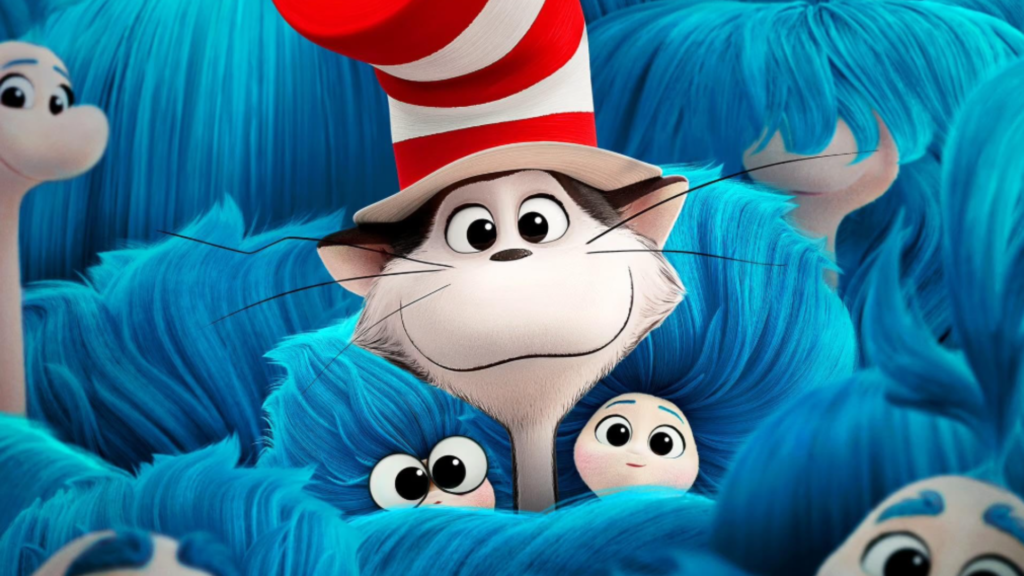
The animated adventure earns praise for its lively voice performances, colourful visuals and imaginative sequences, but critics are divided over its humour, crowded storyline and departure from the original book.
Dr. Seuss’s mischievous feline returns to the big screen in The Cat in the Hat, an animated adventure featuring Bill Hader as the voice of the iconic character. Directed by Alessandro Carloni and Erica Rivinoja, the film takes the familiar children’s book in a new direction, building a much larger story around the Cat and his attempts to bring happiness to two siblings. While some critics enjoy its colourful animation, playful chaos and energetic performances, others feel that the expanded narrative loses the simplicity and charm that made the original book so memorable.
The story follows the Cat, an employee of the Institute for the Institution of Imagination and Inspiration, who is given one final opportunity to prove himself after repeatedly creating trouble during his assignments. His latest task is to cheer up siblings Gabby (Xochitl Gomez) and Sebastian (Tiago Martinez), who are struggling to adjust after their mother, Carmen (America Ferrera), moves the family to a new town for work. However, the Cat’s attempt to help takes an unexpected turn when a device called the Go-Backer goes missing, sending the trio on an adventure through imaginative worlds hidden inside cardboard boxes.
Bill Hader’s performance as the Cat is one of the film’s most appreciated elements. Jesse Hassenger of The Guardian acknowledges the energy he brings to the character, even though he feels the performance cannot rescue an overlong and uneven film. Shalini Langer of The Indian Express also praises Hader’s voice work, particularly in his interactions with Matt Berry, who voices the children’s goldfish, Waffles. The voice performances are among the elements that help give the film its lively personality, even when its larger narrative choices prove less convincing.
Ben Kenigsberg of The New York Times finds the film peppy, pointing to its bold colours, jokes and catchy tunes. The Hindu’s review is similarly warmer in its response, describing the jokes as sweet, the voice performances as lively and the action as delightfully chaotic. These responses suggest that the film’s energetic approach and colourful presentation have considerable appeal, particularly for audiences looking for an animated family adventure. However, the positive responses also sit alongside reservations about whether the film’s constant activity translates into an equally engaging story.
The film’s visual imagination receives attention from several critics. Zachary Lee of RogerEbert.com appreciates the bright animation and the sequences in which the characters enter different worlds through cardboard boxes. Everyday objects are transformed into unusual landscapes, giving the adventure some of its most creative moments. Lee also recognises the ideas behind Gabby’s struggle to adjust to her new surroundings, particularly the film’s exploration of memories, change and the importance of embracing the present. These elements give the film an emotional foundation beyond its comedy and visual spectacle.
However, Lee feels that the film tries to explore too many ideas at once. With multiple villains, supporting characters and individual storylines, the central narrative often loses focus. The Indian Express also points to the film’s breathless action and excessive use of colour, arguing that there are surprisingly few moments that are genuinely moving or laugh-out-loud funny. Langer does, however, single out the Things, the Cat’s unusual helpers, as one of the film’s more inventive additions. The contrast between the film’s visual creativity and its crowded storytelling emerges as one of the recurring points in the critical response.
The biggest disagreement concerns how far the adaptation moves away from Dr. Seuss’s original story. Owen Gleiberman of Variety finds the film overstuffed, comparing its scale and storytelling to a superhero-style blockbuster made for young children. He feels that the adaptation loses the innocent wildness of the source material in favour of familiar blockbuster elements and excessive spectacle. The concern is not simply that the film expands the original story, but that the additional material changes the character and spirit of the familiar tale.
The Guardian raises similar concerns, particularly about the film’s corporate workplace setting and its focus on career ambitions, bureaucracy and parental responsibilities. The review argues that these additions take away from the playful mischief associated with the original character. RogerEbert.com also questions whether the film’s ambition is matched by its storytelling, suggesting that its constant movement and multiple subplots leave little room for its stronger ideas to develop. Together, these criticisms point to a central divide in the reviews: the film’s ambition and scale are appreciated by some, but others believe they come at the expense of the source material’s simplicity.
Despite these reservations, the more positive responses from The Hindu and The New York Times show that the film’s colourful presentation, humour and lively performances can still make for an entertaining family outing. Hader’s voice work, the imaginative settings and the energetic supporting cast provide several elements for younger audiences to enjoy, even if the storytelling does not consistently satisfy every reviewer.
Ultimately, The Cat in the Hat offers plenty of visual activity and imaginative ideas, but its attempt to turn a simple children’s story into a much larger animated adventure has divided critics. While the voice cast and animation provide moments of fun, the film does not consistently capture the playful charm of its source material. Its reception reflects the challenge of expanding a beloved, relatively simple story into a feature-length adventure without losing the qualities that made it memorable in the first place.
Watch Trailer:

Film Details: The Cat in the Hat
- Release Date: November 6, 2026
- Directors: Alessandro Carloni and Erica Rivinoja
- Screenplay: Alessandro Carloni and Erica Rivinoja
- Voice Cast: Bill Hader, Xochitl Gomez, Tiago Martinez, Matt Berry, Quinta Brunson, Bowen Yang, America Ferrera, Giancarlo Esposito and Paula Pell
- Based on: The Cat in the Hat by Dr. Seuss
- Language: English
- Genre: Animation, Adventure, Comedy, Family