
A society divided by an authoritarian system forms the setting of The Flaw, a dystopian thriller examining power, prejudice and the ways in which people judge one another. Directed by Theophilos Papastylianos, the Greece–Latvia co-production is based on the bestselling novel of the same name by Greek author Antonis Samarakis. The film will have its world premiere in the Baltic Film Competition at the 30th Tallinn Black Nights Film Festival (PÖFF) on November 18, 2026.
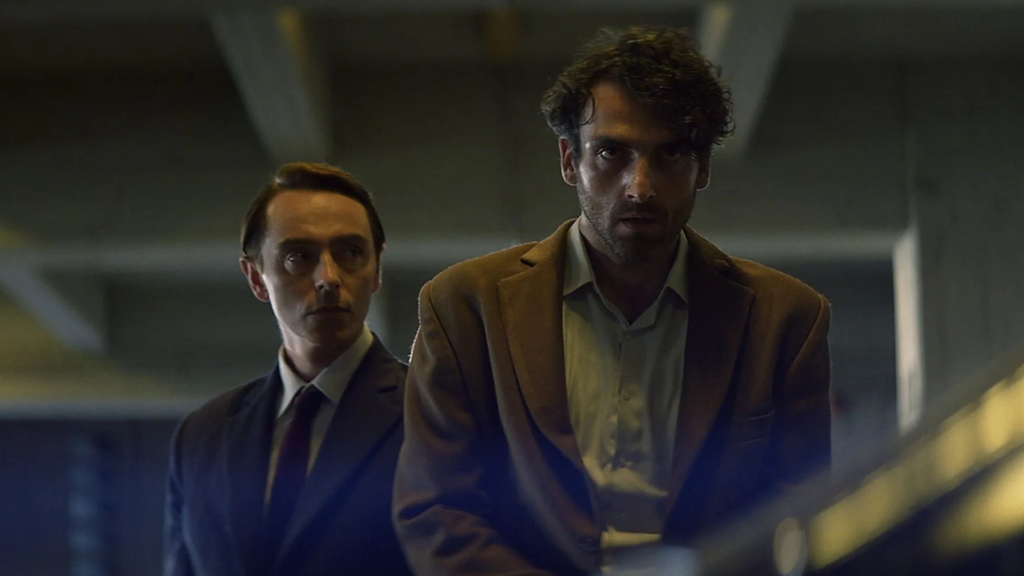
Set in a bleak future, the story unfolds in a society controlled by the Regime, an authoritarian system that determines who belongs and who is excluded. A Line divides the population, reinforcing the boundaries imposed by those in power. At the centre of this system is a ruthless Interrogator, played by David Dawson, who receives orders from the Special Service to follow a carefully constructed Plan and establish a Suspect’s guilt. Arthur McBain plays the Suspect, who becomes the target of a psychological operation built around manipulation, pressure and control. As the Plan progresses, however, a flaw begins to emerge, threatening not only the operation but the authority of the Regime itself.
The film’s central conflict develops through the changing relationship between the Interrogator and the Suspect. Rather than presenting their transformation as an abrupt shift, Papastylianos wanted the characters’ evolution to unfold gradually. The intention was for audiences to recognise by the conclusion how far the two men have moved from the individuals introduced at the beginning. The director also described the protagonists as alter egos of one another, suggesting that qualities concealed beneath their outward identities gradually come to the surface as their encounter develops.
Speaking to The Hollywood Reporter, Papastylianos explained that totalitarianism represents only the first layer of the film’s subject. Beyond its depiction of an authoritarian society, the story examines how individuals create their own systems of judgement based on personal perspectives, assumptions and prejudice. The filmmaker believes that people can become regimes in their own right when they judge others through preconceived ideas about appearance, identity or beliefs.
To illustrate this idea, Papastylianos referred to a hunter looking at a deer through a rifle scope. Once the hunter sees the animal only as prey, that becomes the entire extent of his perception. Lowering the scope, however, allows him to see the deer again rather than viewing it solely through the purpose of the hunt. The director connected this example to human relationships, where labels and assumptions can similarly restrict how people see one another. Through this perspective, The Flaw moves beyond the subject of government control to explore how intolerance, prejudice and division can influence everyday interactions.
Papastylianos also said that the novel’s themes felt increasingly relevant as he worked on the screenplay. Having first encountered Samarakis’ book as a teenager, he returned to it years later from the perspective of a filmmaker, reconsidering whether its central ideas would continue to resonate with contemporary audiences. He described the novel as timeless but expressed concern that changes in society had made its themes feel even more immediate. The film’s dystopian setting therefore serves as a framework for examining questions that extend beyond its fictional world.
The visual design is central to establishing the film’s atmosphere. Production took place in Greece and Riga, Latvia, with the latter playing a particularly important role in creating the brutalist architecture and dark, timeless environment envisioned by the director. One of the production’s challenges was to bring the two countries together on screen without making the locations feel disconnected. The aim was to create a cohesive visual world that would support the story’s oppressive setting.
Papastylianos also highlighted the importance of lighting, framing and carefully planned shots. He explained that visual choices, including close-ups, were made with specific intentions rather than serving merely as aesthetic elements. This approach allows the film’s visual language to contribute to its atmosphere and the psychological tension between its central characters.
The supporting cast includes Ralf Little, Angela Brouskou, Lyne Renée, Sarah Akokhia and Georgia Small. Brouskou plays the Head, a character whom Papastylianos describes as representing the Regime itself and gradually becoming an embodiment of the system’s underlying ideas. The director also spoke about allowing actors room to interpret their characters rather than prescribing how every scene should be performed. This approach gave the performers space to develop their roles while remaining connected to the film’s larger themes.
Music provides another important element of the film’s atmosphere. Composer Dimitris Fessas combines electric guitar with violins, violas and the traditional Cretan lyra to create a distinctive musical texture. The score features separate themes for the Interrogator and the Suspect, which gradually intertwine as the relationship between the two characters evolves. The musical progression mirrors the shifting dynamic at the centre of the narrative, connecting the characters’ individual identities to their increasingly complicated relationship.
Written and directed by Papastylianos, The Flaw marks his feature-film debut following earlier works including Algorhythm and Showtime. The film is produced by Panos Papahadzis and Papastylianos, with Alise Rogule and Lina Yannopoulou serving as co-producers. Thodoris Zacharakis is the cinematographer, while Yannis Chalkiadakis is the editor.
Bringing together psychological tension and questions of authority, identity and prejudice, The Flaw uses its dystopian premise to examine the boundaries between individuals and the systems they create. As the Interrogator’s carefully designed operation begins to unravel, the film explores how the structures used to judge and control others can also expose the assumptions and contradictions of those who uphold them.