
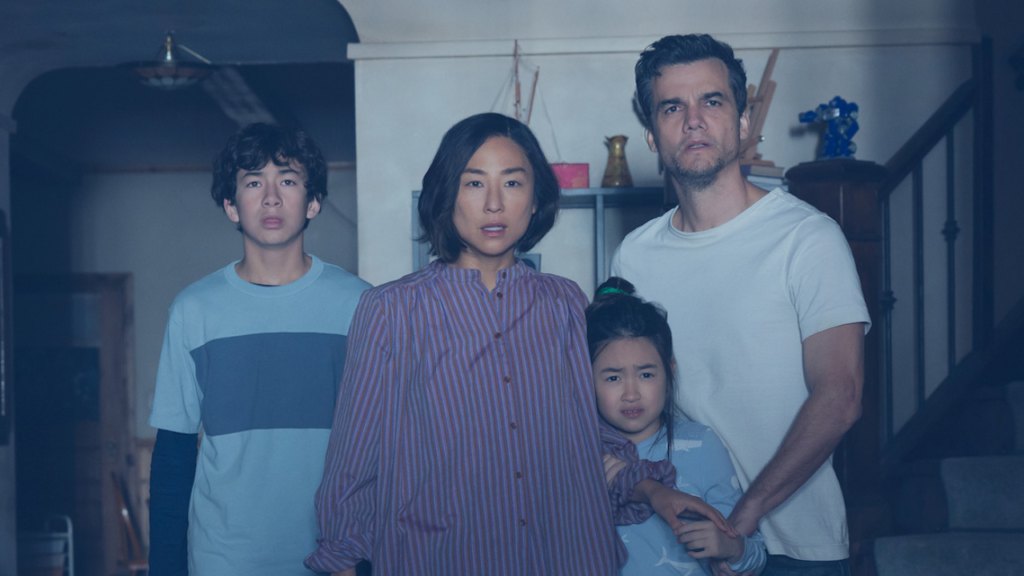
Netflix’s new sci-fi thriller The Last House, directed by Louis Leterrier and starring Greta Lee and Wagner Moura, premiered on August 7 to a surprisingly consistent critical verdict. In this The Last House Review Roundup, the reception is largely mixed, with reviewers broadly agreeing that the film delivers a strong, grounded first half before gradually giving way to a messier, underwritten back half once its supernatural elements take over. The consensus paints a film that is watchable without being particularly memorable—closer to a solid Netflix Friday-night pick than a genuine genre standout.
The Last House follows Jason (Wagner Moura) and Ann (Greta Lee), a married couple raising two children, Graham and Ruth, in a quiet Seattle suburb. After a torrential storm strikes their neighbourhood, the family wakes to find every door and window in their home mysteriously sealed shut, with the same fate befalling their neighbours. With no phone service, no internet and no explanation, the family is forced to ration food, improvise survival strategies and hold itself together as days stretch into months and eventually years, all while a menacing presence lurking outside slowly begins to reveal itself.
Critics are largely aligned on where the film succeeds and where it falls apart. The Hollywood Reporter notes that the screenplay “oscillates between finding comfort and terrified vulnerability in self-reliance,” keeping the nature of the threat deliberately vague for much of the runtime. However, it argues that once the “tentacled entities” are finally revealed, the film “slips out of Leterrier’s grasp,” with creature designs that borrow awkwardly from H.P. Lovecraft, kaiju cinema and The Host without ever developing an identity of their own.
The Guardian arrives at a similarly divided conclusion, praising the “satisfying and relatable itch” of the family’s early makeshift domesticity before criticising the film’s shift into “gloopier sci-fi horror.” The review compares its trajectory to Signs curdling into The Happening, describing the finale as both “sloppy” and “disappointingly un-twisty.” TheWrap is even less forgiving, arguing that the story becomes “more than a bit sub-Shyamalan silly” once the threats outside begin to emerge, with increasingly implausible developments piling up as the narrative progresses.
Where the film consistently earns praise is during its early, grounded stretch. The family’s practical, almost domestic scramble to adapt, ration food and preserve their sanity forms the emotional backbone that most critics responded to. Where it consistently loses them is when the story shifts from survival drama into full-scale sci-fi horror, with both the creature reveal and the vague mythology behind it singled out repeatedly as the weakest elements. Nearly every review frames this as the film’s central problem: a promising premise that runs out of ideas precisely when it needs them most.
The lead performances receive a more measured response. Most critics consider Wagner Moura the stronger of the two leads, though both actors are widely seen as being underserved by the screenplay. The Guardian writes that Moura keeps audiences invested through his confident leading-man presence while finding Greta Lee “unsteady,” largely because the script gives her character very little distinction. NME reaches a similar conclusion, pointing out that Lee was outstanding in Past Lives and Moura earned an Oscar nomination for The Secret Agent, arguing that a stronger screenplay would have allowed both actors to explore their characters’ emotional complexity. Instead, the review concludes, the talented duo is “left flailing against the current.” TheWrap similarly credits both performers with bringing genuine emotional heft to material that desperately needs it.
Louis Leterrier’s direction receives a noticeably warmer reception than Matthew Robinson’s screenplay. While critics generally agree that the script loses momentum once the mystery begins to unravel, several reviews praise Leterrier for maintaining a sense of tension and visual polish throughout. The Hollywood Reporter describes his work as “capable,” arguing that the film functions as much as a psychological chamber drama as it does a horror thriller. The Guardian points to the production’s “above-average sheen,” noting Leterrier’s blockbuster pedigree from films such as Clash of the Titans and The Incredible Hulk, while also arguing that the editing of the climactic set piece is simply too scrappy to generate the level of suspense the material demands. TheWrap echoes that assessment, crediting Leterrier’s set pieces with a “shiny sheen and fleet agility” even as it suggests the plot is best enjoyed without thinking about it too deeply.
Several critics also interpret The Last House through the lens of post-pandemic anxiety. Variety argues that the film returns audiences to the familiar mindset of protective panic, isolation and uncertainty that defined the COVID-19 era, even if its eventual explanations drift firmly into science-fiction territory. The Guardian expands on that idea by placing the film within a broader wave of post-pandemic genre cinema, comparing it to works such as Ari Aster’s Eddington and Mike Leigh’s Hard Truths, both of which attempt to process lingering cultural unease through very different storytelling approaches. NME similarly calls the premise “an odd question to pose in a post-COVID world,” while Yahoo’s review immediately compares the film’s mystery-box structure to the work of M. Night Shyamalan. Collectively, these observations suggest that The Last House resonates most strongly when viewed less as a conventional monster movie and more as a metaphor for prolonged uncertainty and isolation.
Taken together, the reviews describe a film that works best as a grounded survival drama and struggles once it embraces its supernatural mystery. The Wall Street Journal adopts a more playful perspective, describing the film as “at its heart a family-values film” about a family that “has to bond or die.” Yahoo, meanwhile, calls it “a glossy B-movie that doesn’t bore but also never truly thrills.” Perhaps The Guardian captures the overall consensus most succinctly, describing The Last House as “the ideal of a Netflix Friday night movie”—not strong enough to demand the theatrical experience, but more than entertaining enough for a low-stakes evening at home.
Whether or not critics were ultimately won over, there is remarkably little disagreement about what The Last House is trying to be. It is a high-concept, star-driven thriller that begins with an intriguing survival premise, builds genuine tension through its grounded family dynamics and polished direction, but ultimately falters when its supernatural mythology takes centre stage. While few reviewers consider it a standout addition to the genre, most agree it remains an accessible, entertaining watch that delivers enough atmosphere and suspense to satisfy viewers looking for an uncomplicated streaming thriller rather than an awards contender.
Film Details: The Last House
Louis Leterrier’s direction receives a noticeably warmer reception than Matthew Robinson’s screenplay. While critics generally agree that the script loses momentum once the mystery begins to unravel, several reviews praise Leterrier for maintaining a sense of tension and visual polish throughout. The Hollywood Reporter describes his work as “capable,” arguing that the film functions as much as a psychological chamber drama as it does a horror thriller. The Guardian points to the production’s “above-average sheen,” noting Leterrier’s blockbuster pedigree from films such as Clash of the Titans and The Incredible Hulk, while also arguing that the editing of the climactic set piece is simply too scrappy to generate the level of suspense the material demands. TheWrap echoes that assessment, crediting Leterrier’s set pieces with a “shiny sheen and fleet agility” even as it suggests the plot is best enjoyed without thinking about it too deeply.
Several critics also interpret The Last House through the lens of post-pandemic anxiety. Variety argues that the film returns audiences to the familiar mindset of protective panic, isolation and uncertainty that defined the COVID-19 era, even if its eventual explanations drift firmly into science-fiction territory. The Guardian expands on that idea by placing the film within a broader wave of post-pandemic genre cinema, comparing it to works such as Ari Aster’s Eddington and Mike Leigh’s Hard Truths, both of which attempt to process lingering cultural unease through very different storytelling approaches. NME similarly calls the premise “an odd question to pose in a post-COVID world,” while Yahoo’s review immediately compares the film’s mystery-box structure to the work of M. Night Shyamalan. Collectively, these observations suggest that The Last House resonates most strongly when viewed less as a conventional monster movie and more as a metaphor for prolonged uncertainty and isolation.
Taken together, the reviews describe a film that works best as a grounded survival drama and struggles once it embraces its supernatural mystery. The Wall Street Journal adopts a more playful perspective, describing the film as “at its heart a family-values film” about a family that “has to bond or die.” Yahoo, meanwhile, calls it “a glossy B-movie that doesn’t bore but also never truly thrills.” Perhaps The Guardian captures the overall consensus most succinctly, describing The Last House as “the ideal of a Netflix Friday night movie”—not strong enough to demand the theatrical experience, but more than entertaining enough for a low-stakes evening at home.
Whether or not critics were ultimately won over, there is remarkably little disagreement about what The Last House is trying to be. It is a high-concept, star-driven thriller that begins with an intriguing survival premise, builds genuine tension through its grounded family dynamics and polished direction, but ultimately falters when its supernatural mythology takes centre stage. While few reviewers consider it a standout addition to the genre, most agree it remains an accessible, entertaining watch that delivers enough atmosphere and suspense to satisfy viewers looking for an uncomplicated streaming thriller rather than an awards contender.
Watch The Last House Trailer:
Film Details: The Last House
Director: Louis Leterrier
Writer: Matthew Robinson
Cast: Greta Lee, Wagner Moura, Riley Chung, Noah Alexander Sosnowski, Emma Ho, Gabriel Barbosa, Arden Cho
Genre: Sci-Fi Horror Thriller
Rating: PG-13
Running Time: 1 hour 52 minutes
Music: Yair Elazar Glotman
Cinematography: Pål Ulvik Rokseth
Editor: Adam Gough
Production Companies: Chernin Entertainment, 3 Arts Entertainment
Distributor: Netflix
Country: United States
Release Date: 7 August 2026
Read More Review Roundups on POF