
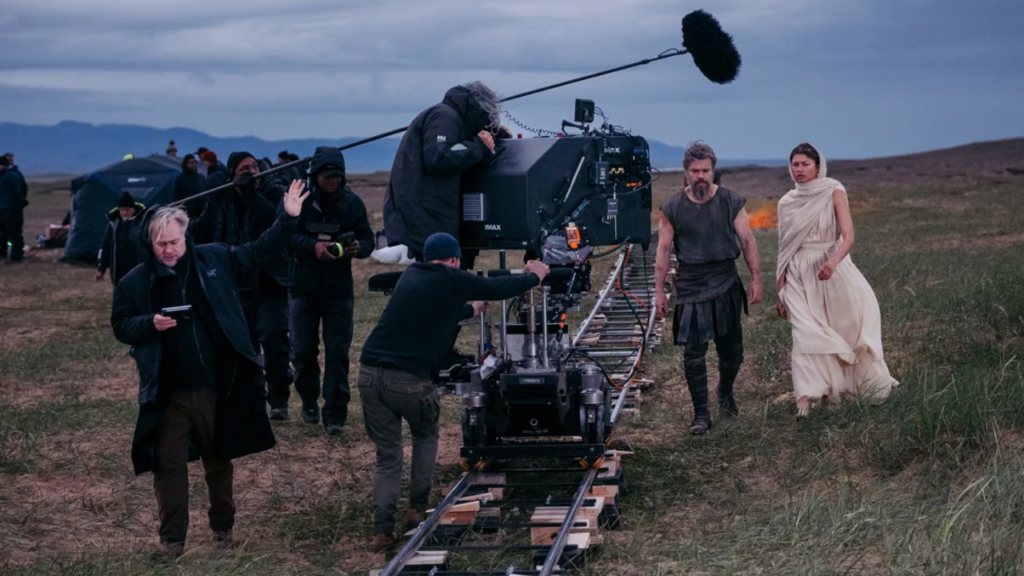
When audiences watch The Odyssey, they’ll be witnessing more than Christopher Nolan’s latest epic. They’ll be watching the first major feature ever photographed entirely on IMAX film, a milestone that required reinventing the camera itself.
To understand why this achievement is so significant, we need to look beyond the headlines and examine the technology, workflow, and creative philosophy behind shooting on the largest motion-picture film format ever used for narrative filmmaking.
What Makes IMAX Film Different?
Traditional 35mm motion picture film runs vertically through the camera using four perforations per frame, exposing an image area of approximately 22mm × 16mm, a format that has defined cinematic storytelling for more than a century. Large format 65mm photography significantly increases that image area, with a conventional five perforation 65mm frame measuring approximately 48.5mm × 22mm, delivering greater detail, finer grain structure, and improved tonal reproduction compared to 35mm. IMAX takes the concept even further. Instead of moving vertically, the 65mm film travels horizontally through the camera, exposing a massive 15 perforation frame measuring approximately 70.4mm × 52.6mm. The resulting negative area is nearly fifteen times larger than a standard 35mm frame and more than three times larger than conventional 65mm photography.
This enormous negative captures an extraordinary amount of visual information, producing exceptional detail, smoother tonal transitions, greater dynamic range, and a heightened sense of depth and dimensionality. On a giant IMAX screen, these qualities combine to create an experience that feels less like watching a projected image and more like looking through a window into a real world. However, this unparalleled image quality comes with significant practical challenges. One of the most frequently asked questions about IMAX film cameras is why they can shoot for only about three minutes at a time. The answer lies in the sheer size of the format. Because each 15 perforation IMAX frame consumes a substantial amount of film stock, the camera moves through a 1,000 feet magazine at an extraordinary rate. At 24 frames per second, a full magazine lasts roughly three minutes before it must be reloaded. Unlike digital cameras that can shoot continuously onto memory cards for extended periods, IMAX productions require constant magazine changes and meticulous planning. This limitation influences every aspect of filmmaking, from actor performances and camera movement to scheduling and production logistics, making every take both creatively and financially significant.
35mm vs 65mm vs IMAX 65mm
| Format | Frame Size | Frame Area | Relative Image Area | Film Consumption | Typical Magazine Duration |
| 35mm 4-Perf | 22mm × 16mm | 352 sq mm | 1× | 90 ft/min | 11 minutes (1000 ft) |
| 65mm 5-Perf | 48.5mm × 22mm | 1,067 sq mm | 3× | 112 ft/min | 9 minutes (1000 ft) |
| IMAX 65mm 15-Perf | 70.4mm × 52.6mm | 3,703 sq mm | 15× | 330 ft/min | 3 minutes (1000 ft) |
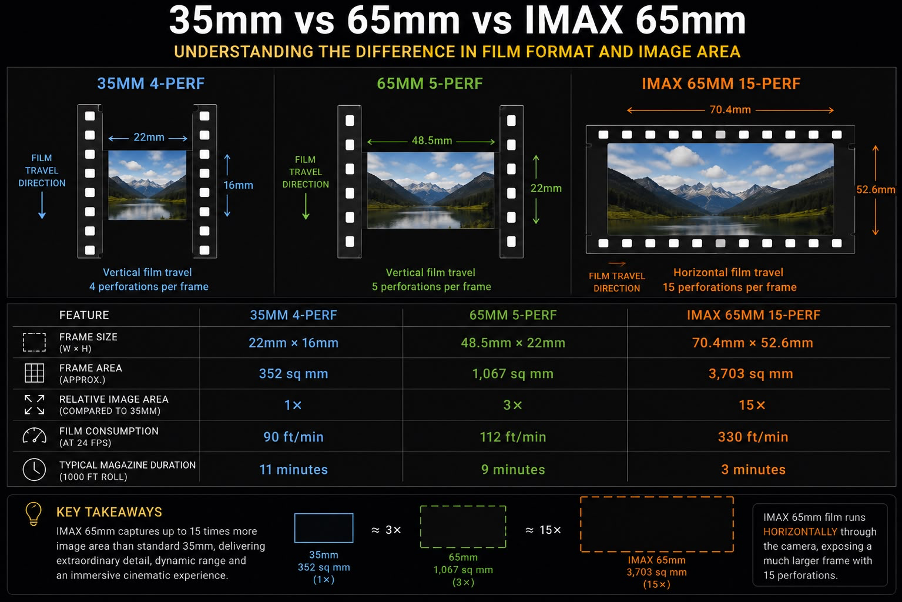
To put these numbers into perspective, a single 15-perforation IMAX frame captures an extraordinary amount of photographic information compared to traditional motion picture formats. However, that image is only the beginning of the journey. Once the negative leaves the camera, it enters a complex workflow that combines traditional photochemical processes with modern digital post production techniques.
What Happens After the Negative Is Exposed?
The journey of an IMAX image does not end when filming stops. Once a magazine has been exposed, the negative enters a highly controlled post-production workflow.
Step 1: Laboratory Processing
The exposed negative is transported to a film laboratory where it undergoes chemical processing. This stage develops the latent image recorded on the emulsion, transforming the exposed film into visible photographic images. Every aspect of processing is carefully monitored because inconsistencies can affect colour reproduction, contrast, density, and grain structure.
Step 2: High-Resolution Scanning
After processing, the negative is scanned at extremely high resolutions. Modern scanners convert the film image into digital files while preserving the immense detail contained within the large format negative. At this stage, the film enters a digital workflow.
Step 3: Editorial
Once scanned, the footage enters the editorial process, where the editor and director assemble the film shot by shot. Performances are evaluated, scenes are refined, and the rhythm of the narrative begins to emerge. Modern productions edit digitally using scans of the original negative, allowing creative decisions to be made without physically handling the camera negative itself.
Step 4: Digital Colour Correction
Once the edit is locked and visual effects work is underway, the film enters the Digital Intermediate (DI) stage, where colourists, working closely with the cinematographer and director, shape the final visual identity of the movie. During this process, exposure is balanced from shot to shot, contrast is refined, colour palettes are carefully crafted, and highlight and shadow detail are adjusted to achieve the desired mood and consistency throughout the film. Any visual effects are integrated and matched seamlessly with the photographed footage to maintain a cohesive look. Far more than a technical correction process, colour grading is a creative stage where the emotional tone, atmosphere, and visual language of the film are finalized, ensuring that every frame supports the story in the way the filmmakers intended.
Step 5: Film-Out and Release Printing
For IMAX film exhibition, the digitally graded master will be transferred back onto positive film stock. This creates a new film element that incorporates all creative decisions made during post-production. From there, release prints can be produced for projection.
Why Nolan Asked IMAX to Build a New Camera for The Odyssey
For decades, filmmakers have admired the visual power of IMAX film while simultaneously accepting its practical limitations. The format offered unparalleled image quality, but the cameras themselves presented significant challenges. They were large, heavy, mechanically complex, and notoriously loud. As a result, IMAX photography was often reserved for spectacle sequences, action scenes, aerial photography, or carefully controlled moments rather than being used throughout an entire narrative feature. Christopher Nolan has long been one of the format’s most passionate advocates. With films such as The Dark Knight, Interstellar, Dunkirk, Tenet, and Oppenheimer, he progressively expanded the use of IMAX photography. Yet even these productions relied on a combination of formats because certain scenes remained difficult to execute with traditional IMAX cameras. For, The Odyssey, Nolan’s ambition was unprecedented, to shoot the entire film on IMAX film cameras.
Achieving that goal required more than simply committing to the format, it required advancing the technology itself. Working closely with IMAX engineers, a new generation of film cameras was developed specifically to address the obstacles that had historically limited the format. The cameras were redesigned to be lighter, more ergonomic, and considerably quieter than previous generations. Most importantly, they were engineered to make sync-sound dialogue recording practical on a much larger scale. This breakthrough may ultimately be remembered as the most significant technological achievement behind The Odyssey. While audiences naturally focus on the spectacular image quality of IMAX, the ability to reliably capture intimate performances and production dialogue is what transforms the format from a specialized visual tool into a complete narrative filmmaking system. For Nolan, the goal was never simply to create a larger image. It was to remove the barriers that prevented filmmakers from using the format as freely as any other motion picture camera. By reducing weight, improving usability, and dramatically lowering camera noise, IMAX has moved closer to that vision than ever before. The result is a camera capable of delivering the immense scale and visual fidelity of 15 perforation IMAX photography while remaining practical enough for the demands of dramatic storytelling. In many ways, The Odyssey is not only a film shot entirely on IMAX, it is also the first true test of what the next generation of IMAX filmmaking can become.
The Sound Problem: Why IMAX Cameras Need a Blimp
Historically, one of the greatest challenges of shooting on IMAX film has been camera noise. Unlike conventional motion picture cameras, an IMAX camera must transport a massive 15 perforation 65mm film frame horizontally through the gate at 24 frames per second with extreme precision. Moving such a large amount of film at high speed requires powerful motors, complex transport mechanisms, registration systems, and magazine assemblies, all of which generate significant mechanical noise. As a result, traditional IMAX cameras have been considerably louder than most modern production cameras. For dialogue scenes, this presents a serious challenge. Not only can the camera’s noise be picked up by microphones, potentially contaminating production sound, but the constant mechanical sound can also become a distraction for actors attempting to deliver nuanced performances. In intimate dramatic scenes, where subtle vocal inflections and emotional concentration are critical, excessive camera noise can become a significant obstacle.
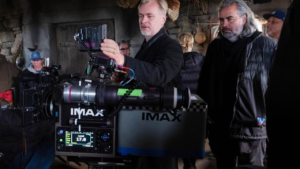 To address this challenge, IMAX and Christopher Nolan developed the IMAX Keighley, a next-generation 15 perforation 70mm film camera created specifically to push the format further into narrative filmmaking. Named in honour of long time IMAX executive David Keighley and his wife Patricia, the camera represents a major evolution in large format cinematography. While the camera itself incorporates quieter engineering than previous generations, it still relies on a highly specialized soundproof housing known as “The Blimp” for dialogue intensive scenes. The Blimp is a massive acoustic enclosure designed to surround the camera and dramatically reduce the amount of mechanical noise escaping into the environment. However, solving the noise problem created another challenge. Once enclosed within The Blimp, the camera system becomes enormous, weighing close to 300 pounds and effectively creating a physical barrier between actors during close-up conversations. To overcome this issue, the crew devised an ingenious mirror system mounted onto the blimp itself. These mirrors allowed actors to look into them and maintain the illusion of direct eye contact with one another, preserving the natural connection between performances despite the substantial camera apparatus positioned between them. This innovation is one of the key reasons The Odyssey has become the first major feature film to be photographed entirely on IMAX film, bringing filmmakers closer than ever to combining the immersive scale of IMAX with the emotional intimacy of traditional dramatic storytelling.
Why Endure All These Difficulties?
Shooting an entire feature on IMAX film is one of the most demanding and expensive ways to make a movie. Yet filmmakers such as Christopher Nolan continue to embrace these obstacles because each of these challenges exists in service of a creative advantage. Most importantly, the format creates a uniquely powerful connection between the audience and the story. The combination of large-format photography, immense image detail, and the ability to place the camera physically closer to performers results in an experience that feels remarkably immediate and immersive on a giant screen. With, The Odyssey, Nolan is not simply using IMAX as a premium presentation format for selected sequences, he is embracing it as the visual language of the entire film. The development of a new generation of lighter and quieter IMAX cameras has finally removed enough technical barriers to make such an undertaking possible, potentially marking the beginning of a new era in large format filmmaking. It demonstrates that technological innovation is most valuable when it enhances emotion, performance, and storytelling. Audiences rarely leave a theatre talking about the camera that was used to make a film, but they always remember how the film made them feel. At its best, IMAX has the ability to bring viewers closer to that emotional experience than almost any motion-picture format ever created.
Whether, The Odyssey changes the future of filmmaking remains to be seen, but it has already expanded the possibilities of what can be achieved with film. In an industry increasingly dominated by convenience and speed, Nolan and Van Hoytema have demonstrated that sometimes the most difficult path can also be the most rewarding. More than a technical achievement, The Odyssey represents a reminder that innovation in cinema is ultimately driven not by technology itself, but by filmmakers searching for new ways to immerse audiences in a story.
Read More: