
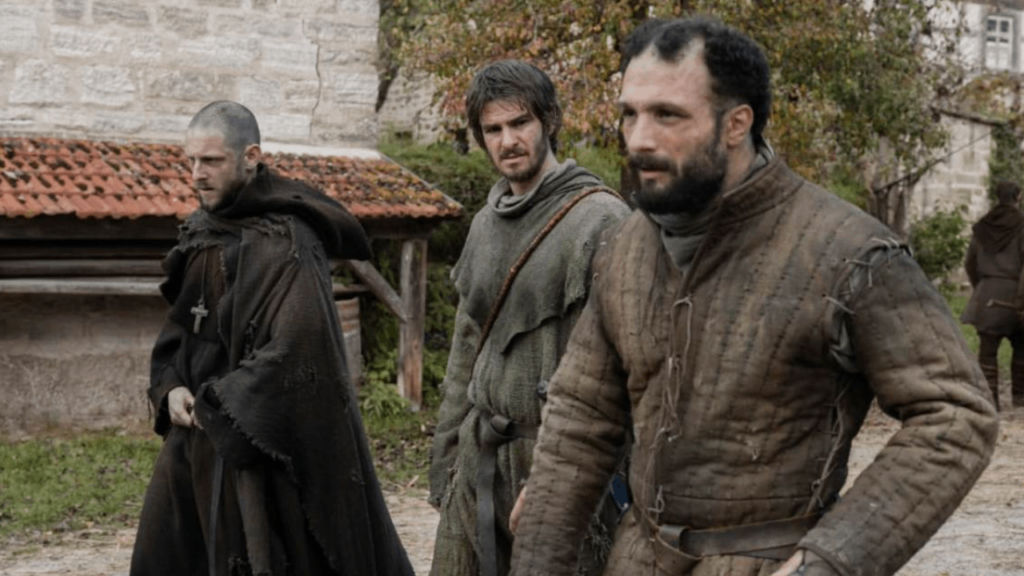
Paul Greengrass’ The Uprising has opened in theatres to a largely mixed-to-negative critical response, with Andrew Garfield’s committed performance, the film’s brutal battle sequences and its gritty recreation of medieval England emerging as its strongest elements. But while some critics have found the historical drama visceral, politically relevant and emotionally powerful, others have called it muddled, monotonous and visually exhausting. The film’s screenplay, Greengrass’ signature handheld style and, most significantly, its late attempt to connect the story to the legend of Robin Hood have drawn some of the sharpest criticism. Rotten Tomatoes currently lists the film at 53% from 66 critics, reflecting that divided response.
Set during England’s 1381 Peasants’ Revolt, The Uprising stars Andrew Garfield as Ploughman, a farmer who becomes involved in the rebellion against the increasingly oppressive ruling establishment. The story unfolds against the aftermath of the Black Death, economic hardship and political unrest, bringing historical figures including Wat Tyler and John Ball into the narrative. Greengrass also draws parallels between the medieval uprising and contemporary political anger, using the revolt as a story about inequality, power and what happens when ordinary people reach their breaking point.
The film’s biggest problem for several critics is that it ultimately moves beyond that historical story and gestures toward the Robin Hood legend. Mark Kennedy of the Associated Press gives The Uprising 2.5/4 and argues that the film begins as a compelling historical drama before being “inexplicably hijacked by an origin story for one of the West’s most popular folk heroes.” Kennedy praises Garfield and several supporting performances, as well as the film’s convincing medieval setting, but believes the Robin Hood connection weakens the historical and thematic material. His conclusion is blunt: “Greengrass has quite simply robbed his own movie. We did not come for this.”
Peter Travers of The Travers Take is similarly unconvinced by the fantasy elements. Giving the film 2/4, Travers says Garfield is trapped in a 14th-century peasant rebellion epic that “makes too many concessions to fantasy.” His sarcastic question, “He’s not really Robin Hood is he?”, gets directly at the problem he sees in the film’s final direction, while his joke about the aerial photography — “And did they have drone cameras back then?” — also reflects his reservations about Greengrass’ visual choices.
William Bibbiani of TheWrap is also frustrated by the ending, although he is considerably more positive about much of what comes before it. He describes The Uprising as an ambitious and visceral historical epic that builds momentum through its depiction of the rebellion, but argues that the film eventually goes too far. The ending becomes “such a tragic rug pull,” he writes, that it sullies the movie’s “hard-earned good will” at the last possible moment.
Linda Marric of HeyUGuys offers a similar assessment from a more moderate position. Giving the film 3/5, Marric says that “for most of its runtime, The Uprising is angry, thoughtful, and genuinely gripping,” but argues that it “loses its nerve right when it should be trusting the story it already told.” That makes her review particularly revealing of the broader response: the film is not being dismissed as devoid of merit, but critics repeatedly feel that its strongest ideas are weakened by choices made in the final stretch.
Greengrass’ filmmaking style is another major dividing line. Owen Myers of The Guardian gives the film 2/5 and calls it “a disjointed slog through the mud with the emotional depth of a History Channel rerun.” Myers is particularly critical of the director’s handheld approach, arguing that the technique has become stale and that the film’s constant visual movement can make the action more nauseating than immersive.
Jacob Oller of the AV Club is similarly harsh, giving the film a C-. He describes it as “a grim tale mired in the muck of semi-historical fact and soggy fields,” arguing that its court politics and bloody battles are presented with a self-conscious modern sensibility that does not necessarily make the story more effective. Oller also believes the film dilutes its characters by dividing attention between Garfield’s Ploughman and Cosmo Jarvis’ Wat Tyler, along with figures such as Jamie Bell’s John Ball and Thomasin McKenzie’s ex-nun.
Michael Phillips of Variety takes issue with another aspect of the filmmaking: the digital effects. He questions the use of “faux-drone overhead flights across the Thames,” arguing that these moments make The Uprising look like “no one in particular made it.” The criticism is significant because the film’s ground-level imagery is among its most frequently praised qualities; for Phillips, some of the digitally constructed spectacle works against the tactile identity Greengrass establishes elsewhere.
The handheld approach does work for some critics, particularly during the battle sequences. Lacy Baugher of RogerEbert.com gives the film 2.5/4 and praises its intense, violent combat, saying Greengrass’ shaky-cam brings an “almost uncomfortably brutal immediacy” to the action. She finds the technique less effective outside the battles, but believes the physicality of the revolt gives the film real force.
The film’s political parallels are also receiving mixed reactions. Marshall Shaffer of Slant Magazine argues that Greengrass draws “many unsubtle parallels” between the 1381 revolt and the global populist wave of the 2020s. For Shaffer, the modern political framing can feel too obvious, particularly when the historical setting is already powerful enough to speak for itself.
Christian Zilko of IndieWire is more forgiving. Giving the film a B, Zilko acknowledges that “the parallels to today’s world are clearly on display,” but believes the script “stops just short of hitting audiences over the head too hard.” The difference between the two reviews reflects one of the film’s central debates: Greengrass clearly wants the Peasants’ Revolt to resonate with contemporary audiences, but critics differ on whether those connections feel organic or overly deliberate.
Andrew Garfield, however, remains one of the film’s most consistently praised elements. Keith Phipps of The Reveal gives the film 3/5 and highlights Garfield’s combination of “rage and hope,” which he says keeps the film grounded in human emotions amid the grime and confusion of the historical setting. Garfield’s Ploughman is deliberately presented as an everyman figure, and his performance provides the emotional connection that some critics believe the screenplay itself struggles to establish.
The Hollywood Reporter’s Frank Scheck also praises the ensemble and the commitment behind the production. He highlights the “superb cast” and the technical departments responsible for recreating medieval England with considerable detail. Scheck’s review is particularly appreciative of the film’s craftsmanship, saying the period setting is rendered with such vividness that “you can practically smell the church incense.”
Mick LaSalle of the San Francisco Chronicle singles out Woody Norman, calling him “the most arresting performance, in a film characterized by strong acting.” Norman plays the young Richard II, while Jamie Bell, Cosmo Jarvis and Katherine Waterston also receive praise across the reviews. Even critics who find the characterisation thin generally acknowledge that Greengrass has assembled a strong cast capable of giving the material weight.
The recreation of medieval England is another area in which the film earns substantial praise. Jeannette Catsoulis of The New York Times, which named the film a Critic’s Pick, describes The Uprising as “authentically gritty and satisfyingly bloody.” Her response appreciates the film’s rough-and-tumble energy and its willingness to depict the revolt without sanitising its violence.
Randy Myers of the San Jose Mercury News is even more enthusiastic, awarding the film 3.5/4 and describing it as a movie that “alternates from thrilling to heartbreaking throughout.” Myers sees the rebellion as a reminder of how power can devolve into cruelty and how ordinary people respond when pushed beyond endurance. His review provides one of the strongest positive counterpoints to the critics who find the film exhausting or monotonous.
Katie Walsh of the Tribune News Service, giving the film 3/4, also believes Greengrass’ gamble ultimately works. Her concise verdict — “Greengrass might be taking a big swing (of the scythe), but his blade finds its target nevertheless” — reflects a more favourable response to the film’s ambition and contemporary relevance.
Still, the film’s relentless physicality becomes a weakness for some reviewers. Nick Schager of The Daily Beast calls it “a drab and monotonous affair that stomps, trots, and rolls around in the mud and muck for two tiresome hours.” That response sits almost directly opposite Myers’ description of a film that can be thrilling and heartbreaking, illustrating how differently critics have responded to Greengrass’ decision to make the revolt so physically oppressive.
Tim Grierson of Screen International is similarly critical of the film’s overall execution. He argues that “a noticeable lack of inspired filmmaking permeates the proceedings,” leading to “a disappointing finale that too cosily embraces modern blockbusters’ least-welcome conventions.” His criticism brings together several of the recurring complaints: the film’s increasingly conventional blockbuster instincts, its uneven visual language and a conclusion that does not live up to the promise of the historical material.
The ending therefore becomes the point at which several otherwise different reviews converge. TheWrap sees a “tragic rug pull,” the Associated Press believes the Robin Hood turn robs the film of its historical strength, Screen International finds the finale disappointing, and HeyUGuys argues that the film loses its nerve when it should trust the story it has already told. Even RogerEbert.com, which finds much to appreciate in the film, calls the Robin Hood-inspired coda “a real clunker,” describing it as an attempt to impose a neater and more uplifting conclusion on a historical story that does not naturally lend itself to one.
Ultimately, The Uprising emerges from the reviews as a historical epic whose individual elements have impressed critics more consistently than the finished whole. Garfield’s performance, the supporting cast, the production design, the brutal action and the film’s willingness to connect a medieval rebellion with contemporary political anger have all earned genuine praise. But the screenplay’s unevenness, Greengrass’ sometimes exhausting visual style, the digital effects and the Robin Hood detour have prevented the film from becoming the commanding historical drama it initially promises to be. The result is a film that can be angry, visceral and even gripping, but whose ambition is repeatedly undercut by the feeling that it ultimately loses confidence in the stronger historical story it had already built.
The Uprising Trailer

Film Details: The Uprising
Film: The Uprising
Rating: R
Runtime: 2h 8m
Genres: History, Drama, War
Director: Paul Greengrass
In Theaters: September 10, 2026
Production: Thank You Pictures, Supernix
Cast: Andrew Garfield, Jamie Bell, Stephen Dillane, Tom Hollander
Read More Review Roundups on POF