
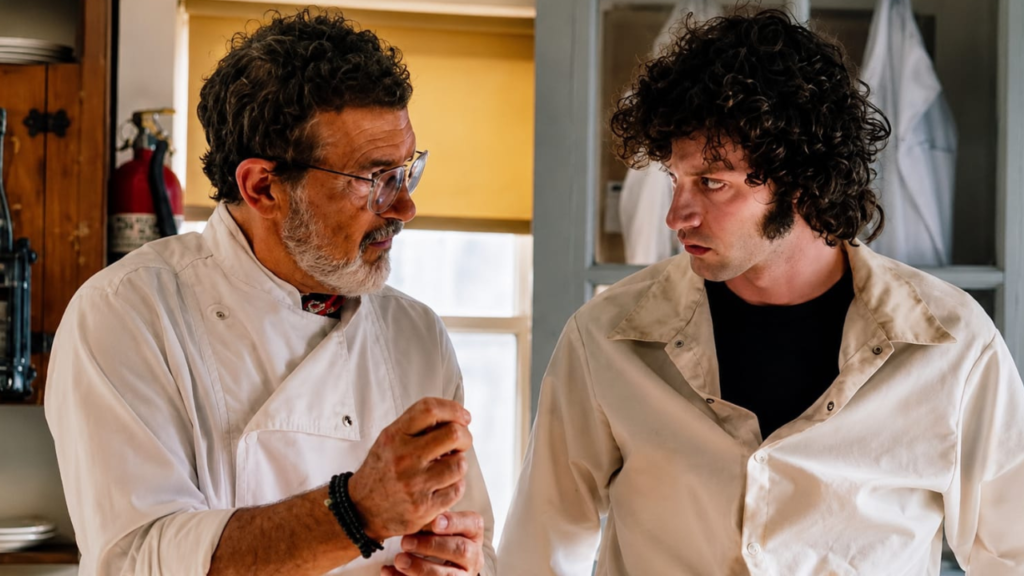
Before Anthony Bourdain became the familiar face who took viewers around the world through food, there was simply Tony, a restless 19-year-old trying to figure out what he wanted to do with his life. The new film Tony goes back to that lesser-known period, when Bourdain was still an aspiring writer and had not yet found the career that would make him famous.
Anthony Bourdain was much more than a celebrity chef. He was a writer, storyteller and television personality who used food to understand people and places. Through shows such as No Reservations and Parts Unknown, he travelled far beyond famous restaurants, meeting local people and using their food, traditions and everyday lives to tell larger stories about different cultures.
But that journey started in a very different place. While studying at Vassar College, Bourdain was interested in writing and hoped to build a literary career. Then, at 19, he spent a summer in Provincetown, Massachusetts, where he took a job as a dishwasher. What began as summer work became a turning point. He moved from washing dishes to working at a cooking station and discovered that the pressure, discipline and rough energy of restaurant kitchens suited him.
That experience eventually led Bourdain to the Culinary Institute of America, where he graduated in 1978. He then spent years working in professional kitchens before becoming executive chef at New York’s Brasserie Les Halles. Yet it was his writing, rather than cooking alone, that ultimately changed the course of his life.
Tony focuses on Bourdain’s early Provincetown period. Dominic Sessa plays the 19-year-old Bourdain, who arrives looking more like a young man searching for direction than the confident global traveller audiences would later know. The story follows his introduction to restaurant work, the people around him and the experiences that begin to give him a sense of purpose.
The film is inspired by Bourdain’s memoir Kitchen Confidential: Adventures in the Culinary Underbelly. Published in 2000, the book grew out of his famous 1999 New Yorker essay, “Don’t Eat Before Reading This,” in which Bourdain pulled back the curtain on restaurant kitchens. Its success established him as a writer with a sharp, funny and unusually honest voice.
However, Tony should not be treated as a completely factual recreation of Bourdain’s life. The filmmakers have used real experiences as a foundation while fictionalising or reshaping some characters, relationships and events. Antonio Banderas, for example, plays a chef who becomes an important figure in young Tony’s story, but the character is part of the film’s dramatic construction rather than a direct recreation of one real person.
Sessa is central to that approach. Known for his breakout performance in The Holdovers, he is not attempting to copy the older, instantly recognisable Bourdain. Instead, he plays the uncertain young man before the famous voice, television career and public image had taken shape. Emilia Jones plays Nancy, while Leo Woodall, Stavros Halkias, Dagmara Domińczyk and Rich Sommer are also among the supporting cast.
Anthony Bourdain later changed food television because he did not treat food as the whole story. A meal could become a way to talk about workers, families, politics, history or a community’s identity. That approach made his travel shows feel different from traditional cooking programmes. His career gradually moved from young restaurant worker to chef, writer, television personality and finally a global cultural figure.
That legacy also has a connection with India. Bourdain travelled through India for Parts Unknown, including Punjab, Kerala and Rajasthan, and spoke warmly about the country’s food and culture. His Punjab episode especially explored food alongside local life and Sikhism, giving Indian viewers another reason to connect with his work.
Tony is scheduled to release in Indian cinemas on August 21, 2026. Current reliable public sources confirm A24 as the film’s distributor. Tony is directed by Canadian filmmaker Matt Johnson, who co-wrote the film with Matthew Miller, Todd Bartels and Lou Howe. The film is produced by Tim White, Trevor White, Matthew Miller and Johnson, with A24 behind the project.
The most interesting question Tony asks is not how Anthony Bourdain became famous, but who he was before fame arrived. Long before the cameras, airports and crowded restaurants, there was a young man who was unsure of his direction and unexpectedly found something that felt right in a kitchen. That is where the story of Anthony Bourdain, as the world came to know him, really began.
Read More: