
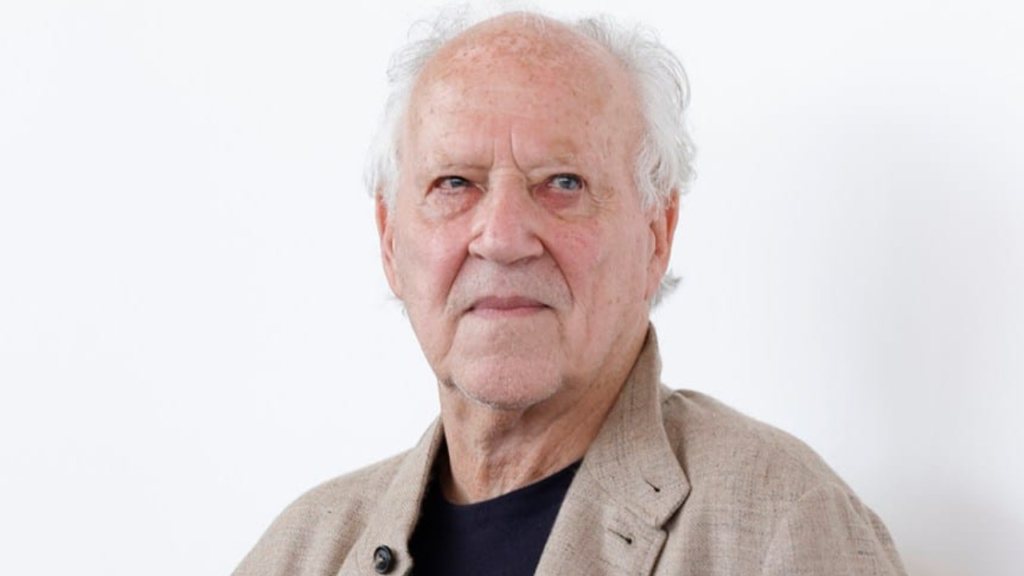
Werner Herzog, one of German cinema’s most distinctive filmmakers, is set to receive the Donostia Award, the highest honor presented by the San Sebastián International Film Festival. Herzog will receive the award during the festival’s opening night in September, recognizing a career spanning six decades and around 80 films.
The Donostia Award has been presented since 1986 to artists whose body of work has made a lasting contribution to cinema. Previous recipients have included Bette Davis, Cate Blanchett and Javier Bardem. For Herzog, the honor recognizes a filmmaking career defined by an unusual willingness to pursue stories in some of the world’s most challenging locations.
Born in Munich in 1942, Herzog spent part of his childhood in a small Bavarian village. The experience of growing up around isolated landscapes would become an important thread throughout his work, where nature, isolation and human obsession frequently intersect.
Herzog never attended film school. Instead, he taught himself filmmaking and reportedly worked night shifts as a welder to finance his early films. That independent approach remained central to his career, as he frequently chose small crews, limited budgets and difficult shooting locations rather than conventional studio production.
By the 1970s, Herzog had emerged as one of the leading figures of New German Cinema, a movement in which a generation of German filmmakers moved away from conventional commercial filmmaking in favor of more personal and challenging work. Alongside filmmakers including Rainer Werner Fassbinder and Wim Wenders, Herzog helped bring German cinema renewed international attention.
Much of Herzog’s filmmaking is centered on people pushed to their limits. His protagonists are often dreamers, obsessives and individuals confronting forces larger than themselves, particularly nature. He has filmed in locations including the Amazon and Antarctica, developing a style that moves between fiction and documentary while maintaining a strong interest in questions of truth and human behavior.
His best-known films include Aguirre, the Wrath of God, Fitzcarraldo, The Enigma of Kaspar Hauser and Nosferatu the Vampyre. His documentary work includes Grizzly Man, Encounters at the End of the World, Cave of Forgotten Dreams and Into the Inferno.
Herzog’s long collaboration with actor Klaus Kinski also became one of the most notable partnerships in German cinema. Their relationship was famously turbulent, with frequent clashes during production, but it resulted in several acclaimed films.
His career has extended well beyond directing. Herzog has worked as a producer, screenwriter and author, directed opera and also appeared as an actor. Younger audiences may recognize him from roles in Jack Reacher and The Mandalorian, as well as from voice work that has included an appearance on The Simpsons.
The San Sebastián festival will also screen Herzog’s newest film, Bucking Fastard, starring Rooney Mara, Kate Mara, Orlando Bloom and Domhnall Gleeson.
The Donostia Award adds another major recognition to a career that has consistently challenged conventional ideas about filmmaking. Six decades after Herzog began making films, his work continues to be defined by his interest in extreme environments, unconventional characters and the boundaries between documentary observation and cinematic storytelling.
Read More: