
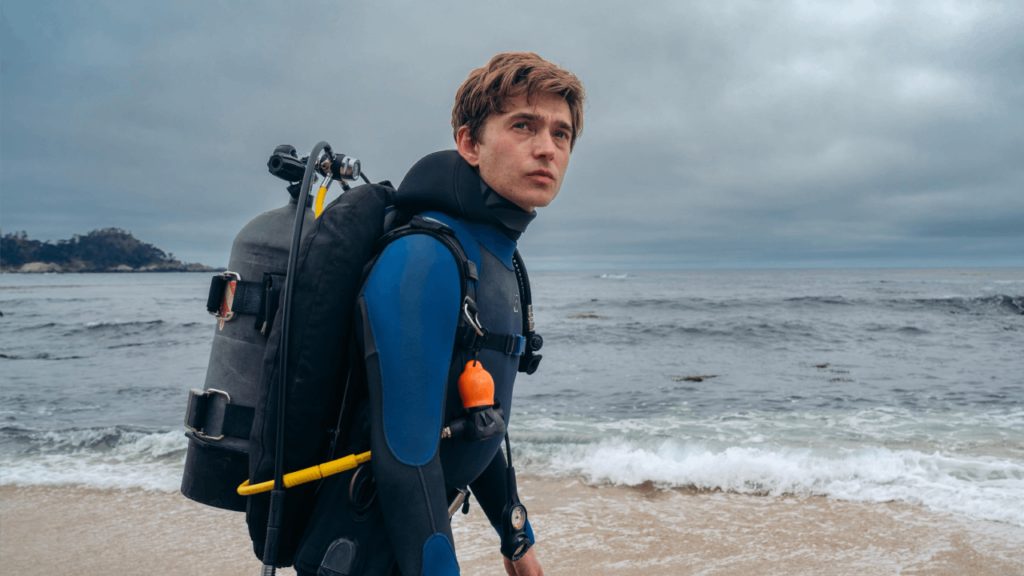
Critics are divided over Whalefall, Brian Duffield’s survival thriller about a young man trapped inside a sperm whale. The film holds a 78% score on Rotten Tomatoes from 69 reviews at the time of writing, but that figure masks a sharply divided critical response. Major outlets, including The Hollywood Reporter, Variety and The New York Times, have delivered negative or mixed verdicts. Other critics, including reviewers at RogerEbert.com, have found the film a thrilling and unexpectedly emotional cinematic experience.
Based on Daniel Kraus’s 2023 novel, Whalefall follows Jay Gardiner (Austin Abrams), a college student who returns to his home in Monterey, California, on the first anniversary of his father’s death. His father, Mitt (Josh Brolin), was a gruff diving legend who died in the ocean while suffering from mesothelioma. Their relationship was painful, but Jay sets out to scuba dive off Monastery Beach in search of his father’s body. During the dive, he becomes caught in a confrontation between a giant squid and a sperm whale and is swallowed by the animal. With roughly an hour of oxygen remaining, Jay must find a way to survive inside the whale as flashbacks reveal the troubled history between father and son. Elisabeth Shue, John Ortiz, Jane Levy and Emily Rudd also star.
Zachary Lee of RogerEbert.com delivered one of the most enthusiastic reviews, describing the film as “a mind-bending joyride that drags you to uncharted cinematic depths.” He praised Duffield’s direction for bringing the survival-thriller creature feature back to life and commended Ramsey Avery’s production design for making the whale’s interior feel “expansive and otherworldly.” Lee also highlighted Aaron Morton’s cinematography and the sound design, noting that Abrams carries much of the film with limited dialogue and “frantic bursts of wheezing.”
Meagan Navarro of Bloody Disgusting praised the film for translating “the white-knuckle intensity of an implausible scenario to screen with all of its emotional resonance intact.” Carla Hay of Culture Mix also commended Abrams’ performance, describing it as “enthralling.” According to a review roundup published by Forbes, several other critics were positive, including Liz Shannon Miller of Consequence, Rocco T. Thompson of Slant, Barry Hertz of The Globe and Mail, Nick Schager of The Daily Beast and Alison Foreman of IndieWire. Simon Crooks of Empire reportedly called the film a genuine one-off and one of the most surreal blockbusters in years.
Even reviewers who were less impressed acknowledged the film’s technical achievements. Ben Kenigsberg of The New York Times described the whale’s interior as “tactile and viscous” and praised the production design, visual effects and sound teams for having “committed to their assignment.” David Rooney of The Hollywood Reporter also credited the filmmakers with handling the initial shock of Jay being swallowed effectively. He praised Abrams for the physical demands of the role, describing the actor’s efforts as “yeoman’s work.” Rooney further highlighted Joseph Trapanese’s churning score and the dense soundscape, which help maintain the film’s tension.
The father-son relationship, however, emerged as one of the film’s most divisive elements. Kenigsberg interpreted the whale as “a multilayered metaphor for the weight of grief,” pointing to a moment in which Jay addresses the animal and his deceased father as though they were one and the same. Lee similarly argued that the film’s spiritual themes elevate it beyond a conventional creature feature.
Rooney disagreed with that assessment. He argued that the film is “weighed down by Dad Drama to the point where it’s soggy even on dry land” and that its attempt to move towards spiritual healing “ends up sinking like a stone.” Odie Henderson of The Boston Globe, who awarded the film two out of four stars, also found the emotional material unconvincing. In his view, the screenplay’s attempts at emotional manipulation are so obvious that the scenes involving human relationships feel less believable than those taking place inside the whale.
Owen Gleiberman of Variety delivered one of the harshest assessments among the major outlets. He argued that the film “comes closer to doing for whales what ‘Howard the Duck’ did for barnyard superheroes” than achieving what Jaws did for sharks. Gleiberman was similarly unimpressed by the suspense, writing, “Is it gross? At times. Claustrophobic? A bit. Scary? Not even a little.” He described Whalefall as “thriller kitsch” and “a carcass of a thriller that never rises,” while also finding Abrams too weak a protagonist to inspire investment.
Rooney’s headline characterised the film as a “dumb thriller that takes itself way too seriously.” In his review, he argued that Whalefall falls short of Duffield’s earlier film No One Will Save You. He also criticised the action sequences, finding it difficult to understand what was happening on screen, and said the whale’s interior never becomes sufficiently clear to the viewer.
Kenigsberg likewise felt that the screenplay undermines the film’s technical strengths. He described it as a “blubber-brained screenplay” and criticised the time-hopping structure for feeling almost mechanical. The repeated arguments between Jay and his father, he suggested, arrive “with monotonous regularity.” He also questioned whether Abrams could overcome the challenge of conveying emotion in close-ups while wearing an oxygen mouthpiece, arguing that the limitation “sinks the star.”
Even Lee, despite his overall positive response, acknowledged that the film sometimes loses momentum when it shifts between Jay’s attempts to escape the whale and the flashbacks exploring his relationship with his father. According to Forbes’ review roundup, Jacob Oller of The A.V. Club offered another mixed assessment, describing the film as half gross-out B-movie and half flashback-heavy emotional flotsam.
Ultimately, Whalefall has opened to a divided critical response. Supportive reviewers have praised its commitment to an audacious premise, its production design and sound work, and Abrams’ physically demanding central performance. Detractors have found the father-son drama overbearing, the screenplay mechanically structured and the suspense less effective than the concept promises. The disagreement centres on whether the film’s emotional ambitions deepen its survival-horror premise or weigh it down.
With its theatrical release set for Friday, October 16, Whalefall offers audiences an unusual survival story that combines claustrophobic body horror with a troubled family relationship. The early reviews suggest that its willingness to pursue both elements is also the source of its most significant critical divide.
Watch Trailer:

Film Details: Whalefall
- Release Date: October 16, 2026
- Director: Brian Duffield
- Screenwriters: Brian Duffield and Daniel Kraus, based on Kraus’s novel
- Cast: Austin Abrams, Josh Brolin, Elisabeth Shue, John Ortiz, Jane Levy and Emily Rudd
- Studio: 20th Century Studios; produced by Imagine Entertainment
- Producers: Brian Grazer, Brian Duffield, Jeb Brody and Allan Mandelbaum
- Music: Joseph Trapanese
- Rating: PG-13
- Runtime: 1 hour 46 minutes
- Rotten Tomatoes: 78% from 69 reviews at the time of writing