
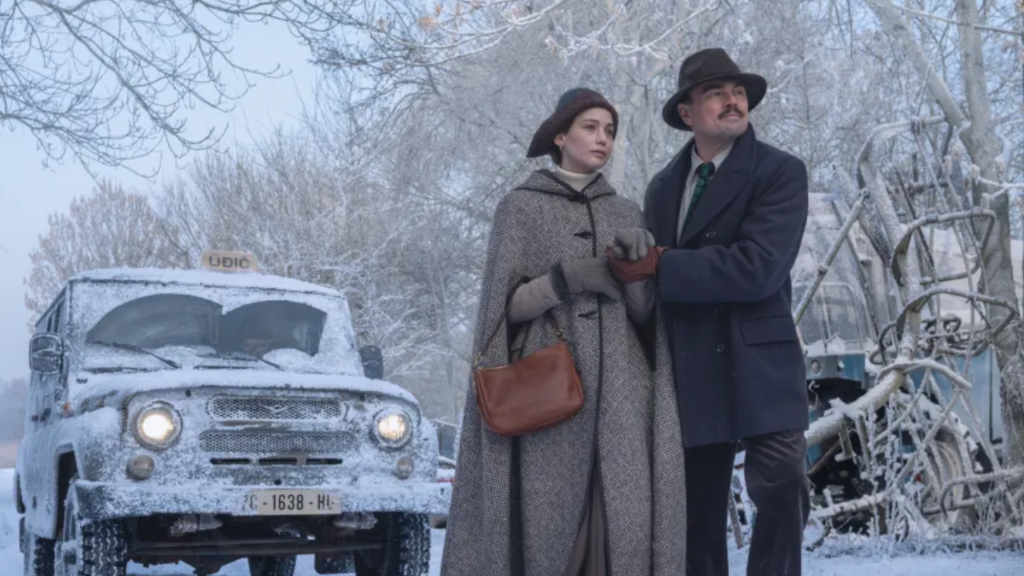
A single image is sometimes enough to define the mood of an entire film. The first look at What Happens at Night does exactly that. Set against a stark, snow-covered European landscape, Leonardo DiCaprio and Jennifer Lawrence walk side by side — small figures swallowed by an overwhelming stillness. It’s a visual that feels distant, cold, and quietly unsettling.
But beyond the image lies a project of significant weight. This is a film directed and produced by Martin Scorsese, backed by Apple Original Films, and adapted from Peter Cameron’s novel by screenwriter Patrick Marber. On paper, it carries all the markers of a prestige production. On screen, however, it appears to be something far more introspective — and perhaps more unsettling — than what audiences typically associate with Scorsese.
The first still doesn’t rely on spectacle. There are no dramatic gestures or overt hints of conflict. Instead, it leans into stillness. Snow stretches endlessly, creating a sense of isolation that feels almost suffocating. DiCaprio and Lawrence, though physically close, seem emotionally distant — a subtle but telling detail that hints at the film’s deeper tensions. Described as a “frozen dreamscape,” the image suggests a narrative that prioritizes mood over movement, where unease builds gradually rather than erupting all at once.
At its core, What Happens at Night is rooted in the psychological terrain of Peter Cameron’s novel, a story that follows an American couple traveling to a remote European town to adopt a child. What begins as a hopeful journey slowly transforms into something far more ambiguous and disorienting. The shift is not immediate, but gradual — a creeping sense of confusion that begins to blur the boundaries between reality and perception.
Bringing this literary foundation to screen is Patrick Marber, whose work is often defined by its focus on character and emotional complexity. His adaptation is likely to preserve the novel’s quiet intensity, allowing the tension to emerge from within the characters rather than from external forces. This positions the film less as a conventional horror story and more as a psychological descent, where the real conflict lies in the fragile dynamics of relationships and the unsettling nature of unfamiliar spaces.
For Martin Scorsese, this project signals an interesting shift. Known for films driven by momentum and narrative energy, he appears here to be embracing a more restrained and introspective approach. Taking on both directing and producing duties, Scorsese seems to be exercising a deeper level of creative control, shaping a film that is less about external drama and more about internal states of mind. It suggests a filmmaker exploring new textures — quieter, more atmospheric, and perhaps more meditative.
The casting further reinforces this direction. Leonardo DiCaprio’s long-standing collaboration with Scorsese has consistently resulted in layered, performance-driven work, and his presence here suggests a character rooted in emotional complexity. Jennifer Lawrence, in her first collaboration with the filmmaker, brings a contrasting energy that complements the film’s psychological tone. Together, their pairing points toward a narrative driven not by spectacle, but by subtle shifts in emotion and perspective. Their reunion after Don’t Look Up adds familiarity, but the dynamic here feels far more restrained and intimate.
Every aspect of the production appears aligned with this vision. Shot in the Czech Republic, the film benefits from a setting that naturally enhances its sense of isolation. The snow-covered landscapes are not just visually striking, but thematically significant, reinforcing the emotional distance and disorientation at the heart of the story. Cinematographer Rodrigo Prieto, a longtime Scorsese collaborator, is expected to bring a muted, textured visual style that complements the film’s tone, while the backing of Apple Original Films positions it firmly within the realm of prestige cinema.
Even at this early stage, What Happens at Night is generating quiet industry buzz. The combination of Scorsese, DiCaprio, and a literary adaptation places it firmly in the conversation for future festival and awards attention. Yet what makes the film particularly intriguing is not just its pedigree, but its restraint. It does not appear to rely on overt hooks or dramatic spectacle, instead building its identity around atmosphere, performance, and psychological depth.
If the first look is any indication, this is a film that embraces stillness and discomfort in equal measure. It is less concerned with what is shown and more with what is felt — a narrative that unfolds in silence, allowing its tension to linger beneath the surface. In stepping into this frozen dreamscape, Scorsese may be offering something unexpected: a film that doesn’t overwhelm, but quietly stays with you long after it ends.
Read More:
- Beyond Hype: The 10 Indian Films Defining Anticipation in 2026
- Hollywood Box Office Failures 2025 Explained — What The Year’s Biggest Misses Taught Us
- Why James Cameron’s Films Refuse to Fade — Even When the Box Office Is Done
- Best Santa Claus Movies of All Time, Ranked by Impact and Legacy
- 35 Years Later: From Traps to Triumphs: Where Are the Stars of ‘Home Alone’ Now?