
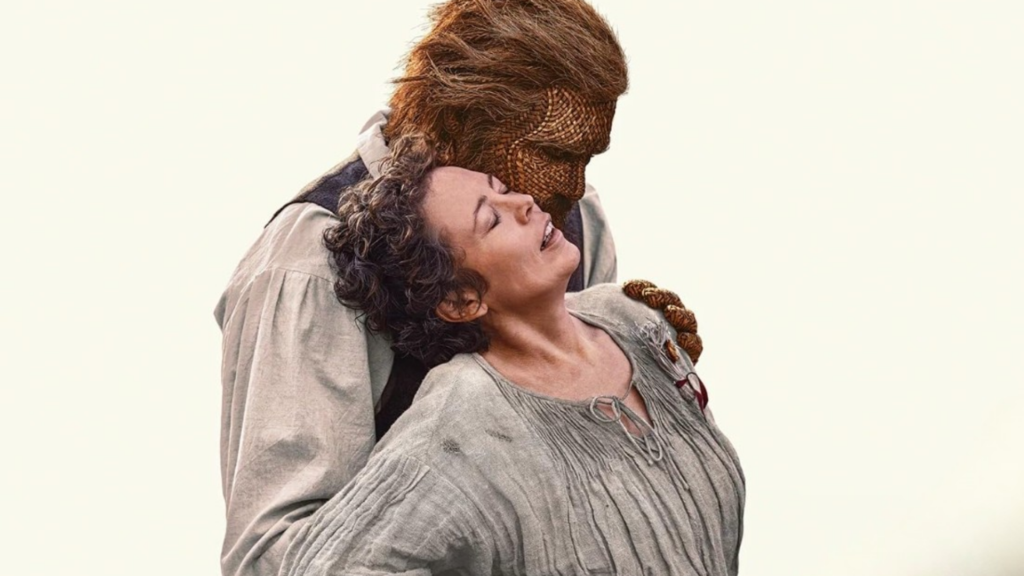
Wicker, a fairy-tale comedy starring Olivia Colman and Alexander Skarsgård, opens in theatres on October 23, 2026, through Black Bear. Written and directed by Alex Huston Fischer and Eleanor Wilson, the R-rated film also stars Peter Dinklage, Elizabeth Debicki and Richard E. Grant. Based on Ursula Wills-Jones’s short story The Wicker Husband, the film premiered at the Sundance Film Festival and has received a divided response from critics.
While Deadline’s review is highly enthusiastic, The Wall Street Journal offers a much less favourable assessment. Early reactions from Sundance also revealed a split, with some critics embracing the film’s bawdy humour and imaginative storytelling while others found its execution stiff and its message heavy-handed. Across the reviews, however, two elements receive particular attention: Peter Dinklage’s performance and the film’s practical effects.
Set in a fairy-tale village where characters are identified by their occupations or marital status, the story follows The Fisherwoman, played by Colman. Ostracised by the town’s men and lonely at home, she finds herself longing for companionship. After fate and the Bottle Washer’s wedding determine that she will be next in line to marry, she approaches the Basket Weaver, played by Dinklage, and asks him to make her a husband out of wicker.
The Basket Weaver creates a husband in the form of Skarsgård, and the result initially seems ideal. The new arrival proves to be everything The Fisherwoman could want, but his presence unsettles the villagers. The Tailor’s Wife, played by Debicki, is particularly unhappy with the arrangement and attempts to convince The Fisherwoman that her husband is unfaithful. The resulting conflict gives the film room to explore jealousy, relationships, gender expectations and the attitudes that shape the village’s social order.
Pete Hammond of Deadline is among the film’s strongest supporters, describing Wicker as “the year’s most unexpected charmer” and a comic fable that is “pure delight.” He calls the film “sexy and satirically funny, but also oddly haunting,” arguing that it has something meaningful to say about relationships between men and women, jealousy and longing.
Hammond also highlights the way the Wicker Husband’s arrival affects the village’s existing marriages. The story examines men who take their wives for granted and the broader misogynistic attitudes that underpin the community. For Hammond, the film’s combination of bawdy comedy and social commentary gives its fairy-tale premise a sharper purpose than its unusual setup might initially suggest.
Kent M. Wilhelm of The Film Stage was similarly impressed at Sundance, describing Wicker as an “audacious, captivating film” and a “can’t-miss curiosity.” He praises its blend of humour, social commentary and exploration of jealousy. Karen Peterson of AwardsWatch gives the film a B+ and calls it a “marvellously bawdy fable” that is “filthy and funny, surprising and weird.” Peterson also enjoys seeing Colman move away from her typically dignified roles to embrace a more raucous comic performance.
Not every critic is persuaded by the film’s approach. Kyle Smith of The Wall Street Journal describes it as a “creaky feminist fable” and a “finger-wagging fairy tale.” He questions the contrast between the film’s children’s-book aesthetic, which includes illustrated chapter titles, and its use of crude humour, including chamber pots and profanity.
Smith argues that the story ultimately delivers an overt feminist message about the evils of male-dominated societies, rather than allowing its satire to emerge more naturally from the characters and situations. Although he is critical of the film’s approach, he acknowledges that Skarsgård fulfils many of the expectations associated with the ideal husband. The character’s wicker body, which produces creaking noises, also provides one of the film’s recurring comic details.
Chase Hutchinson of TheWrap offers another mixed-to-negative assessment, describing the film as “well-intentioned but wooden.” He sees promise in the premise but considers the execution “loving yet laborious.” In his view, the central joke gradually loses its effectiveness, leaving the film short of the magic its fairy-tale setting promises. Hutchinson writes that the experience left him cold, even though he wanted to embrace what the filmmakers were attempting.
The performances are among the most consistently discussed elements of Wicker, including in reviews that are less convinced by the overall film. Hammond praises Colman’s ability to give her characters multiple dimensions, arguing that she is incapable of playing any character with just one note. He also commends Skarsgård for underplaying the Wicker Husband with tenderness, making him seem more human than the men who were born rather than woven.
Dinklage earns particular praise for his portrayal of the Basket Weaver, whom Hammond considers perfectly cast despite the character’s slightly duplicitous nature. Debicki, meanwhile, brings subtlety to the role of the film’s antagonist. Hammond finds the wider ensemble well chosen, although he believes Grant is underused as the doctor.
Peterson singles out Dinklage’s Shakespearean-style monologue and compares Skarsgård’s gentle character to Edward Scissorhands. She also praises Debicki as an effective foil to Colman. Hutchinson, despite his reservations about the film, agrees that Dinklage understands the role perfectly and credits both Colman and Skarsgård for their commitment to the material. Wilhelm also highlights Debicki’s performance as a strong villainous turn.
The film’s technical achievements provide another point of agreement among its more favourable reviewers. Hammond describes the production as exquisite, praising Lol Crawley’s cinematography and Renato Cseh’s production design, which evokes the atmosphere of a Grimms’ fairy tale. He also highlights the makeup and visual effects work by Weta Workshop, which brings the wicker construction to life.
Wilhelm identifies the practical effects as one of the film’s standout elements, while Peterson also praises the Weta Workshop work and the candlelit cinematography. These technical details help establish the film’s distinctive visual identity, combining the texture of a handcrafted fairy tale with the physical comedy inherent in its central character.
The divided response to Wicker ultimately reflects a disagreement over how effectively its unusual premise supports its larger ambitions. For its admirers, the film is an imaginative, bawdy fable that uses fairy-tale conventions to explore jealousy, marriage and misogyny. Its performances, production design and practical effects give the story a distinctive personality, while its comic excesses provide much of its appeal.
For its detractors, however, the premise is stronger than the execution. The film’s feminist message can feel too emphatic, and its central joke does not sustain its initial promise throughout the story. The contrast between its whimsical visual style and deliberately crude humour also proves divisive, with some critics enjoying the collision and others finding it awkward.
Taken together, the reviews suggest that Wicker works best as an imaginative comic fable and a showcase for its cast, particularly Dinklage, Colman and Skarsgård. Its more divisive elements are the strength and delivery of its social commentary, along with the extent to which its central premise can sustain a feature-length story. Whether audiences see it as a charming surprise or a creaky parable, the film arrives with a notable ensemble and practical effects that have earned praise even from critics less convinced by its overall approach.
Watch Trailer:

Film Details: Wicker
- Director: Alex Huston Fischer and Eleanor Wilson
- Writers: Alex Huston Fischer and Eleanor Wilson, based on the short story The Wicker Husband by Ursula Wills-Jones
- Cast: Olivia Colman, Alexander Skarsgård, Peter Dinklage, Elizabeth Debicki, Richard E. Grant, Marli Siu, Nabhaan Rizwan, Gustav Lindh, Ella Bruccoleri, Ben Ashenden and Kiell Smith-Bynoe
- Genre: Fantasy, Comedy, Romance
- Rating: R
- Runtime: 1 hour 45 minutes
- Producers: Ed Sinclair, Tom Carver, Olivia Colman, Justin Lothrop, Brent Stiefel, Brad Zimmerman, David Michôd, Andrea Cornwell, Oliver Kassman, Tim Headington, Lia Buman, Ryan Heller and Michael Bloom
- Distributor: Black Bear
- Release Date: October 23, 2026