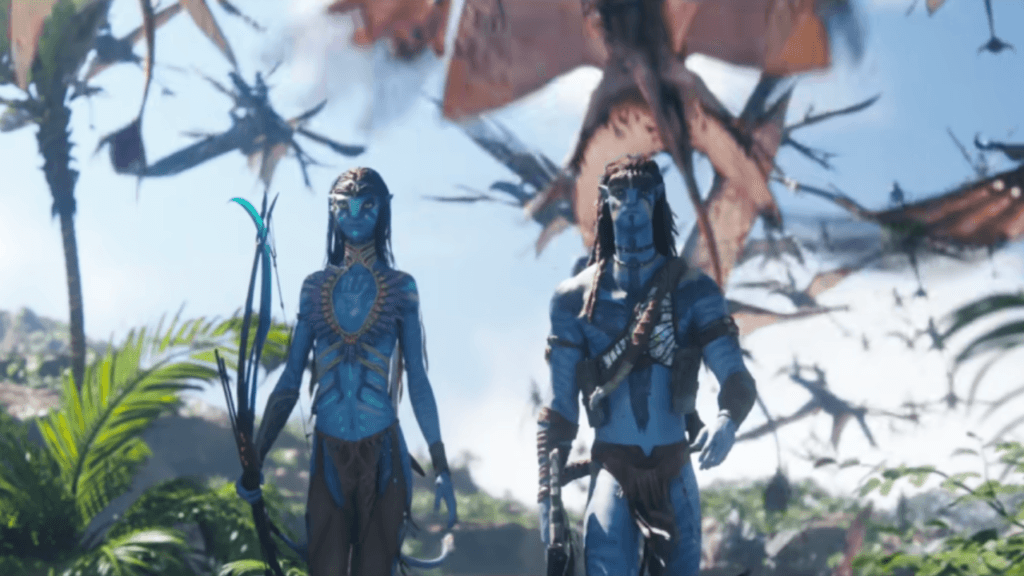
When Avatar released in 2009, it did more than expand the boundaries of visual effects or reset box-office expectations. It introduced a fundamentally different way of thinking about cinematic environments. Pandora was conceived as a living ecosystem where light, movement, and spatial design worked in unison to create continuity. The world was not treated as a decorative backdrop but as an active visual system—one that shaped framing, lighting, and staging at every level. This approach would go on to define the Avatar visual language, placing environment at the center of cinematic expression.
With Avatar: The Way of Water, Avatar: Fire and Ash, and the films yet to come, James Cameron is not merely escalating scale or spectacle. He is deliberately evolving the franchise’s visual language to reflect shifting environments and mounting narrative pressure. For cinematographers, this progression—from jungle to water to fire—offers a clear lesson in how camera movement, lighting behavior, color relationships, and visual rhythm must transform as the story’s physical and emotional conditions change. This evolving grammar sits at the heart of visual storytelling in Avatar, where form is inseparable from world-building.
It is also essential to acknowledge the role of Russell Carpenter in shaping this evolving visual identity across the Avatar films. As the cinematographer on Avatar (2009), Avatar: The Way of Water, and the upcoming Avatar: Fire and Ash, Carpenter has ensured visual continuity while allowing each environment to fundamentally alter how the camera behaves. His work reflects a rare balance between large-scale technological filmmaking and classical cinematographic judgment—understanding when light should remain ambient, when direction becomes necessary, and when restraint carries more power than visual emphasis. Across jungle, ocean, and fire-driven worlds, Carpenter’s contribution lies not in repeating a signature style, but in adapting cinematography to the physical and emotional logic of each setting, reinforcing James Cameron cinematography as a discipline driven by environment rather than excess.
Avatar Visual Language: From Glide to Resistance
In Avatar (2009), camera movement is built around freedom and discovery. Frames glide smoothly through the jungle environment, allowing the audience to absorb spatial detail rather than react to impact. Even during moments of action, movement remains measured, prioritizing orientation and continuity over aggression or speed. The camera behaves as a curious observer, reinforcing Pandora’s openness and stability.

Avatar: The Way of Water introduces a more disciplined visual approach. Water, by its nature, resists speed and abrupt changes in direction, and the cinematography embraces these constraints. Shots are allowed to run longer, movement feels weighted, and choreography is designed to preserve spatial clarity. Cutting is reduced, geography remains legible, and the overall effect reinforces a sense of control and patience within the frame. This restraint becomes a defining feature of Avatar The Way of Water cinematography, where motion is shaped by physical resistance rather than spectacle.
The fire-based environments of Avatar: Fire and Ash are expected to disrupt this stability. Fire introduces volatility and unpredictability, and camera movement is likely to become more directional and reactive. Smooth glide gives way to sharper shifts in momentum, reflecting a world that no longer permits effortless motion—either for the camera or the characters. In this phase, Avatar Fire and Ash visuals are poised to transform movement into an expression of instability rather than exploration.
Lighting Philosophy: From Environmental Emission to Directional Control
In Avatar (2009), lighting is designed to feel embedded within the jungle rather than imposed upon it. Bioluminescent flora and ambient sources replace traditional key lighting, keeping contrast low and shadows soft. Light appears to emanate from the world itself, allowing scenes to feel continuous and inclusive rather than selectively lit. This approach establishes lighting as a component of environmental cinematography, not a tool of emphasis.
Avatar: The Way of Water extends this philosophy through underwater conditions, where light naturally wraps, scatters, and equalizes. Directional hierarchy is minimized, and illumination behaves more like a spatial field than a dramatic instrument. This reinforces the film’s emphasis on clarity, duration, and visual calm, even during moments of heightened action, strengthening the franchise’s commitment to cinematography and world building.
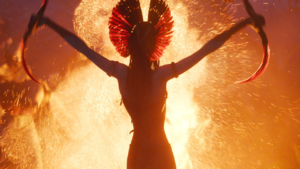
With Avatar: Fire and Ash, the lighting logic shifts fundamentally. Fire introduces hard, unstable sources that flicker, fluctuate in intensity, and generate aggressive contrast. Exposure becomes less predictable, shadows deepen, and faces are often shaped by directional light rather than ambient fill. Environments no longer envelop the characters; they selectively reveal them. Visually, this marks a return toward classical dramatic lighting, where contrast and direction carry narrative weight and emotional tension, altering how Avatar uses light and color to guide audience response.
Color Design: From Environmental Harmony to Visual Conflict
In Avatar (2009), color design is inseparable from the jungle environment, relying on analogous relationships—blues, greens, and cyans—that maintain visual harmony even during moments of tension. The palette supports exploration rather than alarm, keeping saturation and contrast balanced so the world feels stable and immersive. Color functions as environmental continuity.
Avatar: The Way of Water narrows this approach further, drawing heavily from oceanic blues and teals while reducing color separation and visual noise. The image becomes calmer and more unified, with color reinforcing spatial clarity and emotional restraint. Here, color serves immersion rather than urgency, aligning with the film’s measured visual rhythm.
With Avatar: Fire and Ash, the palette is expected to move toward opposition rather than harmony. Fire-based environments naturally introduce warm highlights cutting into cooler surroundings, creating stronger color separation and heightened contrast within the frame. Complementary color relationships replace analogous ones, increasing visual tension and reducing comfort. Color ceases to function purely as environmental description and instead becomes a tool for emotional pressure, echoing the broader Avatar fire and water themes that now give way to confrontation.
Why Avatar’s Visual Evolution Matters
Avatar (2009) established its visual language within a dense jungle environment, where camera movement was fluid and exploratory, lighting was largely emissive, and the frame encouraged immersion over urgency. Avatar: The Way of Water translated that language to island and oceanic settings, enforcing greater visual discipline—slower movement, longer shot duration, and lighting that wrapped and scattered rather than directed, keeping space and geography readable.
With Avatar: Fire and Ash, the environment itself turns hostile, and the cinematography is expected to respond accordingly. Fire-driven lighting introduces flicker, harder contrast, unstable exposure, and sharper directionality, pushing the image away from harmony and toward confrontation. Viewed together, the three films form a deliberate progression in visual design, where environment dictates how the camera moves, how light behaves, and how the audience ultimately experiences the story—completing a clear visual evolution of Avatar that places environment, not spectacle, at the center of cinematic meaning.