
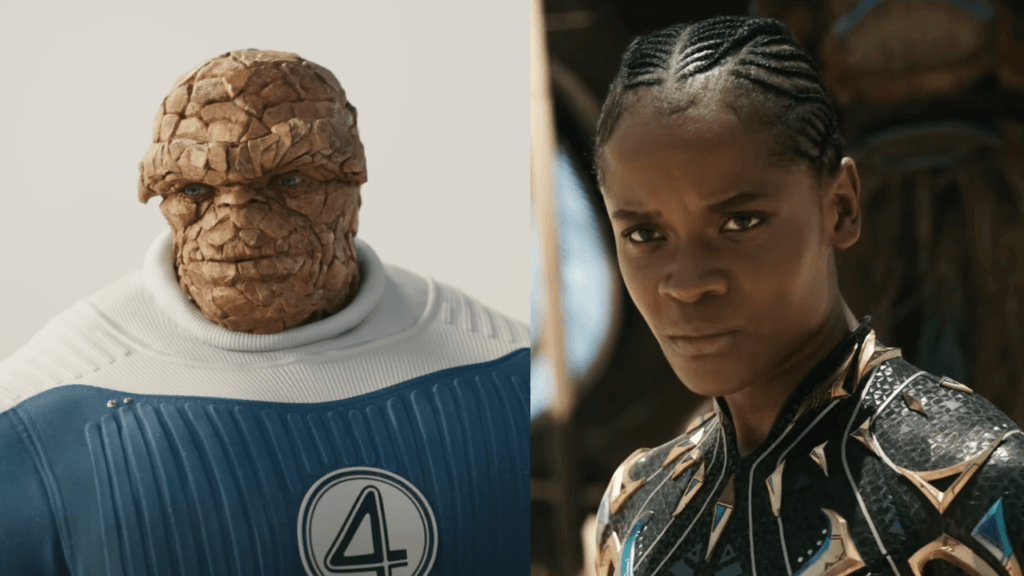
Marvel Studios has unveiled a new teaser for Avengers: Doomsday, and instead of relying on explosive spectacle, the footage makes its impact through symbolism, legacy, and carefully chosen intersections. The teaser’s most striking reveal sees the Fantastic Four making their long-awaited entry into the Marvel Cinematic Universe — not in isolation, but through a meeting with the leaders of Wakanda.
It is a deliberate creative choice. By introducing Marvel’s first family through Wakanda, the teaser immediately frames Avengers: Doomsday as a film about convergence rather than expansion. These are not parallel stories running side by side, but worlds that now share consequences, power dynamics, and responsibility within a single cinematic universe.
The teaser is anchored by a voiceover from Shuri, voiced by Letitia Wright, who stepped into the role of Black Panther following the death of her brother T’Challa. Her narration lends the footage emotional continuity, reminding audiences that the MCU has not moved on from loss — it has evolved through it. The absence of T’Challa, played by the late Chadwick Boseman, still echoes through Wakanda, and that emotional weight quietly grounds the teaser’s larger ambitions.
Wakanda’s central presence is significant. Over the years, it has emerged as the MCU’s ideological and moral anchor — a nation that balances technological superiority with restraint and diplomacy. Placing the Fantastic Four within this context suggests that their arrival will not merely expand the universe but challenge existing structures of leadership and influence. This is not a ceremonial introduction; it is a statement of narrative intent.
Directed by Anthony Russo and Joe Russo, Avengers: Doomsday marks the Russo Brothers’ return to large-scale Marvel storytelling after defining the franchise’s most successful era with Infinity War and Endgame. Their involvement signals a shift back to event filmmaking that prioritises cohesion and character perspective over constant escalation. The teaser reflects that sensibility, favouring tone and implication over rapid-fire reveals.
Hovering over the footage is the promise of an immense threat: Doctor Doom, played by Robert Downey Jr.. Downey Jr.’s return to the MCU in the role of one of Marvel’s most iconic villains is a casting decision loaded with thematic weight. Known for his portrayal of Tony Stark, Downey Jr. stepping into the role of Doom reframes the actor’s MCU legacy and introduces a villain defined not by chaos, but by intellect, control, and ideology.
Notably, the teaser resists fully revealing Doom. His presence is felt rather than seen, positioning him as an inevitability rather than an immediate spectacle. It’s a reminder that Doctor Doom has always represented more than brute force — he is a philosophical and political adversary as much as a physical one, making him uniquely suited for a story that brings together Wakanda, the Fantastic Four, and the remnants of the Avengers.
Disney has set December 18 as the global theatrical release date, placing Avengers: Doomsday firmly in the year-end event slot. The timing, combined with the teaser’s restrained confidence, suggests Marvel is consciously recalibrating its approach to blockbuster storytelling. Rather than overwhelming audiences with scale alone, the studio appears focused on meaning — on why these characters share a screen, and what that collision represents.
What makes this teaser compelling is not what it shows, but what it withholds. There is no exhaustive roll call of heroes, no cascade of action beats, and no attempt to outdo past climaxes. Instead, it lays out intent. Wakanda stands as a symbol of legacy and leadership. The Fantastic Four arrive as disruptors of established order. Doctor Doom looms as a threat capable of reshaping the very idea of power within the MCU.
If the teaser is any indication, Avengers: Doomsday is not trying to replicate Endgame. It is attempting something more complex — to redefine what an Avengers film can be in a post-Endgame era, where unity must be rebuilt, and the cost of power is no longer abstract. Marvel isn’t simply assembling heroes again. It is testing whether its universe can still feel coherent, consequential, and worth believing in when its most important worlds finally collide.