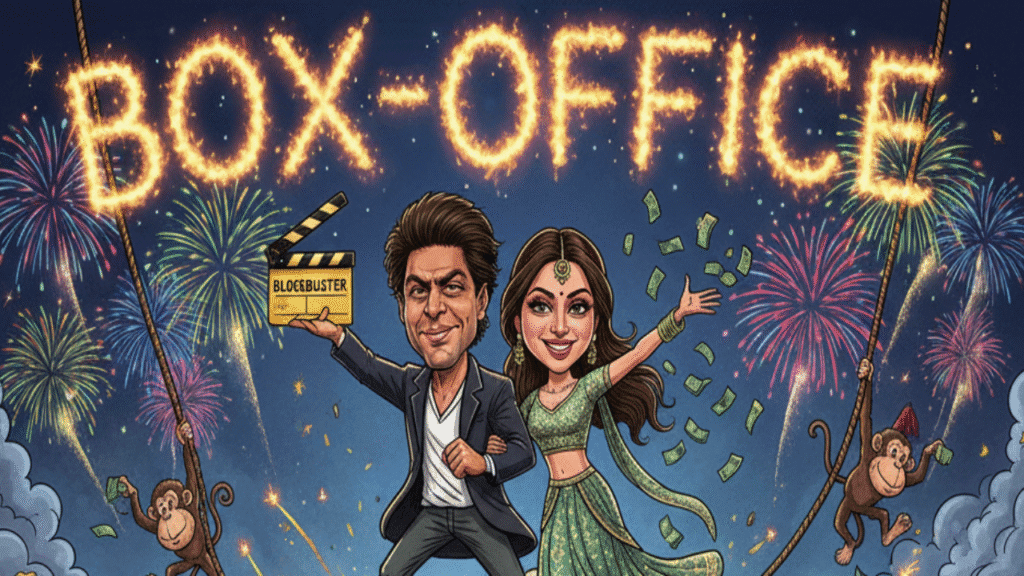
“In the business of Bollywood, the festival slot isn’t just a calendar date — it’s the cash-register ringing at full volume.”
When you look at the Indian film industry, you’ll find that the festival of Diwali is more than just fireworks, sweets and family gatherings. For major studios and A-list stars, it is a strategic release window deliberately chosen for maximising audience, revenue and impact. The story begins with the fact that Diwali brings with it extended holidays, more leisure time, more family outings and a celebratory mood — this means theatres are primed, foot‐traffic is higher, and buyers (audience) are predisposed to going out. Studios know this and therefore bank heavily on scheduling their big films during this period.
The extended holiday period around Diwali gives films a natural boost. Many offices shut down, schools are closed, families travel or entertain guests, and cinemas become a part of the festive outing. Because of this, the footfall in theatres rises, the occupancy per show increases, premium screens get booked, and ticket yields improve. In effect, this slot allows films to hit with stronger opening weekends and longer stays. Over the last 30 years or so, this trend has grown steadily: initially a few films targeted Diwali, but gradually it became a must-consider slot for big releases.
From records collected by industry trackers, the list of Diwali releases from 1990 onwards shows this pattern clearly. For example, according to a compiled list (1990-2023) from a blog aggregating box-office records, 1993’s Baazigar (Shah Rukh Khan) had net collections of approx ₹9.75 crore. (Box Office India Records) 1995’s Dilwale Dulhania Le Jayenge brought in around ₹53.32 crore. (Box Office India Records) 1998’s Kuch Kuch Hota Hai grossed about ₹46.87 crore during Diwali. (Box Office India Records) Later, in 2006, the remake Don – The Chase Begins Again released during Diwali, and Wikipedia notes that it grossed over ₹1.06 billion worldwide against a budget of ₹400 million (India). (Wikipedia) More recently, 2023’s Tiger 3 is cited as the highest‐grossing Diwali release with net business of approx ₹290 crore and gross over ₹470 crore. (Masala) These numbers underline why studios see Diwali as a goldmine.
But why did this trend start and evolve the way it did? In the 1990s, Indian cinema was maturing: middle-class incomes were rising and leisure culture was shifting. Releasing a big film during a festival where families are together and markets are open became a natural leverage point. The advantage: less weekday dip, higher initial occupancy, stronger word-of-mouth over a longer period, and more room for premium pricing. Trade analysts note that festival releases like Diwali get a “built-in demand” because audiences expect something big at this time — the anticipation becomes part of the marketing. (The Times of India) Once one studio scores big during Diwali, other studios are compelled to aim for the same slot — making the window highly competitive. That in turn raises budgets, star casts, marketing spends, and risks.
The footfall and box-office surge during Diwali is real: one article shows that advanced bookings for two Diwali releases (Singham Again and Bhool Bhulaiyaa 3) saw around ₹16‐17 crore even before theatres opened. (The Financial Express) Directionally, Diwali releases dominate box office share and are treated as benchmark films. Yet, important to note: this window also brings heightened risk. When multiple big films clash on the same Diwali weekend, they cannibalise each other’s audiences, reducing the individual potential. There are also films which despite strong star cast and huge budgets flopped even when released at Diwali — for instance, a report lists some of the “biggest Diwali bombs” such as Thugs of Hindostan (2018) which collected about ₹138.35 crore net but was deemed a failure for its budget and expectations. (PINKVILLA) The higher the expectations, the steeper the drop if the film fails to resonate. Also, as more films target this slot, the competition for screens, marketing mind-share and audience time increases — the benefit is no longer guaranteed.
Another challenge is the escalating break-even number: big stars, big budgets, big marketing — all add cost. The festival slot doesn’t make content automatically good — audiences still judge. So if a Diwali release fails in content or word of mouth, the losses are sharper. The environment also shifts: with streaming, shorter theatrical windows, and more entertainment options, the “festival outing” idea must be earned, not assumed.
In conclusion, Diwali matters for Bollywood because it offers a concentrated, high-potential business moment: families are free, they are willing to spend, theatres are functioning, and cinemas become part of the festive ritual. Studios, aware of this, plan years ahead, schedule their star films, secure release slots, ramp up marketing and aim for big openings. But the slot is double-edged: it raises expectations, increases cost, invites competition and demands strong content.
List of Bollywood’s biggest stars and their Diwali releases (1993–2024) — showing just how deeply the festival is woven into Hindi cinema’s box-office strategy.
⭐ Shah Rukh Khan — 11 Diwali releases – Baazigar (1993), Dilwale Dulhania Le Jayenge (1995), Dil To Pagal Hai (1997), Kuch Kuch Hota Hai (1998), Mohabbatein (2000), Veer-Zaara (2004), Don (2006), Om Shanti Om (2007), Ra.One (2011), Jab Tak Hai Jaan (2012), Happy New Year (2014).
⭐ Akshay Kumar — 10 Diwali releases – Suhaag (1994), Sapoot (1996), Aitraaz (2004), Garam Masala (2005), Jaan-E-Mann (2006), Blue (2009), Action Replayy (2010), Housefull 4 (2019), Sooryavanshi (2021), Ram Setu (2022).
⭐ Ajay Devgn — 8 Diwali releases – Golmaal Returns (2008), All the Best (2009), Golmaal 3 (2010), Son of Sardaar (2012), Shivaay (2016), Golmaal Again (2017), Thank God (2022), Singham Again (2024).
⭐ Salman Khan — 7 Diwali releases – Andaz Apna Apna (1994), Hum Saath Saath Hain (1999), Kyon Ki (2005), Jaan-E-Mann (2006), Main Aur Mrs Khanna (2009), Prem Ratan Dhan Payo (2015), Tiger 3 (2023).
⭐ Aamir Khan — 4 Diwali releases – Andaz Apna Apna (1994), Raja Hindustani (1996), Secret Superstar (2017), Thugs of Hindustan (2018).
⭐ Hrithik Roshan — 2 Diwali releases – Mission Kashmir (2000), Krrish 3 (2013).
⭐ Ranbir Kapoor — 2 Diwali releases – Saawariya (2007), Ae Dil Hai Mushkil (2016).
Total Diwali releases (for the seven major stars): 40+ films
These 40+ films span 1993 to 2024, making Diwali one of Bollywood’s most lucrative and strategically vital release windows.
Read More: