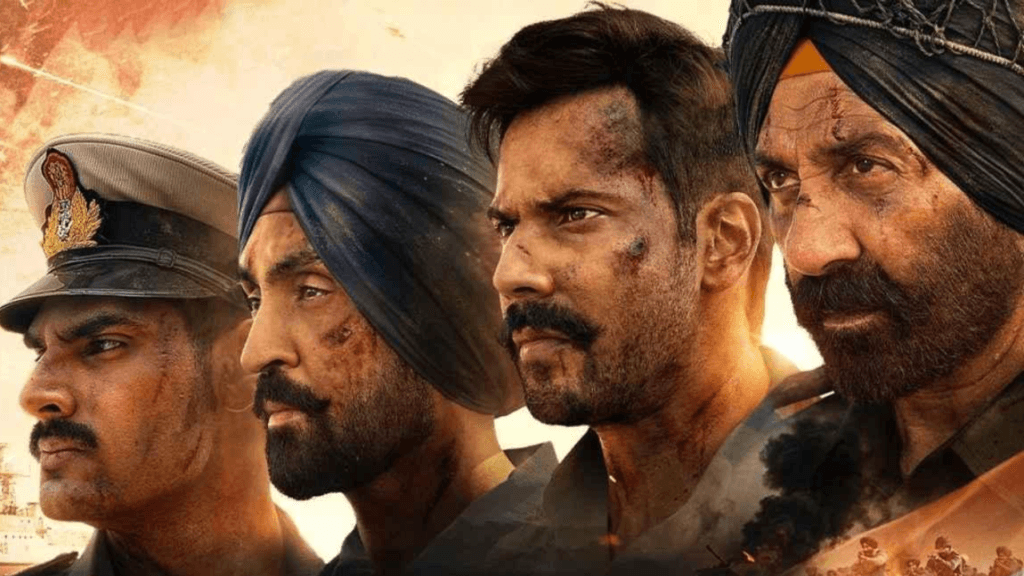
Border 2 opens like a film that very deliberately wants to be felt in a theatre: loud, muscular and constructed to hit emotional beats with the blunt force of patriotic spectacle. Directed by Anurag Singh and released theatrically on 23 January 2026, the film positions itself as a spiritual successor to J.P. Dutta’s 1997 Border, trading the documentary-edge grit of the original for clearer choreography, amplified rhetoric and modern production scale. What emerges is a picture that asks audiences to accept its contract up front — if you come for catharsis, big speeches and battle tableaux staged for maximum crowd reaction, Border 2 delivers; if you come looking for reinvention, you may leave wanting.
The film’s narrative stitches together a battalion-level story with individual backstories and ceremonial patriotism. Rather than a procedural run through tactics, the screenplay alternates frontline engagements with domestic pauses and character moments designed to heighten stakes when the unit is tested. Action is staged for readability rather than handheld chaos; long dialogues and musical swells are used deliberately to unify the film’s emotional aim. The plot framework serves primarily as a scaffolding for set-pieces and rallies — the rescue-and-retreat beats, the unit camaraderie scenes and the climactic push are shaped to produce theatrical applause rather than quiet reflection, a choice reviewers repeatedly emphasise. (Times of India, The Indian Express)
Across prominent publications the critical mood has skewed positive on the film’s own terms: scale, sentiment and the power of performance. Times of India praised Sunny Deol as the emotional anchor who “roars” through the film and helps deliver its cathartic moments, while trade voices such as Taran Adarsh and Bollywood Hungama lauded the movie’s balance of spectacle and feeling. The Indian Express described it as a dignified, flag-forward film that “keeps the flag flying high,” and Hindustan Times called parts of the film thunderous and crowd-pleasing. At the same time, outlets including NDTV and The Hollywood Reporter India framed their approval with caveats, calling the film predictable and noting that its loudness is sometimes its limiting feature rather than its strength. These are not contradictory readings so much as different answers to the same question: does this film aim to move the theatre, or to reimagine the genre? (Times of India; Bollywood Hungama; The Indian Express; Hindustan Times; NDTV; Hollywood Reporter India)
The central cluster of criticism is consistent and straightforward. Several reviewers — most notably Scroll.in and The Hollywood Reporter India — describe the sequel as closer to a retread than a reinvention, arguing that its dependence on familiar rhetorical beats and sometimes overstretched VFX undercuts attempts at novelty. Critics also single out pacing and runtime choices: the film’s deliberate build toward an interval and a set-piece climax creates a long setup that, for some viewers, robs the middle of momentum. Others point to tonal excess: when speeches replace subtle character work, the film’s rhetoric can verge on the ceremonial and the familiar. These reservations are framed, by critics and trade reviewers alike, as foreseeable trade-offs — they are compromises the film makes in service of a specific theatrical ambition. (Scroll.in; Hollywood Reporter India; Times of India)
Performance is the element most critics agree upon. Sunny Deol is repeatedly described as the film’s fulcrum, his presence and delivery anchoring scenes that might otherwise drift into melodrama; reviewers note that his voice and physicality supply much of the film’s intended surge of feeling. Varun Dhawan and Diljit Dosanjh receive steady praise for contributing youthful energy and pathos, and Ahan Shetty and the supporting ensemble are credited with creating the unit cohesion the narrative requires. Trade commentators emphasise moments where individual performances produce genuine, if staged, emotional responses from screenings — the kind of crowd reaction the film is built to elicit. (Taran Adarsh; Bollywood Hungama; Times of India)
Technically the film is designed for in-hall impact. Critics praise the production design, sound and the clarity of action choreography that prioritises legibility over sensory disorientation. Where Border 2 stumbles for some reviewers is in occasional VFX strain and an aesthetic that doubles down on spectacle at the expense of texture; several reviews suggest tighter editing and more restrained effects would have heightened the film’s gravitas. Nonetheless, most critics concede that, judged by its stated aims, the craft largely supports the director’s intention to make a communal, theatre-first experience. (Filmfare; NDTV; Times of India)
The comparison with J.P. Dutta’s 1997 Border is unavoidable and central to the film’s reception. The original remains a cultural benchmark for its rough-hewn realism, ensemble intimacy and documentary like immediacy; Border 2 consciously chooses a different vocabulary. Critics observe that the earlier film’s documentary grit and organic emotional rises are replaced here by staged clarity, music-punctuated sentiment and visual spectacle — a transformation that will please audiences seeking revivalist catharsis but will trouble those for whom the original’s lived-in texture is part of its power. Producer statements and several reviews make clear the intent: this is an homage in tone rather than a literal continuation, and the sequel accepts the burden of legacy rather than trying to escape it. (Indian Express; Scroll.in)
Industry context matters to how critics read Border 2: strong advance bookings and a muscular opening day shifted some reviews into a commercial register, interpreting craft choices through box-office lenses and audience appetite. Trade coverage points to a continuing appetite for emblematic, emotion-first war cinema; critics who view the film through that lens are more inclined to forgive its excesses, while others treat those same excesses as limits on artistic reinvention. (Times liveblog; NDTV)
In closing, critics largely agree that Border 2 is what it declares itself to be: a loud, sincere and often stirring war epic built for theatrical consumption. For viewers who want the revival of broad patriotic melodrama, clear action choreography and a vocal Sunny Deol at the centre, it delivers consistent payoffs. For those seeking nuance, reinvention or the documentary-tuned grit of the 1997 original, it will likely read as a comfortably familiar, if not wholly new, chapter in an enduring franchise.
Principal cast: Sunny Deol, Varun Dhawan, Diljit Dosanjh, Ahan Shetty. Director: Anurag Singh.
Read More: