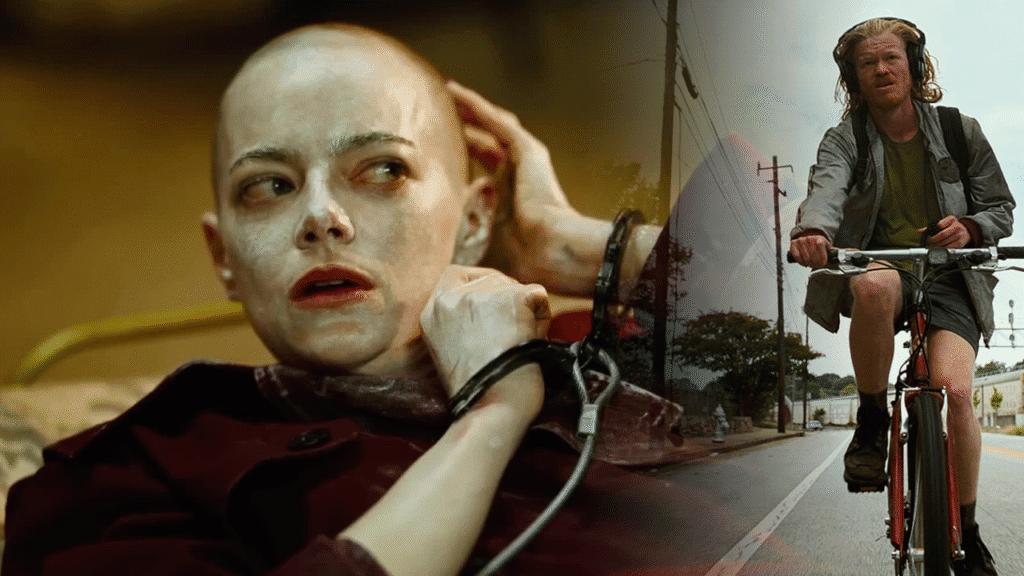
Yorgos Lanthimos’s Bugonia has arrived to strong curiosity and divided admiration — a film that blends dark humor, sci-fi allegory, and psychological absurdity with the signature precision of its director. Reuniting Lanthimos with Emma Stone after The Favourite and Poor Things, this latest collaboration turns myth into modern madness, and audiences can’t stop debating what it all means.
Why Critics Can’t Stop Talking About Emma Stone and Jesse Plemons
The critical response to Bugonia has been intense, wide-ranging, and unmistakably passionate. Most major reviewers admire its ambition, performances, and visual control, even as they wrestle with its meaning.
Variety described the movie as “a heady and gripping experience,” praising Lanthimos’s inventive screenplay and Emma Stone’s “ironically exquisite” performance. The Guardian found it “macabre and amusing,” highlighting Stone’s poise and the film’s surreal tone, particularly its “wonderful montage finale.” Time Out viewed the film as Lanthimos’s “first set in recognisably modern times,” yet argued that beneath its sci-fi surface lies “a high-concept exploitation movie.”
From another perspective, Next Best Picture acknowledged Stone and Jesse Plemons as “exceptional,” but felt the film “dabbles with hot-button topics while refusing to say anything enlightening about them.” RogerEbert.com noted that Bugonia is “an enraged picture — mad at the world and at humanity — but structured with deliberate control.”
At UPI, critics admired the film’s “raw thematic ambition” and the charged chemistry between Emma Stone and Jesse Plemons, calling their interplay “captivating and dangerous in equal measure.” Yet, the review noted that its philosophical edge sometimes “skims the surface of deeper ideas,” leaving some emotional gaps amid its intellectual design.
RogerEbert.com described the film as “mad at the world, mad at humanity,” praising Yorgos Lanthimos’ meticulous framing and control over mood. The critic observed that each composition feels like “a portrait of psychological decay,” turning paranoia into a visual experience.
In contrast, CBR celebrated film’s eccentricity, labeling it “strange, disturbing, cruel, and just plain silly,” yet applauding its fearless blend of absurdity and meaning. The site called it “an eccentric masterpiece” that thrives on contradiction, sustained by the offbeat performances of Stone and Plemons.
Not every review was kind. The Times called Bugonia “a dud,” arguing that despite Stone’s striking transformation, the screenplay feels repetitive and hollow, unable to match its visual ambition.
Together, these perspectives reveal a film that divides and dazzles in equal measure — a cinematic provocation that reinforces Lanthimos’ reputation as one of the most fearless storytellers working today.
Audience Reactions
On Rotten Tomatoes, Bugonia currently holds a 92% score, reflecting broad critical approval. Reviewers have celebrated its craft and audacity, while noting that its allegorical density may confound some viewers.
Over on IMDb, the film stands at 7.9/10, with audience reviews describing it as “a mesmerizing fever dream” and “an uncomfortable but unforgettable experience.”
Social media sentiment mirrors this duality. Viewers on X (formerly Twitter) and Letterboxd have called the film “a symphony of absurdity and empathy,” while others found it “a stunning visual achievement that demands patience.” A few, predictably, remain baffled: “It’s like The Lobster met Arrival and took a philosophy class halfway through.”
The conversation around Bugonia has become a miniature cultural event of its own — filled with admiration, debate, and bewilderment — exactly what one expects from a Yorgos Lanthimos release.
The Stone–Lanthimos Collaboration
Few modern director-actor partnerships have evolved as dynamically as that of Yorgos Lanthimos and Emma Stone. Their creative relationship began with The Favourite (2018), flourished in Poor Things (2023), and now finds new terrain in Bugonia.
In this film, Stone plays Michelle Fuller, a powerful corporate CEO who becomes the target of two men convinced she is an alien intent on destroying Earth. It’s a performance that strips away vanity — Stone shaves her head on screen and oscillates between composure and terror. Her portrayal captures both authority and fragility, making Michelle at once a symbol of modern power and a vessel for existential dread.
Lanthimos has often described Bugonia as “reflective of the real world, despite its absurdity,” and that sensibility shapes Stone’s work here. She brings human texture to an otherwise alienating story, turning cold satire into something deeply felt. This collaboration continues to redefine her as one of contemporary cinema’s most fearless performers and confirms Lanthimos’s rare ability to draw vulnerability from chaos.
The Film’s Creative Core
Bugonia is directed by Yorgos Lanthimos and written by Will Tracy, adapted from the 2003 South Korean cult film Save the Green Planet! by Jang Joon-hwan. The film stars Emma Stone, Jesse Plemons, and Margaret Qualley, with Hong Chau and Willem Dafoe in supporting roles.
Cinematographer Robbie Ryan captures the film’s uneasy beauty with striking precision — alternating sterile corporate interiors with eerie natural landscapes. Production design and costume echo this duality, balancing modern sleekness against organic decay. The music by Jerskin Fendrix, filled with industrial pulses and haunting strings, amplifies the sense of impending collapse.
Produced by Element Pictures, Searchlight Pictures, and Tsamandanis Films, Bugonia retains Lanthimos’s signature creative team. The synergy of recurring collaborators — including Stone, Ryan, and Fendrix — gives the film a continuity of tone that binds his recent works into a distinct cinematic universe of discomfort and desire.
The Art of Madness: Inside Bugonia’s Cinematic Techniques
At the film’s center lies an unnerving blend of performance and precision. Emma Stone anchors the narrative with her most unpredictable turn yet — an emotional spectrum that moves from cold logic to primal fear. Jesse Plemons, as her captor Teddy, delivers one of his career’s most riveting performances: deeply unsettling yet disturbingly sympathetic. His descent into paranoia is played with such conviction that viewers oscillate between horror and pity.
Margaret Qualley and Hong Chau add texture to the story’s outer layers, representing both moral reason and blind faith. Each performance feeds into Lanthimos’s recurring question — how do people behave when reason breaks down?
Visually, the films is a masterclass in tension. Ryan’s cinematography uses wide-angle lenses and off-center compositions to make the audience feel constantly disoriented. Every space feels both familiar and alien — an aesthetic choice that mirrors the story’s theme of humans confronting their own alien nature.
The editing maintains a deliberate rhythm, allowing absurd moments to linger uncomfortably long. The score, with its discordant percussion and haunting vocal hums, blurs the line between ritual and madness.
Thematically, the films examines control, belief, and the fragile boundary between truth and illusion. The title itself — referencing the mythical idea of bees born from dead cattle — suggests transformation through decay, a cycle of destruction and renewal that permeates both the narrative and the characters’ psyches.
Where The Favourite explored hierarchy and desire, and Poor Things examined liberation and identity, Bugonia turns its gaze toward faith and fear. Lanthimos poses the uncomfortable question: in an age of misinformation, can belief itself become the deadliest contagion?
A Beautiful, Bewildering Experience
Bugonia is not designed for comfort or clarity. It’s an experience — by turns hilarious, haunting, and hypnotic. Lanthimos pushes absurdism to its philosophical edge, crafting a film that feels like a mirror held up to the modern psyche. For every viewer who finds it profound, another may find it perplexing, and that’s precisely its power.
Emma Stone and Jesse Plemons deliver performances that anchor the chaos in emotion, while Lanthimos’s craft ensures that even the strangest image feels deliberate. It’s a film to debate, revisit, and argue over — not one to understand in a single sitting.
In the end, Bugonia reaffirms Yorgos Lanthimos’s place among cinema’s boldest visionaries — an artist unafraid to make the audience uneasy, amused, and deeply awake all at once.
Read More: