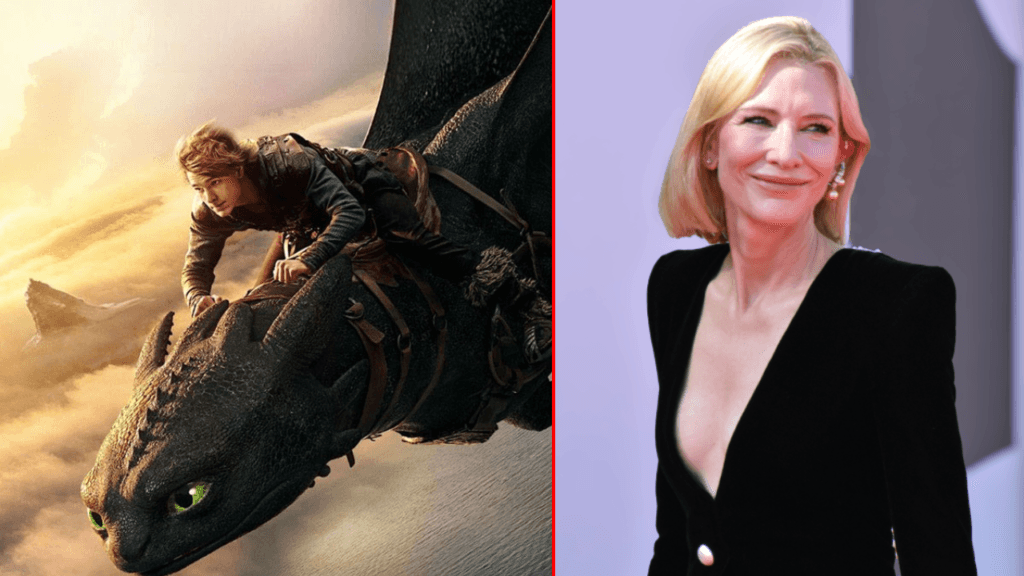
Cate Blanchett has officially signed on to star in the sequel to How to Train Your Dragon, taking on the pivotal role of Valka — Hiccup’s long-lost mother and one of the most consequential characters in the story’s evolution. Her involvement immediately elevates the sequel’s emotional and thematic ambitions, signalling a continuation that is as focused on legacy and family as it is on scale and spectacle.
The How to Train Your Dragon saga began with a deceptively simple idea: a scrawny Viking teen named Hiccup who dares to be different. In a world defined by centuries of hostility between Vikings and dragons, Hiccup’s decision to spare and befriend an injured dragon he names Toothless becomes an act of quiet rebellion. That bond reshapes not just his life, but the fate of an entire society, proving that empathy can dismantle traditions built on fear.
The sequel moves the story forward by five years, allowing the narrative — and its hero — to grow up. Hiccup is now 20, no longer the underestimated outsider but a young man stepping into leadership. The innocence of discovery gives way to responsibility, and the consequences of earlier choices begin to surface. This temporal leap has always been central to what makes the franchise resonate: it allows growth to feel earned, not manufactured.
Valka’s arrival is the emotional turning point of that journey. Having lived for years among dragons, she represents an alternative philosophy to both Viking dominance and uneasy coexistence. Her worldview complicates Hiccup’s understanding of peace, power, and protection, forcing him to reconcile who he has become with where he comes from. Casting Blanchett in the role underscores its importance. Valka is not a narrative accessory; she is a catalyst who deepens the mythology and reframes the story around inheritance — of ideals, of trauma, and of hope.
As the sequel widens its scope, it also sharpens its conflict. The fragile harmony between humans and dragons is threatened by a new antagonist seeking to conquer the world by assembling a dragon army. The shift is deliberate. Where the original story challenged prejudice at a personal level, the sequel confronts the weaponisation of fear and power on a global scale. Dragons are no longer simply misunderstood creatures; they are tools coveted by those who see domination as destiny.
Returning to anchor the sequel is Mason Thames as Hiccup, alongside Nico Parker and Gerard Butler, with Julian Dennison, Gabriel Howell, Bronwyn James, and Harry Trevaldwyn rounding out an ensemble that reflects a world no longer frozen in adolescence. These characters have aged, and so have their dilemmas.
What has always distinguished How to Train Your Dragon from other fantasy franchises is its emotional clarity. Toothless is not merely a creature of awe, but a symbol of trust forged through vulnerability. The films resist the temptation to reduce dragons to spectacle alone, instead using them as mirrors for human fear, greed, and compassion. The sequel’s focus on Valka reinforces that tradition, rooting the story in relationships rather than repetition.
Blanchett’s casting also points to the franchise’s confidence in its own maturity. Rather than chasing novelty for its own sake, the sequel leans into character, consequence, and continuity. It recognises that the most compelling conflicts are not always born from new worlds, but from unresolved truths within familiar ones.
As How to Train Your Dragon moves into its next chapter, the sequel promises more than a return to Berk’s skies. With Valka at its centre, the story positions itself as a meditation on what it means to protect a peace once it has been won — and how easily that peace can fracture when power is pursued without understanding. It’s a reminder that growing up, in this world, is not about abandoning ideals, but learning how fiercely they must be defended.
Read More: