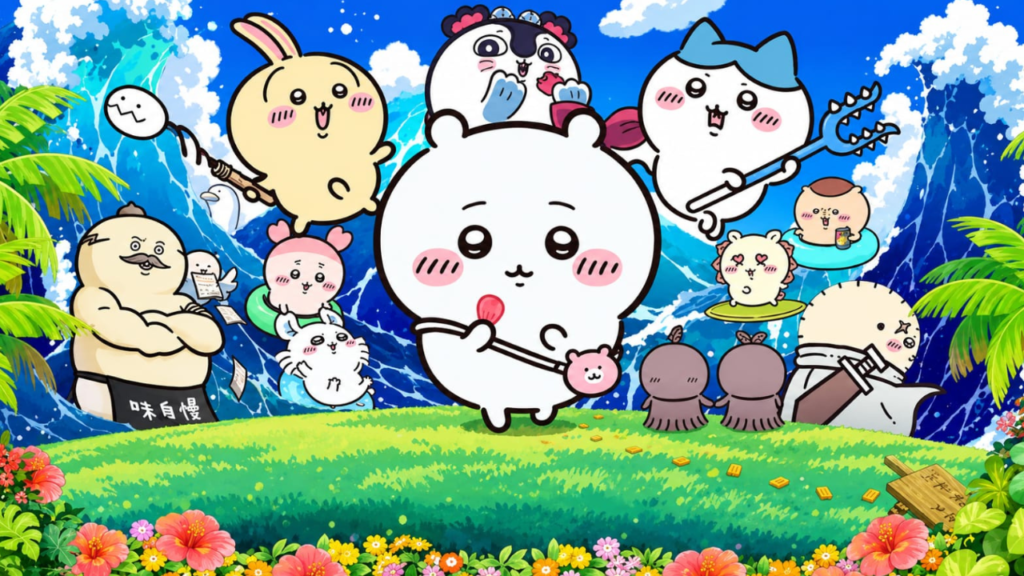
One moment, an irresistibly cute mascot wanders across a sunlit beach. Moments later, that same character stands frozen in the dark, sensing something enormous moving beneath the waves. Few audiences expected that emotional whiplash, and yet it is precisely what has made Chiikawa the Movie: The Secret of Mermaid Island one of the most discussed animated films of the summer. Beneath its adorable character designs lies an unexpectedly unsettling story that quietly transforms a cheerful holiday adventure into a haunting tale of survival, grief and empathy.
For many people in Japan, Chiikawa is impossible to escape. The franchise’s lovable characters decorate handbags, fill arcade claw machines and appear on everything from stationery to T-shirts. Created by the artist Nagano as a web manga that debuted on social media in 2020, Chiikawa quickly evolved into one of Japan’s most recognizable kawaii franchises, spawning a successful anime series and an enormous merchandising empire. Its carefully cultivated image of warmth, innocence and comfort has become inseparable from the brand itself.
That widespread familiarity is exactly what makes The Secret of Mermaid Island so fascinating. Audiences enter the theater expecting another gentle adventure built around lovable mascots, only to find a film willing to explore fear, uncertainty and moral conflict without abandoning the charm that made the characters popular in the first place. Rather than rejecting the franchise’s kawaii identity, the film uses it to amplify its emotional impact, making every unsettling moment feel more surprising because it unfolds through characters viewers instinctively associate with safety and comfort.
The commercial response has been equally remarkable. Since opening in Japanese theaters on July 24, the franchise’s first feature film has become a major box office success, earning approximately ¥990 million on its opening day before reaching around ¥2.24 billion by the end of its opening weekend. Selling well over 1.5 million tickets, the film debuted at No. 1 nationwide and remained strong throughout the school holiday period, holding screens against major international competition. For a franchise that began as a series of online sketches, its theatrical performance represents an extraordinary milestone.
Its success also reflects a broader trend within Japanese animation, where theatrical releases increasingly appeal to audiences across multiple age groups rather than targeting children alone. Like several recent animated hits, The Secret of Mermaid Island blends accessible character designs with emotionally complex storytelling, demonstrating that family-friendly animation can also explore mature themes without sacrificing its broad appeal. While the uploaded source does not compare it directly with other films, its commercial success and thematic ambition illustrate the growing confidence of Japanese animated features in reaching diverse audiences.
What makes the film particularly distinctive is not that it suddenly becomes frightening, but how patiently it builds unease. There are no conventional horror tropes, no graphic violence or obvious jump scares. Instead, the atmosphere gradually shifts through silence, uncertainty and the persistent feeling that something about Mermaid Island is fundamentally wrong. What begins as a dream vacation—complete with beaches, festivals and endless bowls of limited-edition ramen—slowly transforms into a mystery involving disappearances, ominous warnings and the legend of a massive Siren connected to the island’s darkest secret. By the time the story fully reveals itself, the cheerful holiday has become something far more emotionally unsettling.
That gradual transformation is what gives the film its lasting impact. Rather than relying on a single frightening sequence, it accumulates small moments of unease until viewers begin questioning every quiet corner of the island. Grief quietly coexists with moments of joy, while the story’s central antagonist gradually emerges not as a monster to be defeated, but as a tragic figure shaped by loss and circumstance. The result is less a conventional fantasy adventure than an emotional meditation on fear, survival and compassion disguised as a family film.
The characters carry those emotional themes with remarkable subtlety. Chiikawa, small and easily overwhelmed, repeatedly confronts fear despite his uncertainty. Hachiware provides calm reassurance, while Usagi’s unpredictable humor offers welcome relief from the mounting tension. Supporting characters including Momonga, Kurimanju and Shiisaa contribute warmth and stability, while the Sirens themselves become the film’s most compelling creation—figures driven not simply by menace, but by sorrow, history and understandable motivation.
By the time the credits roll, it becomes clear that Chiikawa the Movie: The Secret of Mermaid Island is about far more than a mysterious island or an unexpected monster. Beneath its bright colors and adorable mascots lies a thoughtful exploration of survival, sacrifice, empathy and the fragile line between revenge and grief. Its greatest achievement is making audiences smile at characters they instinctively want to protect while quietly making them fear for their safety at the very same time. That emotional contradiction is what transforms The Secret of Mermaid Island from another successful franchise film into one of the year’s most distinctive animated features.
Read More:
- Spotlight: Making Injustice Heard in a World of Untouchable Power
- Harry Potter and the Question Every Reboot Must Answer
- Good Films Are Often Bad Experiences
- Top 10 Sequels That Elevated Cinema: When Hollywood Got Better the Second Time
- How much does responsibility seep into filmmaking? Or does it at all?