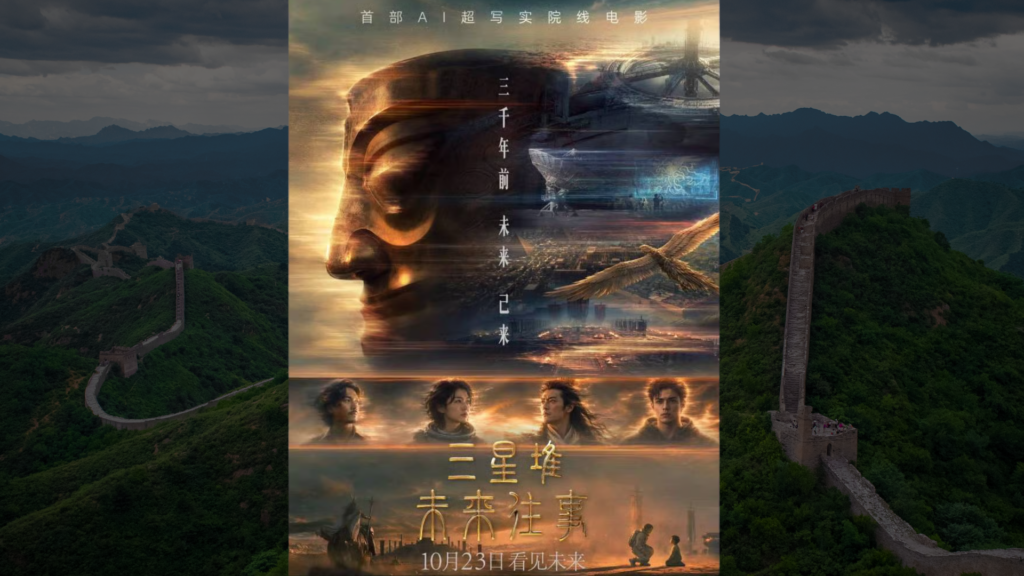
China’s first fully AI-generated feature film, Sanxingdui: Future Past, opened in cinemas on October 23, with more than 10,000 screenings scheduled across the country. However, its theatrical debut has been accompanied by weak advance bookings, raising questions about whether technological innovation alone can persuade audiences to pay to watch an AI-generated film on the big screen.
According to ticketing platform Maoyan, advance bookings stood at just 65,000 yuan (approximately $9,700) on Thursday evening, while the film’s projected box-office collection remained below 100,000 yuan. Produced by Bona Film Group over more than two years, the 100-minute science-fiction feature represents a significant development in AI-assisted filmmaking. Its early commercial performance, however, highlights the challenge of converting a technological milestone into a theatrical success.
The film’s premise combines ancient Chinese civilisation with a future threatened by artificial intelligence. Drawing on the mysteries of Sanxingdui, an archaeological site known for its distinctive bronze artefacts, the story follows an archaeologist who discovers a hidden binary code within 3,000-year-old bronze inscriptions. The discovery could hold the key to saving humanity from a global crisis triggered by a super AI.
The premise places artificial intelligence at the centre of both the film’s production and its narrative conflict. The technology used to create the film’s digital world also becomes the source of the threat facing its characters, establishing a contrast between AI as a creative tool and AI as a potential danger.
Bringing Sanxingdui: Future Past to cinemas also exposed a gap in China’s film classification framework. Although the film received its public screening licence, known as the Dragon Label, from the National Film Administration, it had to be classified as an animated feature. This was attributed to the absence of a separate regulatory category for AI-generated films, rather than simply to the film’s visual style.
The approval establishes a route for an entirely AI-generated feature to receive a theatrical release under the existing framework. At the same time, the classification highlights how regulatory systems must adapt as filmmaking technologies develop. The film’s release therefore represents a milestone not only for production methods but also for the way such projects are accommodated within existing cinema regulations.
The production process behind the film involved considerably more work than simply entering prompts into an AI system and assembling the resulting images. Nearly 100 people worked on the project for more than two years. During that period, the team generated over 1.2 million preliminary images and created more than 100 full iterations of the film before finalising the visuals.
Tools including ByteDance’s Jimeng AI were used to generate the film’s digital elements. According to the production details provided, no physical cameras or live-action performers were used. The creators also said that every character was an original digital creation rather than a copy of a real actor.
These figures indicate the scale of the work involved in producing the feature. Despite the use of generative AI, the project required a substantial production effort, repeated visual development and a team working over an extended period. The production process also demonstrates that the use of AI does not necessarily eliminate the need for extensive human involvement in developing a feature-length film.
Bona Film Group reported production costs exceeding 10 million yuan (around $1.5 million). Against that investment, the advance bookings reported before the film’s opening were modest. Although more than 10,000 screenings were scheduled, the scale of the theatrical rollout had not translated into comparable early audience demand.
The figures remain an early indication rather than a final measure of the film’s commercial performance. Advance bookings and projected collections can change after a film opens, and its subsequent performance will provide a clearer picture of audience interest. Nevertheless, the initial numbers illustrate the difference between securing a theatrical release and attracting paying moviegoers.
The response is particularly notable given China’s growing consumption of AI-generated entertainment. AI-generated short dramas reportedly attracted more than 200 billion views on Douyin, the country’s equivalent of TikTok, in September alone. That level of engagement suggests that AI-generated content has already found a substantial audience in short-form digital entertainment.
However, the viewing habits associated with short videos differ from those involved in watching a feature film in a cinema. Short-form content offers quick entertainment on a phone and can often be consumed without a separate payment for each video. A cinema ticket represents a more deliberate commitment of both time and money. Audiences must see value in the story, characters and overall viewing experience before deciding to attend a screening.
That distinction may be important for Sanxingdui: Future Past. Its production method gives it a clear technological identity, but the scale of its AI-generated imagery and the novelty of its format do not automatically establish audience demand. The film must compete for attention as a feature-length story, not simply as a demonstration of what generative AI can produce.
The opening therefore presents an important test for AI-generated cinema in China. Sanxingdui: Future Past has crossed the technical and regulatory barriers required to bring an entirely AI-generated feature into theatres. Its early ticket-sales figures, however, suggest that technological achievement and commercial appeal are separate challenges.
As the theatrical run continues, the film’s eventual performance will offer a more complete indication of whether audiences are willing to support this form of filmmaking at the cinema. AI may expand the possibilities available to filmmakers, but the early response to Sanxingdui: Future Past underlines a familiar requirement of theatrical entertainment: audiences still need a compelling reason to buy a ticket.