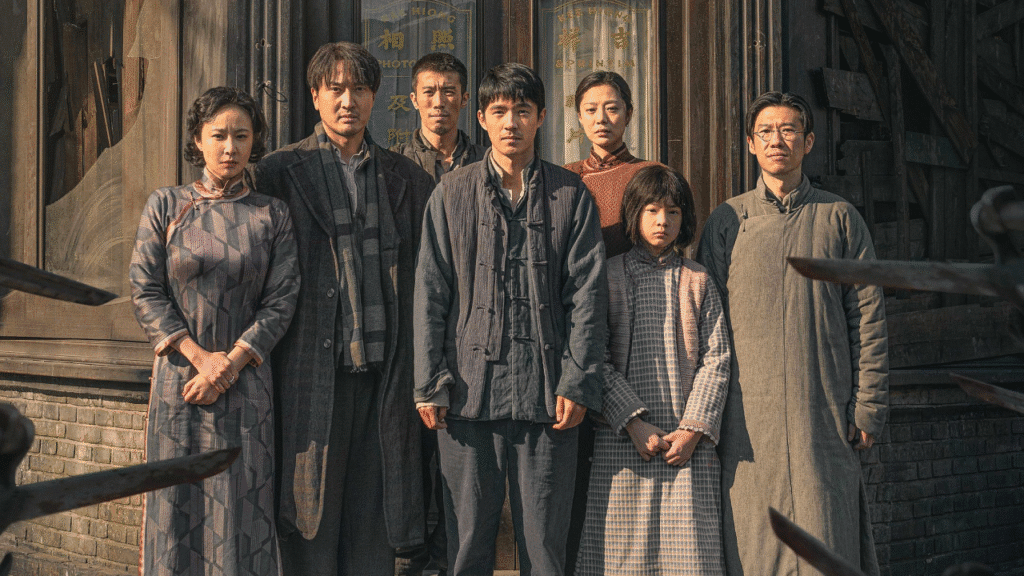
Dead to Rights begins not with sweeping historical exposition but with the intimate disintegration of ordinary life. Set against the backdrop of the 1937 Nanjing Massacre, the film follows a small constellation of civilians who find themselves trapped inside a city collapsing under imperial violence. Instead of tracking large-scale military maneuvers, the narrative focuses on families torn apart, individuals forced into unthinkable choices, and moments of fleeting humanity amid devastation. The terror unfolds through cramped interiors, ruined streets, makeshift shelters, and places once considered safe but now stained with the specter of death. Children search for their parents, nurses fight to protect the wounded with dwindling supplies, and survivors cling to moral clarity even as the world around them abandons it.
The film’s storyline refuses to dilute atrocity. Its emotional spine is built on the experiences of a few key individuals whose perspectives anchor the audience in the immediacy of fear. Their arcs are shaped by impossible dilemmas: the desire to protect loved ones, the guilt of surviving when others cannot, and the haunting awareness that each passing hour is one stolen from the jaws of violence. This narrative intimacy gives Dead to Rights its extraordinary power — transforming a historical event of unimaginable scale into a story lived, felt, and endured one breath at a time.
A Film That Confronts, Not Comforts
The conversation around Dead to Rights has intensified each week not because the film is comforting, but precisely because it rejects comfort as a storytelling premise. Its dramatization of the Nanjing Massacre blends personal tragedy with historical urgency, positioning the film as part of a contemporary cinematic movement determined to reclaim memory from emotional distance. China’s selection of Dead to Rights as its official entry for Best International Feature Film at the 98th Academy Awards (Global Times) has only amplified its visibility on the world stage, pushing it into global discussions about responsibility, representation, and ethical storytelling in wartime cinema.
From its earliest frames, the film announces its visual and emotional intent. Dust and smoke dominate the screen. Movement is captured through a tense, handheld immediacy. Shadows fall across faces in ways that make the past feel disturbingly present. Rather than relying on speeches or historical explanation, the film immerses the viewer directly into chaos — allowing lived horror to speak louder than political rhetoric. Some critics have noted that the emotional crescendos occasionally approach sensationalism, but the broader consensus is that the film’s commitment to realism grounds even its most intense moments.
The film’s production design provides a visceral sense of place — buildings splintered by artillery, streets lined with corpses, shelters overflowing with terrified civilians. This is not a stylized rendition of the past. It is a cinematic excavation of a wound that still bleeds across generations.
What the Critics Are Saying
Among the most detailed early reactions comes from James Marsh of the South China Morning Post, who calls Dead to Rights “a powerful account of one of history’s most egregious events.” Marsh acknowledges moments where the film “verges on sensationalism,” but concludes that its emotional weight, honesty, and technical rigor ultimately shape a profoundly affecting experience. He highlights the meticulous production design, which reconstructs the occupied city with oppressive, near-documentary realism.
Panos Kotzathanasis of Asian Movie Pulse writes about the film’s delicate tonal balance. While he observes flashes of melodrama and patriotic intensity — common pitfalls in war cinema — he notes that the film avoids reducing Japanese soldiers to one-dimensional villains. This refusal to flatten history into simple binaries stands out as one of the film’s greatest strengths, reinforcing its commitment to human complexity.
Carla Hay of Culture Mix praises the film as “harrowing and impactful,” commending its focus on emotional realism instead of political grandstanding. For Hay, the film succeeds because it refuses to mythologize trauma or package violence into cinematic spectacle. Its horror is rendered plainly, recognizably, and with an unvarnished honesty.
Avi Offer of NYC Movie Guru is unequivocal in his admiration, calling Dead to Rights “a triumph” — one of the most accomplished representations of the Nanjing Massacre ever put to screen. His review emphasizes the film’s restraint, arguing that its most devastating moments strike harder precisely because they never feel manipulative.
In Variety, critic Richard Kuipers describes Dead to Rights as a “stirring drama” built on the tension between human decency and the unrelenting brutality of war. He highlights the film’s gripping portrayal of an ordinary postal worker who becomes an inadvertent photographic witness to atrocity, navigating danger with quiet resolve. Kuipers notes that the film oscillates between suffocating, close-quarter tension and sweeping large-scale recreations of the fall of Nanjing, giving the narrative both emotional precision and historical scope. While he points out that the final act veers slightly into melodramatic patriotic messaging — softening the otherwise unsparing realism — Kuipers concludes that the film remains a “potent reminder” of how images captured in moments of terror can become lasting instruments of truth and justice.
On Rotten Tomatoes, the film currently holds a 97% critics’ score, with praise centered around its unflinching portrayal of violence and its refusal to soften the record of history to suit modern sensibilities.
Audience Reactions: Emotional Reverberations Across Borders
For audiences, the experience of watching Dead to Rights has been described as overwhelming, haunting, and unforgettable. Many viewers report that the film lingers long after the credits roll, its images refusing to leave the mind. The emotional intensity has sparked a divide — some praise its honesty while others find the experience nearly unbearable — but even this division reflects the raw power of the narrative.
According to City News Service, the film earned an 7.9 Rating on IMDB and 8.6 on Douban, making it one of the best-received war dramas of recent years in China. The domestic praise laid the foundation for its wider international expansion and its journey through festival circuits leading to its Oscar submission.
Across platforms, viewers highlight similar themes: the film’s staggering realism, its refusal to compromise emotional integrity, and its insistence that remembering atrocities requires discomfort, not escapism.
Craft, Direction & Cinematic Architecture
Dead to Rights is constructed with a level of craft that refuses embellishment. Its direction embraces immediacy; its cinematography blends harsh natural light with shadowed interiors; its editing privileges breath, silence, and sudden eruptions of violence. Dialogue is often sparse, replaced by the sounds of bombs, footsteps, and panic echoing across broken stone.
The director’s approach rejects spectacle in favor of immersion. Scenes linger on faces, on trembling hands, on bodies moving through the wreckage with instinct rather than plan. The camera observes rather than dramatizes. Even in its most violent moments, the film adheres to a rigorous emotional discipline that allows horror to unfold without romanticization.
The production design reconstructs Nanjing with painstaking authenticity. Costumes are worn, frayed, and stained with smoke. Interiors feel cramped and suffocating. Streets buckle under the weight of destruction. Every department works toward the same unified goal: to bring the audience into history not as distant spectators but as unwilling witnesses.
Dead to Rights: Cast & Crew
The film is directed by Shen Ao, a Beijing Film Academy graduate who, over years of research and artistic rigor, sculpted this harrowing narrative with a clear commitment to historical truth. The screenplay is credited to Xu Luyang, Zhang Ke, and Shen Ao himself.
On screen, the ensemble is led by Liu Haoran, who plays Su Liuchang (A-Chang), a postman turned covert developer in wartime Nanjing. Wang Chuanjun portrays Wang Guanghai, a translator caught between collaboration and conscience. Gao Ye plays Lin Yuxiu, Wang Xiao embodies Jin Chengzong (the photography-studio owner), Zhou You is Song Cunyi, Yang Enyou plays Jin Wanyi, and Daichi Harashima is cast as the Japanese military photographer Hideo Itō.
A Film That Forces Us to Look
Dead to Rights is not designed for comfort, catharsis, or easy conversation. It is constructed as a reckoning — a cinematic insistence that the horrors of the Nanjing Massacre must not be softened, simplified, or forgotten. Its critical acclaim, audience resonance, and awards momentum all point toward a film destined to endure for years to come.
By embracing emotional realism, ethical responsibility, and narrative intimacy, Dead to Rights stands as one of the most urgent and devastating historical dramas of the decade — a film that demands we remember not only with our minds but with our hearts.