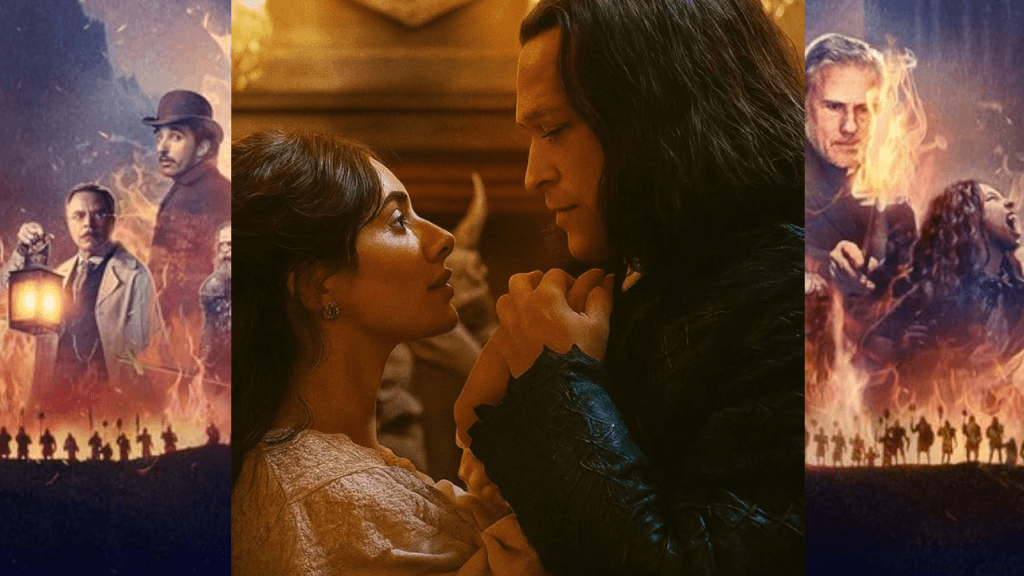
Dracula: A Love Tale arrives carrying the weight of one of literature’s most revisited myths—and critics across global publications are largely unconvinced that this latest retelling needed to exist at all. Directed by Luc Besson and released in the U.S. by Vertical on February 6, the film has been met with a predominantly negative-to-mixed critical response, framed less around outrage and more around exhaustion. Reviewers repeatedly describe it as visually ornate but narratively hollow, a gothic romance that arrives late to a conversation cinema has already moved past.
At a basic level, Dracula: A Love Tale revisits familiar territory: the immortal vampire, doomed romance, and a heavily stylised vision of 19th-century Europe. Besson sets his version amid an exaggerated, hyper-designed Paris, leaning hard into colour, costume, and theatrical staging. Yet from the outset, critics argue that the film’s storytelling feels as overfamiliar as its source material. Rather than reinterpreting Bram Stoker’s novel through a new emotional or thematic lens, the film is widely seen as circling well-worn ideas without discovering fresh urgency.
The global critical consensus is remarkably aligned. While publications differ in tone—from measured disappointment to outright dismissal—they converge on the same core assessment: Dracula: A Love Tale looks far better than it feels. IndieWire described it as a “narratively tedious and contrived” work that drains even Besson’s considerable visual flair, while The Guardian summarised the experience more bluntly, calling it “all surface, very little bite.” Variety, striking a more restrained note, acknowledged Besson’s enduring eye for spectacle but argued that the storytelling remains emotionally thin and overworked. Across The Hollywood Reporter, RogerEbert.com, and Screen Daily, similar language recurs—handsome, elaborate, but dramatically inert.
One comparison critics return to again and again is with Nosferatu. In a cinematic landscape still reverberating from Robert Eggers’ austere, dread-soaked reimagining of vampire mythology, Besson’s flamboyant approach feels oddly misplaced. Reviewers argue that where Nosferatu embraced restraint, silence, and atmosphere, Dracula: A Love Tale leans into excess and explanation. IndieWire noted that Eggers’ film understood the power of withholding, while Besson’s version insists on spelling everything out. The Guardian echoed this distinction, suggesting that where Nosferatu chills, Besson’s film merely decorates. The shadow of recent gothic cinema looms large, and critics largely agree this film struggles to step out of it.
The screenplay is the focal point of most criticism. Reviewers repeatedly highlight Besson’s tendency to over-explain his narrative, mistaking literary density for emotional depth. Variety argued that the film confuses ornate dialogue and excessive detail with sincerity, while The Hollywood Reporter observed that the script refuses to trust the audience’s ability to feel rather than be told. Emotional beats are described as announced rather than earned, and the romance at the story’s core rarely convinces critics that its intensity is justified. Screen Daily put it succinctly, noting that the film’s craft outpaces its emotional intelligence.
This reception has prompted a broader reassessment of Luc Besson as an auteur. Once celebrated for bold, imaginative works like The Fifth Element, Besson is now seen by many critics as a filmmaker whose visual instincts remain sharp while his writing discipline has weakened. Variety described him as a maximalist increasingly unchecked, and The Hollywood Reporter framed Dracula: A Love Tale as an example of indulgence without sufficient counterbalance. The film, critics suggest, reflects a director enamoured with his own imagery but less attentive to emotional coherence.
Performances have not escaped scrutiny, particularly that of Caleb Landry Jones. His portrayal of Dracula has been widely characterised as extreme and camp-leaning, with many reviewers arguing that it distracts more than it disturbs. IndieWire described the performance as tipping into excess, while The Guardian suggested it veers toward caricature. Variety acknowledged the boldness of the choice but questioned whether the film ever integrates it into a consistent tonal framework. A small minority of critics defend the performance as intentionally grotesque, but even these voices concede that it clashes with the film’s self-serious romantic ambitions.
Where critics do find near-universal agreement is in the film’s visual design. The production values, elaborate sets, and saturated colour palettes are frequently praised as striking and ambitious. Besson’s version of Paris is undeniably lavish, a world of heightened artifice and fantasy. Yet this praise almost always arrives with a caveat. As RogerEbert.com noted, the film looks expensive and literary, but rarely feels alive. Reviewers argue that the visual splendour ultimately floats free of the story, creating a sense of aesthetic detachment rather than immersion.
This disconnect feeds into a broader critique of tonal confusion. Critics question what kind of film Dracula: A Love Tale wants to be. It is not frightening enough to function as horror, not emotionally persuasive enough to succeed as romance, too earnest to play as camp, and too exaggerated to achieve tragic weight. Empire summed up this tension by calling the film more baroque than biting, an indulgence that sacrifices tension for ornamentation. The result, many reviewers conclude, is a work stranded between genres, unable to fully commit to any of them.
In terms of release context, the film’s rollout has done little to counter this perception. Distributed by Vertical with a modest theatrical presence, Dracula: A Love Tale has generated limited box-office conversation, with critics framing it more as a curiosity than an event. Its arrival amid stronger, more distinctive gothic cinema has further diluted its impact, reinforcing the sense that the film exists on the margins rather than at the centre of contemporary genre discourse.
By the end of its critical run, the consensus around Dracula: A Love Tale is clear. Reviewers see it as a visually ornate but emotionally underpowered retelling that struggles to justify its place in a crowded cinematic lineage. While it may appeal to devoted Besson admirers or viewers drawn to maximalist gothic aesthetics, most critics regard it as a relic rather than a reinvention—a film that mistakes decoration for depth and arrives long after the genre has moved on.
Dracula: A Love Tale is directed by Luc Besson, stars Caleb Landry Jones, and was released in U.S. theatres on February 6, 2026, by Vertical.
Read More Review Roundups on POF