
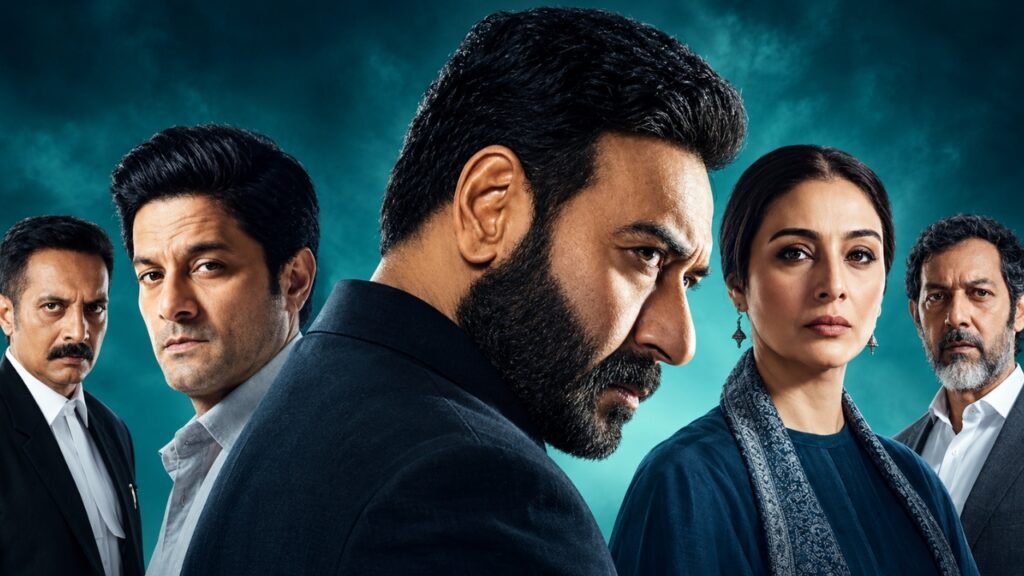
“Drishyam: The Conclusion,” the third and reportedly final installment in the Hindi “Drishyam” franchise, released in theatres on October 2 and has received a largely positive, though occasionally divided, critical response. Directed by Abhishek Pathak, the film brings back Ajay Devgn as Vijay Salgaonkar, with Jaideep Ahlawat joining the franchise as a formidable new adversary and Tabu reprising her role as former IG Meera Deshmukh. Most reviews agree that the film works as a satisfying, crowd-pleasing conclusion to the eight-year saga, although some critics have pointed to weaknesses and implausibilities in its plotting.
Set six months after Vijay once again outsmarted the police and Meera Deshmukh, the film introduces a new Crime Branch officer, SP Rajveer Singh Tomar, a metaphor-loving outsider who reopens the long-buried case. As Tomar begins examining the loopholes left behind in the Salgaonkar family’s story, including ordering DNA tests of the space beneath the police station that had previously gone unchecked, Vijay is forced into another escalating battle of wits to protect the family he has spent years shielding from the truth.
Several critics responded warmly to the film. The Hollywood Reporter India’s Rahul Desai called it a surprisingly satisfying watch, arguing that, freed from constant comparisons with its Malayalam counterpart, the Hindi franchise has finally become comfortable in its own identity. He described the film as mainstream Hindi storytelling without the baggage of parity, suggesting that after eight years of following the Salgaonkar family’s increasingly complicated attempts to escape the consequences of the original case, the new film feels more liberated in both form and spirit.
The Indian Express critic Shubhra Gupta gave the film 3 out of 5 and titled her review “Ajay Devgn Owns the Screen in a Gripping Finale.” India.com was more enthusiastic, awarding the film 4 stars and calling it a gripping finale that lives up to the expectations surrounding the franchise. Trade analyst Taran Adarsh rated it 4.5 stars and called it the best film in the franchise so far, specifically highlighting the courtroom sequences as a major strength.
Across the reviews, Ajay Devgn’s performance emerges as one of the film’s most consistently praised elements. Desai noted that Devgn’s trademark restraint works particularly well for a character who needs to be more difficult to read than ever. Vijay’s limited expressions become part of the storytelling, with even small changes in his face carrying significance. India.com similarly observed that Devgn makes Vijay’s constant calculations visible without over-explaining them, giving the character’s silences considerable weight.
Desai also highlighted Vijay’s cinephile instincts. The character remains a writer and lifelong movie buff, and the film uses that aspect of his personality for its rainy flashbacks, unreliable-narrator techniques and self-conscious voiceovers. The approach adds another layer to a franchise that has always placed considerable importance on Vijay’s ability to anticipate how the system and the people around him will respond to his actions.
Jaideep Ahlawat’s addition to the franchise has also received consistent praise. Both Rahul Desai and India.com singled out the face-off between Ahlawat and Devgn as one of the film’s major highlights. Desai specifically pointed to a scene during daughter Anju’s rishta meeting, where Ahlawat’s character enters the family’s living room and shifts into what the critic described as “Hans Landa in Inglourious Basterds mode.” He called the sequence one of the film’s best scenes.
India.com similarly praised Ahlawat’s character for approaching the case with determination and a sharp understanding of the evidence, creating a genuine counterpoint to Vijay’s patience and calculated approach. According to aggregator Sacnilk, which compiled nine critic reviews into a consensus score of 69 out of 100, the Devgn-Ahlawat confrontation and the courtroom sequences were among the most consistently praised elements of the film. Prakash Raj’s performance as a cocky, chain-smoking lawyer was also singled out in the consensus.
Several reviews also noted the film’s reliance on self-aware, meta humour to acknowledge the repetition inherent in a third installment. Rahul Desai highlighted sub-inspector Gaitonde, played by Kamlesh Sawant, as the primary vehicle for these jokes. The character comments on being the only surviving figure from the original case while successive bosses come and go, and even compares Vijay to his own wife in the familiarity-breeds-contempt dynamic surrounding the character.
Desai also observed that the film openly incorporates its own franchise fatigue into the story. Gaitonde’s jokes about October 2, the film’s actual release date, becoming a humiliating annual anniversary for the Goa police force function as a self-aware reference to the series’ longevity and commercial status.
Tabu’s return as Meera Deshmukh was generally acknowledged, although some critics felt the role gives her limited material. Desai argued that there is only so much Tabu can do this time, suggesting that the first film had already exhausted much of Meera’s emotional arc in 2015. He was more positive about the rest of the supporting cast, noting that Shriya Saran’s unusual dialogue delivery as Nandini is cleverly deployed during one of the film’s major twists. Rajat Kapoor, meanwhile, gives the grieving parents’ decision to reopen the old case a strong emotional justification through the unresolved grief of losing a child without answers.
Not every critic was fully convinced by the film’s storytelling. Scroll.in’s Nandini Ramnath offered a more critical assessment in her review, titled “Vijay Salgaonkar Faces a New Adversary, But Barely.” She argued that in attempting to close the loopholes left by the Malayalam original, the Hindi film introduces convoluted twists of its own. She specifically questioned the plausibility of a judge delivering a verdict with startling haste without properly weighing the evidence, even within the heightened world of the franchise.
Ramnath also noted that the title’s emphasis on “The Conclusion” suggests an intention to close the door on further sequels, although the ending still leaves room for a potential fourth installment. Despite her reservations, she acknowledged that the film remains slickly filmed and fleet despite its 150-minute runtime, giving it credit for taking its “Conclusion” subtitle seriously.
The Hindu’s review, titled “Ajay Devgn and Jaideep Ahlawat Play to the Gallery in a Gripping Finale,” similarly acknowledged the film’s theatrical and crowd-pleasing instincts while finding the overall experience gripping enough to recommend. Rahul Desai’s review also returned to a broader question surrounding Vijay’s character, arguing that the film never allows him to cross fully into genuinely dark antihero territory. Even when the story briefly suggests that possibility, Vijay’s humanity remains intact, helping preserve the audience’s identification with him.
Desai also highlighted the climactic courtroom-and-cemetery intercutting, arguing that the sequence is extended for as long as the film believes its audience will continue responding to it. His broader reading is that “Drishyam: The Conclusion” is ultimately built around the finality of a lie rather than the return of a truth, functioning primarily as an entertaining, showboating cat-and-mouse thriller rather than a film that prioritises the full weight of its themes.
Taken together, the reviews present “Drishyam: The Conclusion” as a franchise finale that understands the expectations surrounding Vijay Salgaonkar and delivers the courtroom confrontations, twists and character dynamics that audiences have come to associate with the series. Ajay Devgn’s controlled performance, Jaideep Ahlawat’s presence as the new adversary, the self-aware humour surrounding the franchise’s longevity and the courtroom-heavy final act are among the elements most frequently praised. At the same time, critics such as Nandini Ramnath have questioned some of the film’s convoluted plotting and individual story choices.
The overall critical response therefore remains largely positive, with some differences in how reviewers assess the film’s writing and plausibility. For many critics, its theatrical energy and performances make it an effective send-off for the Hindi “Drishyam” trilogy, while others see its plotting as less convincing when examined closely. The ending closes much of Vijay’s story while leaving enough room for speculation about another chapter, despite the film’s stated position as a conclusion.
Watch Trailer:

Film Details: Drishyam: The Conclusion
Director: Abhishek Pathak
Writers: Abhishek Pathak, Aamil Keeyan Khan, Parveez Shaikh
Cast: Ajay Devgn, Tabu, Jaideep Ahlawat, Shriya Saran, Rajat Kapoor, Prakash Raj, Kamlesh Sawant
Runtime: 150 minutes
Language: Hindi
Release Date: October 2, 2026
Read More Review Roundups on POF