May 18 turned into one of the most energetic screening days of the 79th Cannes Film Festival, with several major titles drawing strong reactions from audiences and critics. The day brought together Cristian Mungiu’s emotionally charged Fjord, Nicolas Winding Refn’s stylized genre return Her Private Hell and Arthur Harari’s strange Competition title L’inconnue, also known as The Unknown.
Together, the films gave Cannes a striking mix of moral drama, neon nightmare and surreal body-swap cinema. If some festival days are defined by one breakout title, May 18 stood out because multiple films generated conversation for very different reasons.
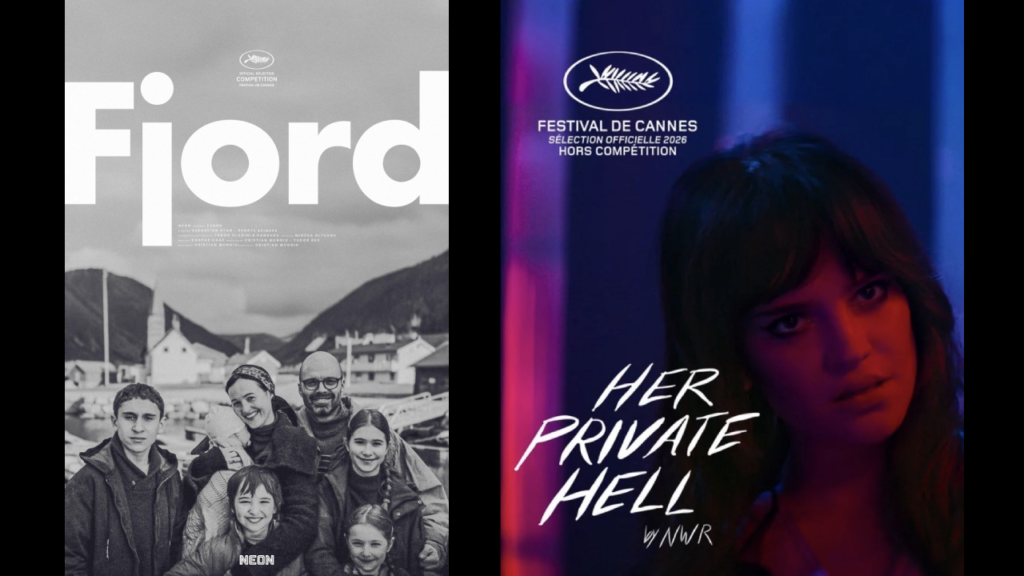
Cristian Mungiu’s Fjord appeared to deliver the biggest emotional moment of the day. The film premiered in Competition and received one of the longest ovations of Cannes 2026 so far, with reports placing the response at around 10 to 12 minutes. Deadline and The Hollywood Reporter described it as a 12-minute standing ovation, while Variety reported a 10-minute response.
The ovation was significant not only because of its length, but because of the filmmaker behind the film. Mungiu is one of the most respected European auteurs of the last two decades, having won the Palme d’Or for 4 Months, 3 Weeks and 2 Days. His return to Cannes Competition naturally carried weight, and Fjord now appears to be one of the serious conversation pieces of this year’s festival.
The film stars Sebastian Stan and Renate Reinsve, a pairing that immediately gives the project international visibility. Stan, who has continued to build a varied career between mainstream projects and auteur-driven work, reportedly appeared emotional during the ovation. Reinsve, widely admired since The Worst Person in the World, brings another layer of festival prestige to the film.
Early descriptions position Fjord as a disturbing family drama and a morally charged work that puts ethics under pressure. That places it firmly within Mungiu’s cinematic world, where personal choices are rarely isolated from social, institutional and emotional consequences. His films often ask difficult questions without offering easy answers, and Fjord appears to continue that tradition.
The film’s strong Cannes reception could make it a major awards and festival-circuit title in the months ahead. Long ovations do not always guarantee universal critical agreement, but in Cannes they do shape early narratives. For Fjord, the immediate narrative is clear: Mungiu has returned with a film that moved the room.
If Fjord gave the day its emotional centre, Nicolas Winding Refn’s Her Private Hell gave it a jolt of genre electricity. The film screened Out of Competition and marked Refn’s first feature since The Neon Demon in 2016. For a filmmaker known for stylized violence, neon-lit dread and polarizing visions, the Cannes return itself was enough to generate curiosity.
Her Private Hell reportedly drew a lengthy standing ovation, though the exact duration varies across reports. Variety reported a seven-minute ovation, while some outlets cited a 12-minute response. Either way, the film clearly made an impact, especially as an Out of Competition title bringing midnight-style energy into the festival’s main conversation.
The film stars Sophie Thatcher and Charles Melton, with a wider cast that includes Havana Rose Liu, Kristine Froseth, Dougray Scott, Diego Calva, Shioli Kutsuna, Aoi Yamada and Hidetoshi Nishijima. The ensemble reflects Refn’s global-facing approach to a story that appears to blend horror, fantasy and apocalyptic urban dread.
According to the official Cannes synopsis, Her Private Hell begins when a mysterious mist engulfs a futuristic metropolis and unleashes a deadly entity. A troubled young woman searches for her father, while her path collides with an American GI trying to rescue his daughter from Hell. It is the kind of premise that fits Refn’s fascination with mythic violence, damaged souls and nightmarish visual worlds.
The film’s trailer, released around its Cannes premiere, leaned heavily into Refn’s signature visual language: heightened colour, ominous atmosphere and a sense of danger that feels both physical and psychological. After years spent working in series formats such as Too Old to Die Young and Copenhagen Cowboy, Her Private Hell brings Refn back to feature filmmaking with a project that appears designed to provoke strong reactions.
Neon is attached to the film for the U.S. release, while Mubi has acquired rights in several international territories. That combination suggests a strong arthouse and genre-distribution pathway, especially for a filmmaker whose work often performs best with cinephile audiences and curated theatrical positioning.
The third major May 18 title was Arthur Harari’s L’inconnue, also titled The Unknown, which screened in Competition. Harari arrives with major credibility as the Oscar-winning co-writer of Anatomy of a Fall, and his new film appears to move in a very different direction from that courtroom drama.
The official Cannes synopsis follows David Zimmerman, a nearly 40-year-old photographer who rarely leaves home. After being dragged to a party, he becomes fixated on a mysterious woman, follows her, and later wakes up inside her body. That body-swap premise gives the film a strange genre hook, but early reviews suggest Harari uses it for something more cerebral and unsettling.
The film stars Léa Seydoux and Niels Schneider and runs 139 minutes. It has been described by critics as a weird arthouse genre-and-gender-bender, an uncanny body-swap horror and a cryptic study of human identity. Rather than offering a straightforward fantasy setup, The Unknown appears to use bodily transformation as a way to explore desire, identity, gender and dislocation.
That makes it one of the more intellectually unusual titles in Competition. While Fjord seems to have connected emotionally and Her Private Hell created genre heat, The Unknown appears to have divided and fascinated critics in equal measure. Cannes often thrives on such films — works that may not be immediately crowd-pleasing but generate serious debate.
Harari’s move from co-writing Anatomy of a Fall to directing a surreal identity thriller also makes The Unknown an important career step. It shows him stepping into a more personal and formally adventurous space, using genre not as a commercial shortcut but as a way to destabilize the viewer’s sense of self and perspective.
The film’s presence in Competition also reinforces Cannes’ willingness to place strange, genre-adjacent work alongside more traditional auteur drama. A body-swap film starring Léa Seydoux may sound like a high-concept premise, but in Harari’s hands it appears to become something more cryptic and philosophical.
Taken together, the screenings showed Cannes at its most varied. Fjord brought the moral seriousness and emotional weight associated with European auteur cinema. Her Private Hell delivered stylized genre spectacle from a filmmaker returning to the Croisette after a long gap. The Unknown added a surreal, identity-driven puzzle to the Competition lineup.
The day also helped energize the festival’s middle stretch. Cannes can sometimes move between quiet prestige dramas and louder industry moments, but May 18 offered both. It had long ovations, major stars, divisive critical conversation and genre films that refused to stay in simple categories.
What stood out most was the range of responses. Fjord seemed to move audiences deeply. Her Private Hell appeared to excite viewers with its bold style and nightmare imagery. The Unknown invited a more complicated reaction, drawing attention for its ambition, strangeness and thematic density.
Read More:
- Beyond Hype: The 10 Indian Films Defining Anticipation in 2026
- Hollywood Box Office Failures 2025 Explained — What The Year’s Biggest Misses Taught Us
- Why James Cameron’s Films Refuse to Fade — Even When the Box Office Is Done
- Best Santa Claus Movies of All Time, Ranked by Impact and Legacy
- 35 Years Later: From Traps to Triumphs: Where Are the Stars of ‘Home Alone’ Now?