Forbidden Fruits reviews reactions have arrived with the kind of reception that immediately sparks conversation — not because it is universally loved, but because it refuses to sit comfortably within one critical lane. Premiering at SXSW before its theatrical rollout, Meredith Alloway’s horror-comedy enters the cultural space as a stylized, sharply voiced exploration of identity, consumerism, and what many critics are calling the illusion of empowerment. Early reactions, still forming without a consolidated Rotten Tomatoes consensus, paint a picture of a film that is as intriguing as it is uneven — one that critics admire for its ambition even as they question its execution.
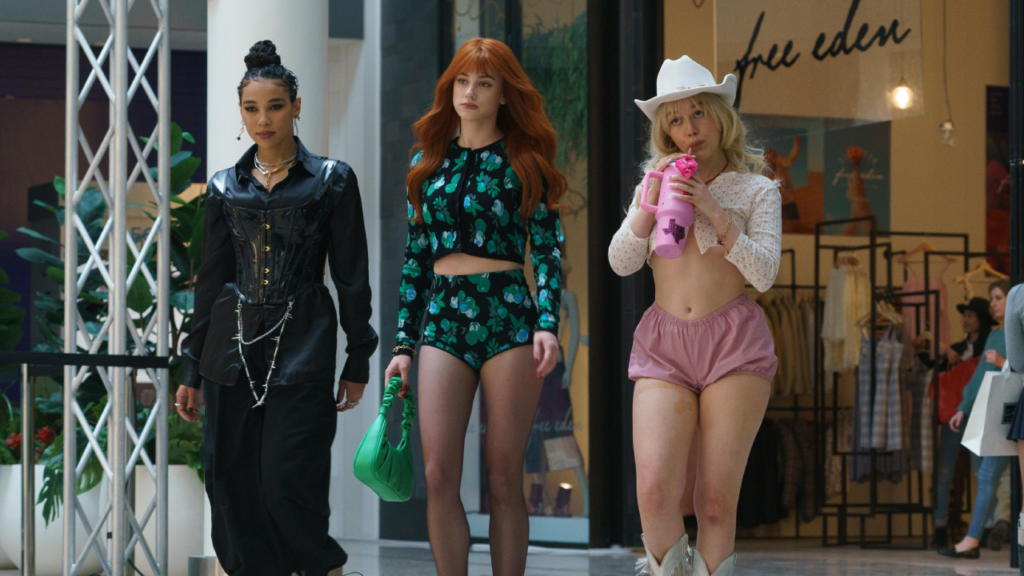
Forbidden Fruits, directed by Meredith Alloway in her feature debut, stars Lili Reinhart, Lola Tung, Victoria Pedretti, and Alexandra Shipp. The film is set within a shopping mall and follows a group of young women working together while secretly involved in a coven-like dynamic. As relationships within the group evolve, the story explores themes of identity, belonging, and power within a tightly controlled social environment. Produced by Mason Novick and Diablo Cody, the film blends elements of horror and satire, drawing from genre influences while presenting a contemporary take on female friendships and social hierarchies.
At its core, Forbidden Fruits is being read as a satire of performative feminism operating within a hyper-commercialized environment. The film’s mall setting is not incidental; rather, it becomes a central metaphor — a curated, artificial ecosystem where identity is constructed, hierarchies are reinforced, and power is often more aesthetic than authentic. Several critics have pointed out that this environment mirrors the mechanics of social media, turning the film’s physical space into a symbolic extension of digital culture. This conceptual layer has been widely appreciated, with reviewers noting that Alloway’s vision carries a clear thematic intention, even when the storytelling struggles to fully articulate it.
Major publications have leaned into this reading, framing the film as both a genre piece and a cultural commentary. Critics from Variety describe it as a “depraved satirical thriller,” emphasizing its provocative tone and willingness to push its premise into darker, more chaotic territory. Similarly, Slashfilm calls it a “delightfully sharp satire of the dangers of commercializing feminism,” highlighting how the film directly engages with the commodification of empowerment in a capitalist landscape. This idea — that empowerment itself can be packaged, marketed, and performed — sits at the heart of many positive reviews, positioning the film as a relevant, if imperfect, reflection of contemporary culture.
The film’s tone has also emerged as one of its defining strengths. Critics repeatedly describe it as campy, chaotic, and visually striking — a film that embraces excess rather than restraint. Screen Rant goes as far as calling it “a welcome return” to a kind of rebellious, unapologetically stylized cinema that feels increasingly rare in today’s landscape. This sense of tonal boldness is echoed by San Jose Mercury News, which notes that the film is “campy, full of laughs and some gore,” suggesting that its entertainment value remains intact even when its narrative falters.
Beyond tone, the film’s aesthetic and atmosphere have drawn consistent praise. Critics from Fangoria highlight its “sparkly” and visually engaging quality, while Boston Hassle points to its “unapologetically alluring” ambience. These elements contribute to a viewing experience that feels immersive and stylized, reinforcing the film’s identity as a piece driven as much by mood and texture as by plot. The mall itself becomes a character — a neon-lit stage where relationships unfold and tensions simmer, further strengthening the film’s visual identity.
Performance is another area where Forbidden Fruits finds strong support. Across reviews, the ensemble cast is consistently praised, with Lili Reinhart emerging as the film’s anchor. Critics describe her presence as both commanding and nuanced, grounding a narrative that often leans into heightened, almost surreal territory. The chemistry among the central group has also been noted as a key strength, creating a believable dynamic that adds emotional weight to the film’s exploration of power, belonging, and insecurity. Even critics who are less enthusiastic about the film overall acknowledge that the performances elevate the material, preventing it from feeling entirely hollow.
There is also a recurring suggestion that Forbidden Fruits carries the DNA of a future cult film. Loud and Clear Reviews explicitly notes that its final stretch “puts Forbidden Fruits on the map as a future feminist cult classic,” a sentiment that aligns with the film’s unapologetically niche appeal. Its blend of satire, horror, and stylized storytelling places it in a lineage of films that often find their audience over time rather than immediately upon release. For some critics, its very messiness becomes part of its charm — a reflection of a film willing to take risks rather than conform to expectations.
However, for all its strengths, Forbidden Fruits is far from universally embraced. A significant portion of critics argue that the film’s ambition ultimately exceeds its execution, resulting in a narrative that feels fragmented and underdeveloped. This criticism is perhaps most clearly articulated by IndieWire, which states that “the ingredients are all there, but never coalesce into a coherent thesis.” This idea — that the film has strong components but fails to unify them — appears repeatedly across reviews, forming the backbone of the film’s critical divide.
Another recurring critique centers on the film’s perceived lack of depth. While its themes are timely and its satire is pointed, some critics feel that it does not explore its ideas with enough substance. One reviewer notes that the film “generates some laughs while cleverly tweaking commercialism and superficiality,” but ultimately finds “not much substance beneath the acerbic surface.” This sentiment reflects a broader concern that Forbidden Fruits prioritizes style and concept over meaningful narrative development, leaving its thematic potential only partially realized.
Even critics who lean positive often acknowledge these shortcomings. There is a sense that the film is enjoyable in the moment but does not leave a lasting impact. Some reviews describe it as engaging but fleeting, suggesting that while it delivers entertainment and visual flair, it lacks the emotional or intellectual weight needed to resonate more deeply. Others point to tonal inconsistencies, noting that the film struggles to balance its satirical edge with its horror elements, particularly as it moves toward its final act.
Major outlets have also highlighted the film’s reliance on familiar genre influences. Critics from The New York Times and Los Angeles Times observe that while the film draws on recognizable tropes — from mall culture to clique dynamics — it does not always transcend them. This has led to comparisons with earlier genre staples, with some reviewers suggesting that Forbidden Fruits borrows more than it reinvents. While these influences are not inherently negative, they contribute to the perception that the film’s originality is unevenly realized.
What ultimately emerges from this wave of criticism is a film that is consistently interesting but inconsistently effective. Forbidden Fruits is widely recognized as a project with a strong voice, a clear perspective, and a willingness to engage with contemporary themes. Yet it is also seen as a film that struggles to fully translate those strengths into a cohesive cinematic experience. This duality defines its reception — a balance between admiration and frustration that keeps it firmly in the realm of conversation.
In the end, Forbidden Fruits stands as a reminder of the risks and rewards of ambitious filmmaking. It may not achieve complete critical consensus, but it succeeds in establishing an identity — one rooted in satire, style, and cultural observation. For some, it will be an uneven experiment; for others, a future cult favorite waiting to be rediscovered. What is undeniable, however, is that it leaves an impression, and in a landscape often dominated by safer choices, that alone gives it a certain significance.
Film: Forbidden Fruits
Director: Meredith Alloway
Writers: Meredith Alloway, Lily Houghton
Cast: Lili Reinhart, Lola Tung, Victoria Pedretti, Alexandra Shipp
Producers: Mason Novick, Diablo Cody, Trent Hubbard, Mary Anne Waterhouse
Cinematography: Karim Hussain
Music: Anna Drubich
Production Companies: MXN Entertainment, Quadrant Motion Pictures, Lollipop Woods
Runtime: 1h 43m
Premiere: SXSW 2026
Release: March 27, 2026
Read More Review Roundups on POF