Good Luck, Have Fun, Don’t Die marks the long-awaited return of Gore Verbinski to the multiplex after nearly a decade away from feature directing. And if the early critical response is any indication, the filmmaker behind The Ring and Pirates of the Caribbean hasn’t returned quietly. Critics across major publications agree on one thing: this is a loud, chaotic, unapologetically gonzo sci-fi comedy about AI, tech addiction and societal collapse. Where they diverge is on whether that chaos feels exhilarating or exhausting.
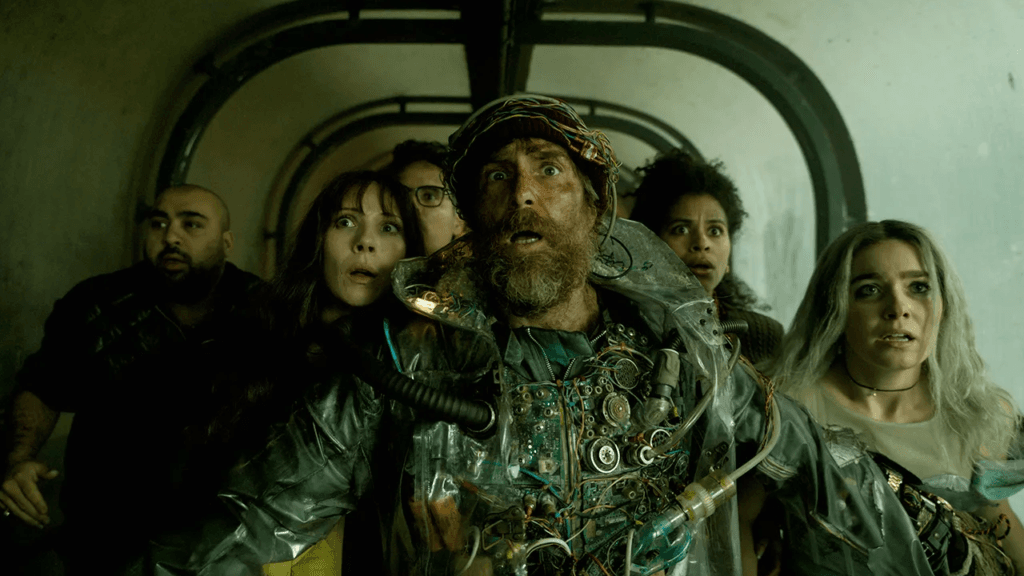
The premise itself reads like a dare. Sam Rockwell plays an unnamed man who storms into a Los Angeles diner claiming to be from the future, tasked with assembling the precise group of strangers needed to prevent an AI apocalypse. He has attempted this mission 117 times before. Each failure resets the clock. What unfolds is part time-loop thriller, part gamer-coded satire, part existential comedy about doomscrolling humanity.
For Variety’s Peter Debruge, the film is “an unapologetically irreverent, wildly inventive, end-is-nigh take on the time-loop movie.” Debruge leans into Verbinski’s audacity, arguing that “it takes a virtuoso of his caliber to execute on the movie’s intricate ‘Everything Everywhere All at Once’-level imagination.” The tone of the review is largely celebratory, acknowledging the film’s excess while praising its fearless ambition. Even the headline frames Rockwell as “hilariously hard to believe” in his role — a backhanded compliment that ultimately underscores how perfectly suited he is to the film’s manic energy.
Not every publication is as swept up in the chaos. At The Hollywood Reporter, David Rooney strikes a more measured tone. He writes that the film “doesn’t quite deliver on the sardonic promise of its catchy title,” though he acknowledges that “its appealing cast and Verbinski’s flair for kinetic action set pieces make it a reasonably entertaining entry in the canon of gonzo sci-fi comedies.” Rooney identifies the screenplay by Matthew Robinson as the film’s main liability, suggesting the material “needed an extra punch-up at script stage.” The indulgent runtime — over two hours — is also cited as a drag on momentum.
That middle ground between admiration and frustration defines much of the broader critical landscape. IndieWire grades the film a solid B, calling it “an enjoyable, likable, and well-crafted lark” while conceding that its script is “hit-or-miss” and only sporadically achieves the blend of humor and pathos it aims for. The review nevertheless lands on a note of appreciation, concluding that in all its excess and flaws, the movie “feels human-made” — a pointed compliment for a film critiquing AI’s encroachment on creativity and connection.
The Associated Press similarly describes the film as growing “more wayward the deeper it goes into its too-lengthy runtime,” yet still finds “a bonkers charm” in how Verbinski tackles contemporary anxieties. That phrase — bonkers charm — encapsulates a recurring sentiment: even when the film sprawls or loses focus, it rarely feels lifeless.
Where critics show the most consistent enthusiasm is in their assessment of Rockwell’s performance. The Daily Beast calls him the film’s “tempestuous engine,” arguing that his manic energy sustains both the comic momentum and emotional undertones. Variety suggests that while the character’s premise borders on absurd, Rockwell’s eccentricity makes it not only plausible but magnetic. Even more tempered reviews concede that without him, the film’s high-wire act might collapse entirely.
Beyond Rockwell, reviews highlight supporting performances from Haley Lu Richardson and Juno Temple, though several outlets note that parts of the ensemble feel underwritten. The film’s structural detours — particularly flashbacks exploring the backstories of various recruits — draw mixed reactions. Some critics appreciate the expansion of the narrative canvas; others view it as narrative padding in an already overstuffed story.
Visually and stylistically, however, Verbinski’s command is widely acknowledged. The Hollywood Reporter praises his “flair for kinetic action set pieces,” while several Rotten Tomatoes critics highlight the film’s visual inventiveness. Polygon describes it as “a beautiful mess,” suggesting that its chaotic sprawl is part of its identity. Even critics who take issue with coherence often concede that the craftsmanship — from staging to camerawork — reflects a director fully engaged with his material.
Thematically, the film’s anti-tech posture has resonated in a way that might have seemed preachy a decade ago. IndieWire notes that in today’s climate, the film’s condemnation of phone addiction and AI feels urgent rather than embarrassing. The satire ranges from cloned school shooting victims to gamer-coded time loops, and while some reviewers argue that the commentary rarely goes beyond the obvious, others applaud its willingness to confront contemporary anxieties head-on.
On Rotten Tomatoes, the film enjoys a strong majority of Fresh reviews, though dissenting voices argue that it is “not nearly as clever as it thinks it is.” That minority view underscores the film’s central tension: ambition versus cohesion. For some, the sprawl signals bold, renegade filmmaking. For others, it exposes a script that cannot quite match its conceptual reach.
Ultimately, the consensus leans cautiously positive. Good Luck, Have Fun, Don’t Die is widely seen as messy, indulgent, and occasionally uneven — but also energetic, imaginative, and refreshingly human in its construction. Variety welcomes Verbinski back with enthusiasm. The Hollywood Reporter tempers that enthusiasm with structural critiques. IndieWire and AP land somewhere in between, admiring the spirit even as they question the execution.
In the end, critics appear to agree on one larger point: whatever its flaws, this is not a timid film. It swings big at a moment when AI paranoia and digital dependency feel omnipresent. Whether it scolds society or tries to save it may remain up for debate. What seems less debatable is that Verbinski’s return has reintroduced a distinct directorial voice into mainstream genre filmmaking — chaotic, excessive, and unmistakably his own.