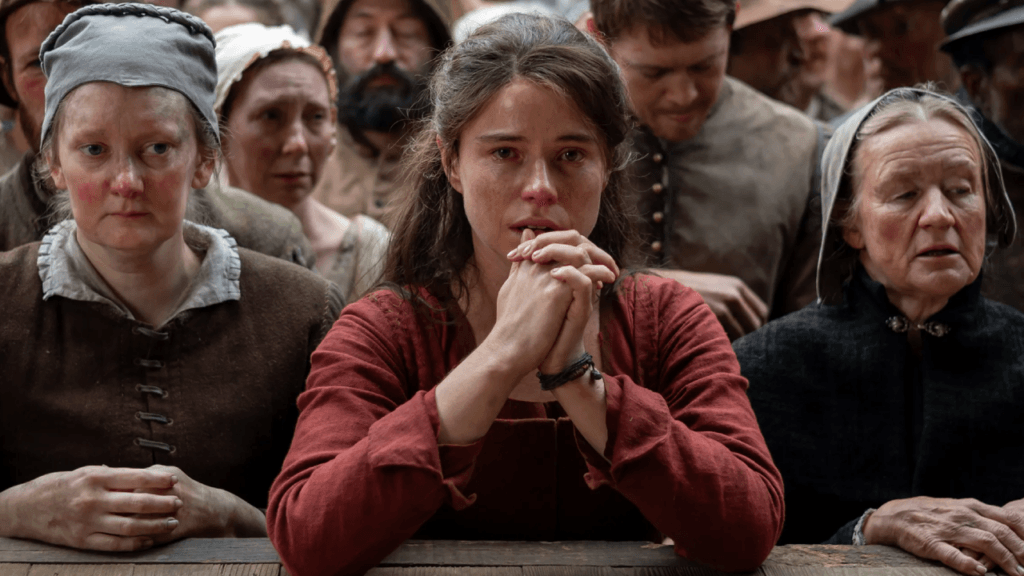
Hamnet review: Hamnet arrives as one of 2025’s most emotionally pulverising films, and critics across festivals have described it as a work of staggering intimacy. Directed by Chloé Zhao and adapted from Maggie O’Farrell’s 2020 novel Hamnet—the widely celebrated reimagining of the family history and emotional landscape that ultimately inspired Shakespeare’s Hamlet—the film reframes how the death of William Shakespeare and Anne Hathaway’s only son may have shaped one of literature’s greatest tragedies. Early reactions from Telluride set the tone, with several critics drawing comparisons to past Hamlet interpretations while calling Zhao’s version “devastating,” “formally possessed,” and “a cinematic experience that stays inside the body long after it ends,” establishing its reputation as a season-defining awards contender.
Set in late-16th-century Warwickshire, the story follows Agnes, portrayed with elemental force by Jessie Buckley, a healer whose intuitive understanding of the natural world shapes every relationship around her. Her husband, William Shakespeare, played by Paul Mescal, is a conflicted young tutor drawn toward the creative pull of London even as life at home becomes increasingly fragile. Their twins, Hamnet and Judith, share a bond built on imagination and mischief, a closeness that becomes the film’s emotional center. When illness enters the household and fate intervenes, their intimate world begins to fracture, and the family is left to confront a grief that reshapes their identities and ultimately sparks the beginnings of Shakespeare’s artistic transcendence.
What has struck critics most is how intensely felt the film is. IndieWire’s David Ehrlich described Hamnet as “a nuclear-grade tear-jerker” and wrote that the film “rips your soul out of your chest so completely that its seismic grief almost feels like falling in love.” The Guardian praised the film’s “ferocious emotional clarity,” while Variety called Zhao’s work “her most mature and haunting film since The Rider,” noting how she fuses sparse naturalism with spectral formalism. At Telluride, critics repeatedly singled out Jessie Buckley, whose performance was referred to as “a howl from the earth itself,” while Mescal’s portrayal was said to summon “a man simultaneously being and not being,” echoing the film’s meditation on presence, loss and the liminal space between them. The performances by young actors Jacobi Jupe and Olivia Lynes, as Hamnet and Judith, were widely described as “astonishingly intuitive,” with several European critics calling their scenes among the most devastating committed to screen this decade.
Visually, the film has been celebrated for its near-mythic tone, shaped by the stark and haunting cinematography of Łukasz Żal, whose surveillance-like compositions make the characters feel watched by an unseen presence. Festival reviews repeatedly highlighted how the film avoids theatricality despite portraying legendary figures, grounding every moment in mud, breath, sweat, and whisper. The sound design has also drawn significant praise for its atmospheric layering, from winds that groan like a living creature outside the Shakespeare home to the near-silences that swallow whole stretches of dialogue. Max Richter’s score has divided critics slightly, with some calling it “overwhelmingly beautiful” and others finding the emotional intensity almost too direct, but even detractors acknowledge its formidable cumulative power in the film’s final movement.
While the film invents a fictionalised context for the creation of Hamlet, critics have noted how Zhao resists easy parallels or overt “origin story” gestures. Instead, the drama blooms in the gaps between intention and consequence, between the creation of life and the creation of art, and between a couple whose mutual grief reshapes them in ways they cannot fully articulate. This refusal to literalise Shakespeare’s inspiration has been singled out as one of the film’s greatest strengths, with Sight & Sound calling it “a masterpiece of negative space — what’s unsaid becomes the arena of its most profound truths.”
The film has already begun its awards journey with enthusiasm, and early indicators point to major season momentum. At the Gotham Awards, Hamnet scored three significant wins, reinforcing its position as a frontrunner heading into the major guild and critic circles. Festival chatter suggests strong prospects for Best Actress, Best Actor, Adapted Screenplay, Cinematography, and Best Picture nominations across major awards bodies. Critics at Telluride and London have repeatedly mentioned it in the same breath as Nomadland, with some even proposing that Zhao may be on track for the most emotionally ambitious film of her career.
Against this tide of acclaim, what resonates most is how deeply the film has affected audiences. Viewers at Telluride reported audible sobbing throughout its final act, with many calling it “the most devastating cinematic experience of 2025.” Yet the film never feels manipulative. Zhao’s direction, the grounded performances of Buckley and Mescal, and the aching emotional architecture of O’Farrell’s source material blend into a work that handles grief with rare delicacy and honesty. It is not a story of how a tragedy created a masterpiece; it is a story of how love, loss, and the unknowable space between them transformed a family and echoed through one of literature’s greatest works.
If early reactions are any measure, Hamnet stands not only as one of the year’s most accomplished films but also as one destined to remain in conversation for years to come. It is an intimate, devastating drama that critics agree is both formally daring and emotionally overwhelming, the kind of film that reorders your internal weather system and stays with you long after its final, breath-snatching images fade.
Read more POF Reviews Roundups