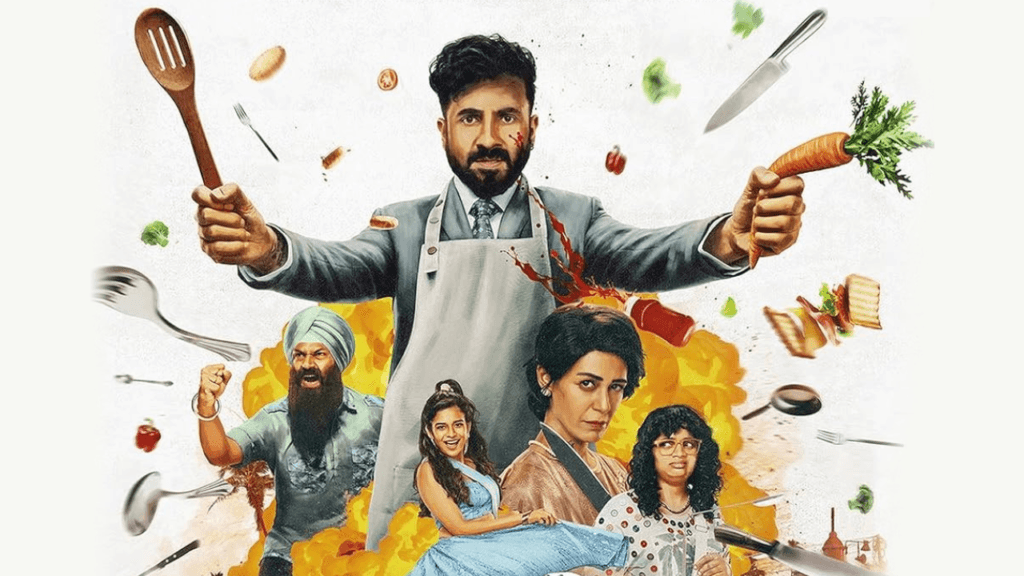
Happy Patel: Khatarnak Jasoos arrives as a rare mainstream Hindi comedy that openly embraces absurdity without apology. Directed by and starring Vir Das, the film marks his feature directorial debut and positions itself as a spoof of spy thrillers rather than a conventional action comedy. Released theatrically in January 2026, the film comes at a time when the genre is largely dominated by high-stakes spectacle and franchise-driven seriousness. Happy Patel instead chooses chaos, self-awareness, and silliness as its primary tools, signalling early on that it has little interest in logic, realism, or narrative gravity.
Set largely in India after a brief international setup, the film follows Happy Patel, an earnest but spectacularly unqualified intelligence operative whose ambition far exceeds his competence. Assigned to retrieve a kidnapped scientist, Happy stumbles through the mission with misplaced confidence, colliding with gangsters, civilians, and a rotating cast of eccentrics along the way. The plot functions less as a tightly wound narrative and more as a framework for escalating comic situations, misunderstandings, and genre parody. Rather than building suspense around the mission itself, the film derives humour from Happy’s inability to behave like a spy at all, undercutting familiar tropes with deliberate incompetence. Critics have noted that the story often pauses or detours to accommodate jokes, characters, and set-pieces, reinforcing the sense that the film prioritises comic rhythm over narrative propulsion.
Across major publications, the critical consensus around Happy Patel: Khatarnak Jasoos has been broadly positive, though rarely unanimous. Times of India described the film as an energetic laugh riot that rarely loses momentum, praising its commitment to silliness and its willingness to go all in on absurd humour. Filmfare echoed this sentiment, highlighting the film’s buoyant tone and consistent comic energy, while crediting Vir Das for sustaining momentum both as actor and director. OTTplay went further, calling the film confident and controlled in its chaos, noting that its self-aware parody allows it to sidestep expectations of coherence. At the same time, several publications framed their praise with caveats, acknowledging that the film’s humour-heavy approach is likely to divide audiences.
A recurring observation across reviews is that Happy Patel succeeds most when viewed as a sketch-driven parody rather than a traditional feature film. The Hollywood Reporter India, in its review, described the film as a gleeful send-up of spy cinema that finds humour in exaggeration and cultural references, rather than in plot mechanics. The film’s jokes often rely on meta-commentary, pop culture callbacks, and deliberate tonal whiplash, a choice that some critics found refreshing and others found exhausting. Moneycontrol characterised the film as bold and unruly, arguing that its lack of restraint is part of its design, even if it occasionally comes at the cost of narrative clarity.
The strongest criticisms cluster around the unevenness of the humour. Hindustan Times noted that while the film aims to be quirky and different, not all jokes land with equal impact, resulting in stretches where the comedy feels forced or repetitive. Koimoi was more severe, describing the film as chaotic to the point of being unfunny for viewers not aligned with its sensibility. These critiques consistently point to the same issue: Happy Patel demands a specific tolerance for absurdity and tonal excess. Critics who engaged with the film on its own terms tended to be more forgiving of its narrative looseness, while those expecting a more structured comedy were less receptive.
Performances emerge as a central point of discussion in most reviews. Vir Das’s turn as Happy Patel has been widely described as committed and energetic, with critics noting that his comic timing and physicality drive much of the film’s appeal. Times of India and Filmfare both highlighted his ability to sustain the character’s exaggerated innocence without slipping into monotony. The supporting cast, including Mona Singh, Mithila Palkar, and Sharib Hashmi, has been praised for leaning into the film’s exaggerated tone rather than grounding it unnecessarily. Several reviewers also noted that cameo appearances and surprise casting choices add to the film’s unpredictability, even if they occasionally distract from the central narrative.
On the technical front, responses have been measured but largely positive. Critics have observed that the film’s brisk pacing and relatively compact runtime work in its favour, preventing the chaos from becoming overwhelming. The visual style is functional rather than flashy, with the direction prioritising comic timing over spectacle. Some reviewers pointed out that the film’s music and background score serve the humour adequately without becoming memorable in their own right, reinforcing the idea that Happy Patel is driven more by performance and writing than by technical flourishes.
A significant theme in the review discourse is the film’s relationship with audience expectations. Trade observers and critics alike have noted that Happy Patel is unlikely to appeal to viewers seeking a conventional spy thriller or even a structured comedy. Its humour is deliberately anarchic, often discarding logic for laughs, and its narrative repeatedly resets itself to accommodate jokes. For audiences attuned to Vir Das’s stand-up sensibility and meta-humour, this approach may feel familiar and rewarding. For others, the same qualities may register as indulgent or chaotic. Several publications framed this divide not as a flaw, but as an inherent risk of the film’s chosen tone.
Within the broader industry context, Happy Patel: Khatarnak Jasoos stands out as an unusual studio-backed comedy that resists formula. In an era dominated by franchise extensions and genre seriousness, the film’s willingness to embrace nonsense has been described by critics as both refreshing and risky. As Vir Das’s directorial debut, it signals a creative voice that prioritises personality over polish, even if that choice comes with uneven results.
Happy Patel: Khatarnak Jasoos stars Vir Das, Mona Singh, Mithila Palkar, Sharib Hashmi, and features extended cameo appearances from several familiar faces. The film is produced by Aamir Khan Productions, written by Vir Das and collaborators, and has a runtime of approximately 121 minutes.
In closing, the critical consensus around Happy Patel: Khatarnak Jasoos recognises it as a film that knows exactly what it wants to be. While its brand of humour may not work for everyone, critics largely agree that its confidence, energy, and refusal to conform give it a distinct identity within contemporary Hindi cinema. Whether audiences embrace that chaos or reject it outright ultimately depends on their appetite for a spy comedy that treats logic as optional and laughter as the only real mission.
Read more POF review roundups
More articles: