Filmmaking is an art. Like painting, photography or any other artistic medium, it demands precision, intention, attention to detail. Art, in itself, holds value, it reflects society, interprets it and sometimes even challenges it. While cinema can exist for multiple reasons, one of its primary functions is surely entertainment. And within that broad space, every single genre deserves its own identity and respect.
Hindi horror, however, often feels derivative and uninspired. It tends to rely on predictable storytelling that rarely ends up surprising the audience. The narratives frequently come across as superficial and not well-built, filled with overused elements that dilute genuine fear rather than evoke it.
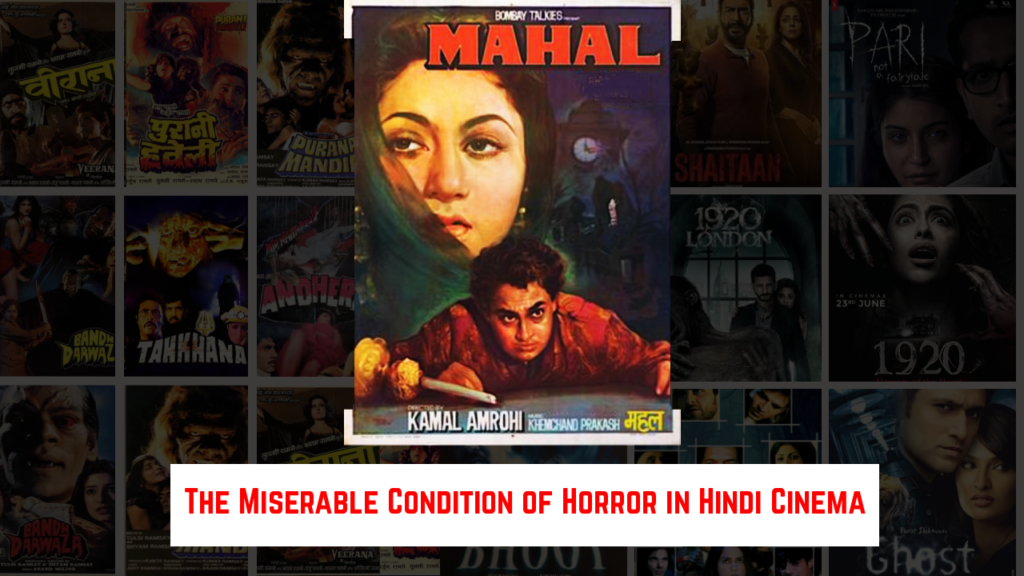
Historically, Hindi horror has also struggled with perception. The genre’s association with B-grade cinema, particularly through the works of Ramsay brothers in the 1970s and 1980s, has left a lasting imprint. These films, termed as B-grade cult classics, were often constrained by low budgets and focused on melodrama and spectacle. Over time, this created a stereotype that horror is inherently exaggerated and commercially risky. Breaking free from that image has proven to be a challenge. Films like Darwaza, Purani Haveli, Do Gaz Zameen Ke Neeche, Purana Mandir, and Shaitani Ilaaka became symbols of this phase, high on melodrama, exaggeration, blood, and music, often blurring the line between spectacle and horror.
Another significant factor is the lack of consistent involvement from mainstream actors. For a genre to gain wider acceptance, it often requires visibility and endorsement from established names. While some actors today have participated in horror-comedy, very few have committed to films that are purely horror. This hesitation reinforces the idea that horror alone may not be strong enough to carry a film, a notion that continues to limit the genre’s growth.
This wasn’t always the case. As early as the 1940s, films like Mahal proved that horror could exist within the mainstream and succeed. It wasn’t just a horror film, it was a cultural moment, featuring prominent actors like Madhubala and Ashok Kumar and achieving commercial success deeming it a blockbuster. While star power alone isn’t the defining factor for a film’s success, in an industry like India’s, it undeniably plays a role in legitimizing a genre. Audiences, consciously or subconsciously, often invest in films because of the actors attached to them. When established actors participate in a genre, they contribute to normalizing it.
In contrast, the West has consistently treated horror as a standalone genre. Francis Ford Coppola, a highly renowned and hugely respected filmmaker, known for groundbreaking films like The Godfather and Apocalypse Now, also made Bram Stoker’s Dracula, a horror film that reinforced the genre’s artistic credibility. When you talk about Western horror films, one can easily recall numerous pure horror films on one’s fingertips. Some such are The Shining, The Grudge, Insidious, The Conjuring, Get Out, The Exorcist, It, and Hannibal, stories that rely entirely on horror elements like atmosphere, narrative, and psychological impact rather than external support. The genre has been allowed to evolve, experiment, and stand on its own.
This raises an important question, shouldn’t every genre be given that same space? Cinema is, after all, sustained by its audience. If people are willing to engage with different kinds of stories, isn’t it only fair to offer them that variety? If a purely horror film could achieve success decades ago, why is that possibility so rarely explored today? Why does horror in Hindi cinema so often need the support of another genre, especially comedy and romance, to be considered viable? People have gone to watch films like Insidious and The Conjuring in India, which made remarkable numbers. Now what does that tell you?
A closer look at contemporary trends reveals a pattern. Many so-called horror films lean heavily on romance or comedy. And to be clear, romance itself isn’t the problem, it never is. The question is whether it serves the story or merely sells it. Is the narrative driving the film, or is it being shaped around elements that are perceived as more appealing? During the promotion of Ragini MMS Returns, Ekta Kapoor, mentioned, “We had the format of Scream Queens, really hot women, hot men, lots of sexuality and horror.” When romance or sex becomes a tool to market a film rather than an organic part of the story, it weakens the core experience.
Similarly, the rise of horror-comedy further complicates the genre’s identity. These films are often directed by filmmakers known for making comedy films, bringing with them a sensibility that prioritizes humor over fear. While they succeed in entertaining, one could argue that they are, at their core, comedies with horror elements rather than true horror films. In such cases, labeling them as “horror” feels almost redundant.
For a long time, it has been assumed that horror cannot stand on its own in Indian cinema. But how much of that is true? Are we not underestimating our audience by believing they wouldn’t appreciate a well-crafted, narrative-driven horror film? Or is it simply a reluctance to take creative risks within a system that prioritizes formula over experimentation?
As a result, many Hindi horror films end up feeling fragmented and unrefined, and the genre continues to struggle with cliched and chaotic execution followed by weak narratives, offering, if I can say so, shallow content that feels more imitative than nuanced.
Read More: