
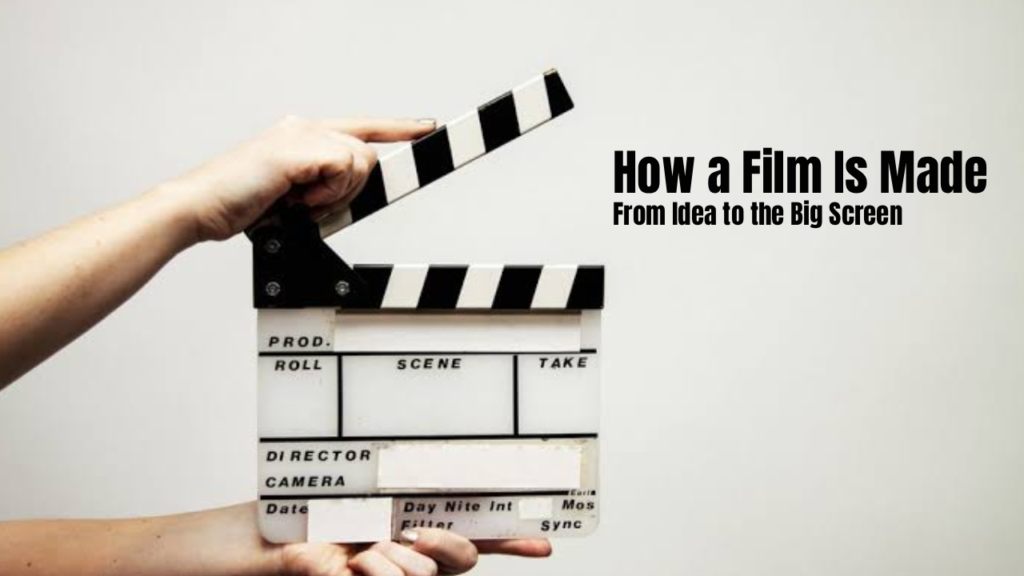
We have been talking about filmmaking for a while now. About why films are made, what they mean to us, what they make us feel, and the many philosophical questions that surround the medium. Let’s move a little away from that side of things now, and dive into the mechanism of filmmaking itself.
Because before a film becomes something we sit down and watch, before the lights go off in a theatre and the screen lights up, there is a long, complicated process that gets it there.
So how does a film actually come into existence?
It starts with something very small. An idea.
Development of the Idea
Every film begins with a seed, an idea. Sometimes it comes from a genre or a world that fascinates a filmmaker. Sometimes it arrives unexpectedly, during a walk, in a conversation, in a dream, or simply while observing something around you.
It could be an entirely new idea. It could come from a book that someone wants to adapt. It could be inspired by a real-life event, a video game, a historical incident, a person, a place or a conversation. And from there, off goes a world-building process of your story.
A screenwriter might take the initial idea and begin turning it into a screenplay. Sometimes producers find a story or acquire the rights to an existing work and then bring a writer and director on board.
Take The Social Network, for example. The film began with material based on the creation of Facebook, which was then developed by screenwriter Aaron Sorkin into the screenplay that eventually became David Fincher’s film.
The idea is only the beginning. But it is the beginning that everything else will grow from.
Writing
Then comes the process of writing. This includes developing events, structuring scenes, understanding characters, building the world and eventually figuring out how this entire thing is going to exist on screen.
The process itself can be different for each writer. There’s no hard and fast rule ever, as there never is when talking about creating art. And of course, making films is an art form. While there are basic rules attached to it, because it’s a creative form, there’s also freedom to bend rules.
And then there are writers who do something completely different. Phoebe Waller-Bridge once described her own writing process by saying, “I’ve never thought structure first. I’ve always thought material first, dialogue first, and we’d just put them all on the wall. And honestly, just the game of what if you put this next to this. And usually, the more unusual that pairing is of those scenes, the more interesting it comes out, and you start pulling a story out of that.”
The screenplay becomes the blueprint of the film. There can be multiple drafts, rewrites, feedback sessions, changes to characters and sometimes complete changes to the story itself. Until eventually, the script is locked. And once it is, another very important question arrives.
How do we pay for all of this?
Finding Money
Finding money can prove to be tough. You have to find people who are willing to back your project financially, but also understand and trust the vision behind it. Investors may sometimes have creative opinions because they have a financial stake in the film, which can lead to disagreements about the story, marketability or even the way it should be made.
So, it’s not just finding investors. It’s finding the right ones. The ones who trust your vision and back you with money.
Financing can come from producers, studios, production companies, private investors, co-productions, grants, streaming platforms and distributors. The budget eventually determines a lot of what is possible. Locations, number of shooting days, cast, crew, equipment, sets, costumes, visual effects, music and even the scale of post-production.
Once the financing is secured and the script is locked, the film can finally begin preparing to become a physical thing. This is where pre-production comes in.
Pre-production
Pre-production is the real groundwork before a single scene is filmed. If production is the actual construction of a building, pre-production is laying its foundation.
One of the first major tasks is casting. The casting director works with the director and producers to find the right actors for each role. Not simply actors who can perform the role, but actors who fit the character, the world and the larger vision of the film. Heath Ledger as the Joker is one of those examples where the actor became inseparable from our understanding of the character.
At the same time, the director starts working closely with the other heads of departments.
The cinematographer, or Director of Photography, is in charge of how everything looks on screen. From lighting to camera angles, lenses, movement, framing and the overall visual language of the film. The film 1917 is a stunning example of this. Roger Deakins, a master cinematographer, designed the film around an elaborate visual approach that made it appear as though the entire movie had been filmed in one continuous shot.
The production designer helps shape the physical world of the film, from sets and locations to props, architecture, colours and overall visual environment. The costume designer works alongside them to ensure the characters’ clothing belongs to that world. The director and cinematographer may work on storyboards and shot lists. Locations are scouted and selected. Shooting schedules are created. Equipment is arranged. Sets are built. Actors rehearse.
Every little thing that can be planned is planned. Because once the camera starts rolling, time is money.
Production
This is the part most people imagine when they think about filmmaking. The camera rolls. Actors act. The crew moves. Lights are adjusted. Sound is recorded. Cameras capture everything. But even here, what we see on screen is the result of an enormous number of people working together.
The cinematography team makes sure the image looks right. The sound team makes sure dialogue and production sound are being captured properly. The assistant directors keep the schedule moving. The production team manages the logistics. And the director is overseeing all of it.
This is where the planning of pre-production meets the unpredictability of reality. Actors may improvise. Weather might change. Locations can create unexpected problems. Equipment can fail. Filmmaking is therefore both extremely planned and constantly changing.
Mad Max: Fury Road is a remarkable example of the sheer physical scale and difficulty of production. The film was shot under extremely difficult conditions in the Namibian desert, with stunt teams performing some of the most dangerous car chase sequences ever captured on film, while director George Miller oversaw the enormous operation.=
And then, after weeks or months of this, the camera finally stops rolling. But the film is nowhere near finished.
Post-production
Post-production is where everything that has been captured begins to take shape.
The first major part of this is editing. Editors are some of the unsung heroes of the filmmaking process. They sift through hours and hours of footage, look at different takes, decide what stays and what goes, and slowly construct a seamless story out of pieces that were never necessarily shot in the order we eventually see them. A scene can change completely in the edit. Thelma Schoonmaker’s editing work in films like Goodfellas is legendary for how effectively it builds rhythm, tension and excitement. But editing is only one part of post-production.
Sound designers add sound effects, dialogue dubbing, ambience and sometimes create entirely new sounds that did not exist during filming. The iconic sound of the lightsaber in Star Wars, for example, was created by sound designer Ben Burtt. Then comes the music. Colour grading gives the film its final visual finish. Visual effects teams add CGI and digital effects wherever required.
And slowly, all of these separate pieces begin becoming one film. The final cut is eventually locked, and the film is ready. Or at least, ready to leave the people who made it.
The Festivals Route
For many films, especially independent and international films, film festivals can become an important part of the journey. But determining which festivals to aim for, for which kind of film, can be different, and hence, becomes essential.
A film might be suited to a festival known for independent cinema. Another might find its audience at a genre festival. Some festivals are particularly important for documentaries, animation, experimental cinema or regional filmmaking. Festivals can provide a film with visibility, reviews, awards and recognition. They can also become spaces where filmmakers meet distributors, producers, critics and other filmmakers.
There isn’t one fixed route. Just like there isn’t one fixed way of making a film.
Distribution
Now comes another crucial question. Where does the film go?
Distribution decides how and when a movie will be released, and to a large extent, who gets the opportunity to see it. Will it be released in theatres? Will it go directly to a streaming platform? Will it have a limited theatrical release before moving online? Distributors work on these decisions while also handling the practical side of getting the film to theatres and platforms.
The film that began as an idea in someone’s head has now become a product that needs to travel. And that brings us to the next part of its journey. Making people know that it exists.
Marketing
Then the marketing team gets to work. Trailers are created. Posters are designed. Teasers are released. Interviews are organised. Press tours happen. Social media campaigns begin.
The aim is simple. Get people interested enough to want to watch the film. But marketing a film is not simply telling people that a film exists. It is also deciding what part of the film you want people to know about before they watch it. Sometimes the marketing sells the story, the stars, the world, a feeling, and sometimes, the smartest marketing is knowing what not to reveal. Because by this point, the filmmaker has spent months or years building the film. Now, they have to convince someone else to spend two hours with it.
And eventually, that someone arrives.
The Audience
The final step is, of course, the film being watched by the audience. And that shifts the entire meaning.
Now the film is out of your hands and in someone else’s. Fresh eyes are going to judge it, sit with it, hate it, love it, be inspired, be shaken, be disturbed, be moved, be admired, and every emotion that a film can invoke is going to be felt by the people watching it. And this is where something beautiful happens.
The filmmaker’s interpretation is no longer the only interpretation.
A film that meant one thing to the writer might mean something completely different to the audience. A line that seemed insignificant while writing might become the one thing someone remembers years later. The film develops a life of its own. And that is the beautiful finish of the process of how a film is born. Where you conjure it from yourself, put all your soul into developing it, grooming it, polishing it to the very last second, and when you think it’s ready, you send it out into the world on its own to have its own unknown, unpredictable, unexpected journey.
That is the journey of a film.
And the strangest and most wonderful part of it is that while the process of making it can be controlled, planned and constructed to an incredible degree, what happens once it reaches the audience can never truly be controlled. The film finally belongs to the world.
Read More:







One Response