We can spend an entire film chasing something, only to realise that the chase was never really about the thing itself.
A mysterious object is being chased, a person has to be found, a secret has to be uncovered. The characters are willing to risk almost everything to get to it. And yet, sometimes, the thing they are chasing is not really what the film is about at all.
This is the idea behind one of cinema’s most fascinating plot devices: the MacGuffin.
A MacGuffin is, simply put, the person, object, event or secret that sets a story in motion and gives its characters a reason to act. It can be the thing everyone is looking for, fighting over or trying to protect. But what makes it interesting is that filmmakers have never really agreed on how important that thing should be.
Alfred Hitchcock, who popularised the term, had one of the clearest ideas about it. For him, the MacGuffin was the thing the characters cared about, while the audience cared about what happened because of it. It was a reason for the story to begin, but not necessarily the reason the audience stayed.

Alfred Hitchcock’s North by Northwest (1959) is likely one of the purest examples of this approach. The film revolves around government secrets that spies are trying to obtain, but the actual nature of those secrets is barely important. Hitchcock himself considered this one of his best MacGuffins because it was almost nothing. The characters needed something to chase, and the audience needed something to make sense of the danger surrounding them. Beyond that, the object itself did not matter much.
And that is what makes Hitchcock’s use of the MacGuffin so clever. It can almost be meaningless and still create an entire film around it.
Hitchcock’s Psycho (1960) takes this idea in another direction. Marion Crane steals money and runs away with it, making the money appear to be the thing that will drive the story. But then Marion is killed, and suddenly the money no longer seems important. The film has moved somewhere else entirely.
What first looked like the story was only the thing that led us into the story.

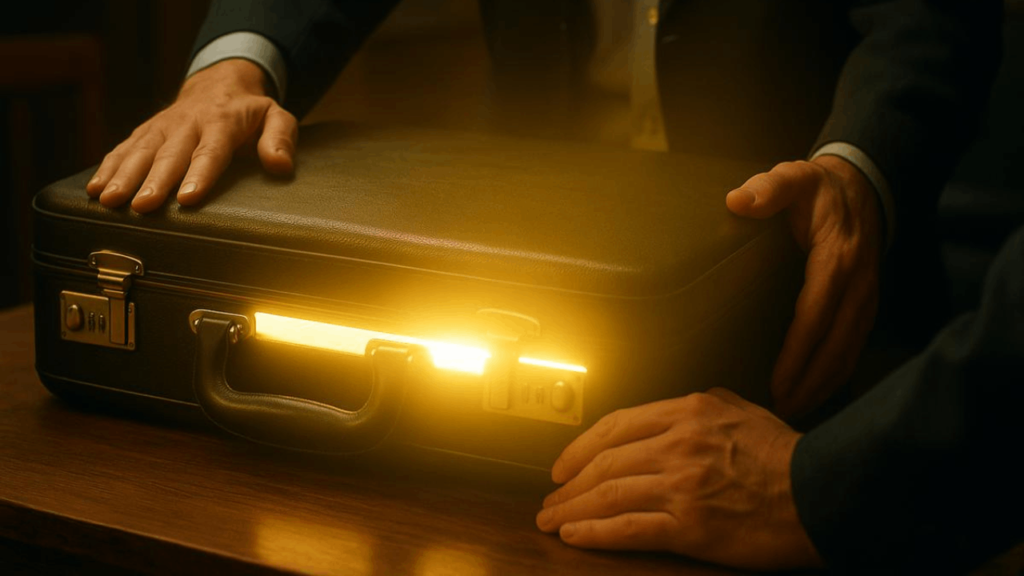
The same idea can be seen in Quentin Tarantino’s Pulp Fiction (1994), where the mysterious briefcase is constantly being carried, fought over, and sought after. The audience never discovers what is inside it, and yet, that does not stop it from becoming one of the film’s most memorable objects. The characters care about what is inside, and that is all the story really needs from it.
Hitchcock’s MacGuffin, then, does not need to be something the audience understands or even remembers by the end. It only needs to make the characters move. But filmmakers have also used the MacGuffin in almost the opposite way, making the audience care about the thing just as much as the characters do.
In George Lucas’s Star Wars: Episode IV – A New Hope (1977), the Death Star plans are not some vague secret that can simply be replaced by another one. The plans are at the centre of the conflict. The Empire wants them, the Rebels need them, and the audience understands their importance. But Lucas takes the idea further by placing the plans inside R2-D2.
Suddenly, the MacGuffin is not just information. It is a character we have become attached to.
By the time R2-D2 is damaged during the final battle, the audience is not only worried about whether Luke will destroy the Death Star. There is also a small but genuine fear that R2 might not survive. The object driving the story has become connected to someone the audience cares about.
This is a very different way of using a MacGuffin. Hitchcock could make the thing itself almost irrelevant. Lucas makes it part of the emotional experience.
Lucas’s Indiana Jones films take this approach even further. The objects Indiana Jones searches for are not vague government secrets. They are ancient and mysterious artefacts with histories and powers of their own. The Ark of the Covenant in Raiders of the Lost Ark (1981), directed by Steven Spielberg, for instance, is something both Indiana Jones and the Nazis want, and the audience knows why it matters.
The Ark therefore gives the film more than a destination. It gives the adventure a sense of danger and mystery. Yet, curiously, even Lucas’s MacGuffins can eventually become less important than the people chasing them.
By the end of Raiders of the Lost Ark, Indiana does not get to keep the Ark. The American government takes it away and stores it somewhere unseen. After spending the entire film trying to find it, Indiana walks away with Marion instead. And somehow, that feels right.
The Ark was what brought Indiana into the adventure, but it was never the most important thing waiting for him at the end of it.

The One Ring in Peter Jackson’s The Lord of the Rings also makes for a powerful example of a MacGuffin. It drives the story forward, but it is more than an object the characters have to carry from one place to another. The Ring represents power, corruption, and temptation. Different characters want it for different reasons, and those desires reveal something about them. The Ring is therefore tied to both the physical and emotional journey of the story.
That may be what separates a memorable MacGuffin from one that simply gives a film something to do. A strong MacGuffin does not only move the plot. It can also become connected to what the film is trying to say.
This is where Peter Jackson’s The Hobbit trilogy offers an interesting contrast. Unlike The Lord of the Rings, it has several competing objects and objectives. There is the Arkenstone, the Lonely Mountain, Smaug, and other elements that take turns becoming important. Each one has its own meaning, but the story keeps shifting between them. The problem is not that a film cannot have more than one MacGuffin. It is that when too many things are asked to carry the same weight, the story can lose the sense of one central pursuit holding everything together.
The MacGuffin can also be a person.
Steven Spielberg’s Saving Private Ryan (1998) builds its central mission around a man the audience spends much of the film waiting to meet. The soldiers crossing through the devastation of war are not sent out simply to win another battle. They are sent to find Private Ryan and bring him home.
James Cameron’s The Terminator (1984) uses a similar idea with John Connor. In the first film, John is not even born yet, but his existence drives almost everything that happens. The Terminator has been sent back to kill his mother before John can be born, while Kyle Reese has travelled back to protect her. John is hence important before we ever meet him. But Terminator 2: Judgment Day (1991) changes the meaning of that idea. John is no longer just the future leader of humanity or the person everyone has been told he will become. He is a teenage boy who is angry with his mother and struggling to understand the world around him. The story begins by asking us to care about the person John is supposed to become. It then makes us care about the person he actually is.
That shift is what makes the use of a human being as a MacGuffin so gripping. The thing driving the characters forward does not always have to remain a thing. It can become a person, and once the audience gets to know that person, the reason for the journey can change.
And that is the larger reason filmmakers have been able to use the MacGuffin in so many different ways.
Hitchcock used it to remind us that the object being chased is often less important than the people caught up in the chase. Lucas made his MacGuffins more visible and emotionally important, allowing the audience to care about what the characters were pursuing. Other filmmakers have taken the idea somewhere in between, making the object important to the story while allowing its meaning to change as the characters change.
The best MacGuffins, then, are not necessarily the ones that are the most mysterious or the most powerful. They are the ones that give the characters somewhere to go while giving the filmmaker something more to say once they get there.
A film can spend two hours making us believe that everyone is fighting over an object, a person or a secret. But by the time the journey is over, we may realise that the thing being chased was never the real point.
It was the people who chased it. It was what they became while chasing it. And more often than not, that is where the story was all along.