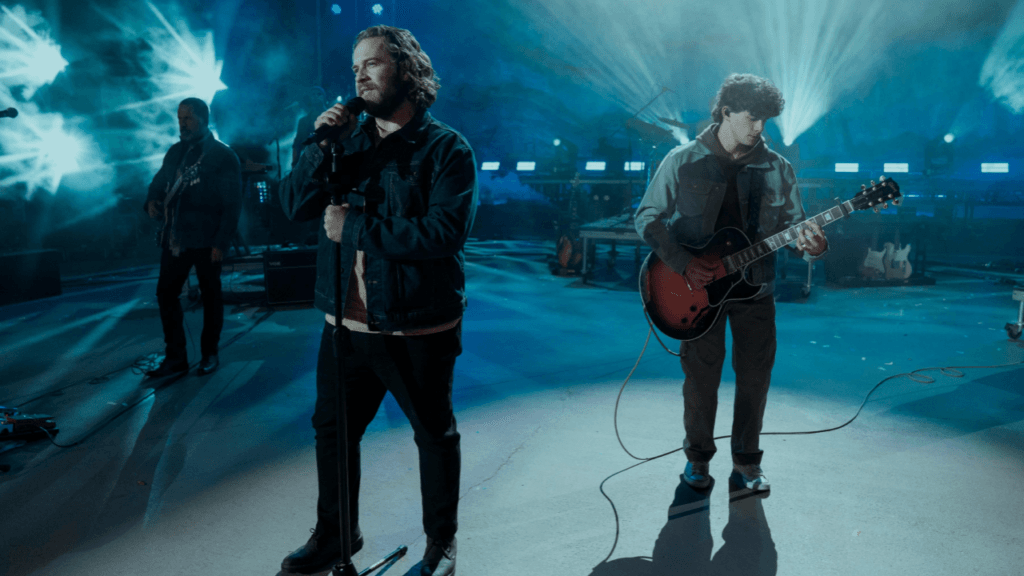
Eight years after the original became a surprise phenomenon, I Can Only Imagine 2 arrives with the weight of both expectation and skepticism. The 2018 film, produced by Kingdom Story Company and released by Lionsgate, stunned the industry by earning more than $83 million domestically on a modest budget. It told the deeply personal story behind MercyMe’s breakthrough hit and ended on a note of redemption so complete that many wondered whether a sequel was even necessary. Now, with I Can Only Imagine 2, the filmmakers revisit Bart Millard’s life — not to retell the origin story, but to explore what comes after spiritual triumph.
The sequel shifts its focus to a later chapter in Millard’s journey. Bart, once defined by the trauma of an abusive father and the catharsis of forgiveness, is now a husband and father navigating the pressures of success, touring, and family life. His young son’s serious health challenges add a new emotional dimension, forcing Bart to confront fears that echo the past. Into this story enters Tim Timmons, a Christian musician diagnosed with terminal cancer, played by Milo Ventimiglia. The narrative weaves together fatherhood, mortality, faith, and the creation of MercyMe’s later hit “Even If,” positioning the sequel as both a continuation and a spiritual companion to the original.
Now that major publications have weighed in, the critical response is measured, divided, and notably centered around performance. Among the most supportive voices is Pete Hammond at Deadline, who frames the sequel as a meaningful extension rather than a redundant echo. Hammond argues that despite the first film’s sense of closure, there is “plenty” left to tell in Millard’s story. Most significantly, he writes that Milo Ventimiglia “steals the film lock, stock and barrel,” describing the actor as “completely authentic” in his portrayal of Timmons. Hammond also emphasizes that the film works “without preaching to the choir,” suggesting that its faith-driven themes maintain accessibility rather than tipping into overt sermonizing. For Deadline, the sequel justifies itself through emotional sincerity and a grounded performance that anchors its dramatic arc.
The tone shifts, however, in coverage from The Hollywood Reporter. While acknowledging the film’s heartfelt intentions, that review describes portions of the sequel as “laborious and dull,” suggesting that the narrative momentum falters and that the emotional beats lack the organic spark that defined the first film. The sequel’s themes of fatherhood and spiritual endurance remain clear, but the dramatic propulsion, according to this perspective, feels heavier and less urgent. Where the original built toward a singular, cathartic moment of creative breakthrough, the sequel operates in a more diffuse emotional register.
Other critics echo these structural concerns. Edward Douglas refers to moments of tension that resolve almost as quickly as they appear, describing some of the film’s conflicts as “five-second drama.” The criticism centers on pacing — an impression that emotional escalations are introduced and then swiftly smoothed over without fully exploring their weight. Alonso Duralde at The Film Verdict observes that the sequel attempts to explore what happens after a defining spiritual victory, a compelling thematic direction in theory. Yet he suggests that the execution struggles to rekindle the dramatic electricity that made the original resonate so strongly. Some reviewers go further, describing the storytelling as overly familiar and reliant on established faith-film rhythms rather than pushing into new narrative territory.
Yet even the more skeptical voices rarely dismiss the film outright. There is a consistent acknowledgment of sincerity. The film’s exploration of illness, parental fear, and spiritual perseverance is treated with respect, even when critics question the dramatic urgency. That distinction is important. The conversation surrounding I Can Only Imagine 2 is less about failure and more about whether it achieves the same emotional inevitability as its predecessor.
Across virtually every review, Milo Ventimiglia emerges as the film’s emotional cornerstone. His portrayal of Tim Timmons — a musician facing mortality while holding fast to faith — is described as grounded and believable. Critics note that Ventimiglia reportedly learned guitar and singing for the role, and that preparation translates onscreen in moments that feel lived-in rather than performative. His character’s quiet resilience and the symbolic ritual of marking an “X” over his pulse are frequently cited as the film’s most affecting elements. Even reviews that question the screenplay concede that Ventimiglia elevates the material.
John Michael Finley’s return as Bart Millard receives more measured praise. While reviewers acknowledge his commitment to the role, some note that the character’s extended solemnity leaves him playing in a narrower emotional register. The weight of fatherhood anxiety and professional pressure renders Bart more restrained than in the first film, and critics differ on whether that choice deepens the character or limits his range. Supporting performances from Trace Adkins, Sophie Skelton, Arielle Kebbel, and young Sammy Dell are generally described as warm and steady, contributing emotional texture without overshadowing the central arc.
One of the more nuanced threads in the critical conversation revolves around tone. Like its predecessor, the sequel leans heavily into prayer, perseverance, and divine providence. However, many critics acknowledge that the film avoids aggressive sermonizing. The message is explicit, but it rarely feels confrontational. Instead, the film operates within a familiar framework of faith-based storytelling: earnest, emotionally direct, and anchored in music. For audiences who embraced the first film, that consistency may feel reassuring. For broader critics, it may feel dramatically predictable.
Ultimately, I Can Only Imagine 2 occupies a middle ground. It is not the lightning-in-a-bottle success that its predecessor was, nor is it widely dismissed. It is described as sincere, performance-driven, and emotionally earnest — yet narratively less surprising. Its strongest asset is Milo Ventimiglia’s presence, which provides a compelling human center to a story that otherwise follows familiar spiritual contours. For some critics, that is enough. For others, the sequel underscores how difficult it is to replicate the singular emotional impact of an origin story once its defining moment has already been told.
Directed by Andrew Erwin and Brent McCorkle, who also penned the screenplay, I Can Only Imagine 2 continues the partnership between Kingdom Story Company and Lionsgate. The film stars John Michael Finley, Milo Ventimiglia, Trace Adkins, Sophie Skelton, Arielle Kebbel, Sammy Dell, and Dennis Quaid. Rated PG, the film runs approximately 110 minutes and will be released in theaters on February 20, 2026.
Read More Review Roundups on POF