Jafar Panahi’s It Was Just an Accident (Persian title: یک تصادف ساده) has rapidly become one of the most important films of 2025, not only because of its extraordinary craft but also because of the political firestorm surrounding it. Shot without state permission and featuring depictions that openly defy Iranian censorship rules, the film has evolved from a compelling moral thriller into a global cultural event. Its Cannes premiere on May 20, 2025, triggered a fifteen-minute standing ovation. It went on to win the Palme d’Or, France selected it as its official Oscar submission, critics nearly universally praised it, and the Gotham Awards 2025 honored it with three major awards: Best Director, Best Original Screenplay and Best International Film — a clean sweep that formally stamped the film as an awards-season heavyweight.
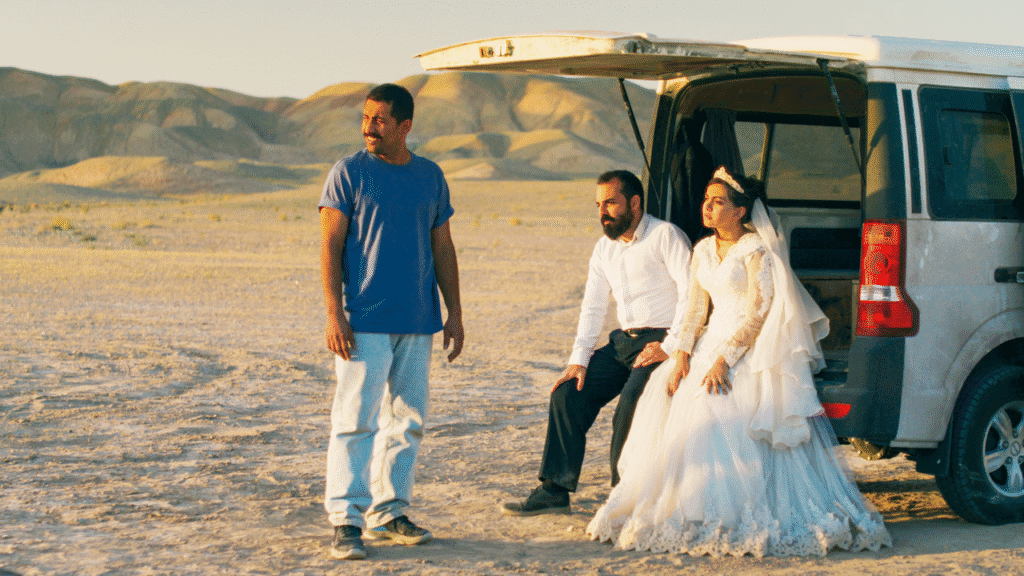
The film follows Vahid, played with aching restraint by Vahid Mobasseri, whose life unravels after a seemingly minor road incident spirals into a confrontation involving guilt, coercion and the absence of institutional justice. Maryam Afshari’s performance as Shiva adds emotional force, while supporting actors Ebrahim Azizi, Hadis Pakbaten, Majid Panahi and Mohammad Ali Elyasmehr flesh out a world where ordinary life is shaped by fear, suspicion and the unseen machinery of power. Panahi constructs the film with his trademark mixture of realism and controlled formal precision; the editing by Amir Etminan and the cinematography by Amin Jafari serve the narrative’s unbroken tension. Much of the film unfolds in tight domestic interiors where silence does as much storytelling as dialogue.
What the critics are saying
Critical reception has been overwhelmingly enthusiastic, with reviewers across the world describing It Was Just an Accident as one of the most urgent and emotionally gripping films of the decade. RogerEbert.com praised the film as “a controlled, thrilling moral drama” built on Panahi’s exceptional command of tone and environment. Their review highlights how the director gradually tightens suspense around the smallest gestures until the emotional stakes become suffocating. American critics have embraced the film with similar fervor. The New York Times called it “a cry from the heart” and argued that the film’s political courage is inseparable from its cinematic brilliance. The Wall Street Journal described it as a work of exceptional moral clarity and emotional truth, while The Hollywood Reporter noted how Panahi’s stark approach transforms everyday settings into volatile psychological spaces.
The U.K. press responded just as forcefully. The Guardian described the film as a “nightmare descent” into moral darkness, applauding its slow-burn intensity and devastating final movement. Reviewers at the BBC and Time Out emphasized the tension between dark humor and despair that gives the film its distinctive emotional rhythm. Cineuropa, Rolling Stone and festival critics across Europe repeatedly singled out the ensemble acting, calling performances by Mobasseri and Afshari “unvarnished” and “emotionally exact.” The Film Stage awarded the film a perfect score, praising it as “the most thematically direct and formally dangerous work Panahi has made in years.”
Even critics offering reservations ultimately reinforce the film’s significance. A minority argue that the middle act’s pacing may test patience, or that Panahi’s forthright political critique lacks the allegorical subtlety of his earlier films such as Taxi or The Circle. However, these same writers acknowledge that this bluntness is part of the film’s force. The explicitness, they note, is the point: Panahi is no longer working metaphorically but speaking plainly, and the film’s direct engagement with repression demands a direct voice. The political risks Panahi took — filming without a permit, depicting women without hijabs, confronting corruption head-on — are universally regarded as inseparable from the film’s emotional impact.
Aggregated scores reflect this consensus. Rotten Tomatoes reports a 97% Tomatometer, with critics describing the film as “a defiant rebuke of authoritarianism that still delivers the entertainment value of a gripping thriller.” Metacritic lists a score in the low 90s, signalling universal acclaim, while IMDb users have responded strongly as well. For many critics, the film sits alongside Panahi’s greatest works and may well come to define his late style: stripped-down, morally unflinching and fearlessly direct.
Festival journey, awards and Craft Analysis
The film’s festival trajectory was unusually swift and explosive. Its Cannes victory not only restored Panahi to the global stage after years of legal battles and partial bans, but also sparked immediate international debate. Its selection as France’s official entry for the 98th Academy Awards surprised industry watchers, who saw the choice as both an artistic endorsement and a symbolic act of solidarity with Panahi. The decision accelerated awards-season momentum, culminating in the film’s strong showing at the Gotham Awards 2025, where it earned three major prizes: Best Director, Best Original Screenplay and Best International Film.
Industry analysts expect the film to perform strongly at the Oscars, BAFTAs and various critics’ groups. Many commentators argue that Panahi’s narrative — a filmmaker repeatedly silenced by the state and yet creating a global sensation — places him at the center of this year’s awards conversation. The combination of undeniable craft, political timeliness and near-universal critical acclaim has made the film a rallying point for international cinephiles.
It Was Just an Accident is more than a film; it is a confrontation with a system that Panahi refuses to silently endure. The political context has only sharpened the film’s reception. Iranian authorities’ attempts to suppress the film, including a reported one-year prison sentence and a renewed travel ban issued in absentia, have sparked widespread condemnation. Yet what resonates most is not only the film’s courage but its tenderness — the way Panahi observes human frailty with empathy even as he stages escalating moral catastrophe.
Panahi’s direction is restrained yet razor-focused, shaping tension through ordinary domestic spaces — a kitchen doorway, a dim hallway, the quiet interior of a parked car. He lets the emotional weight build naturally, using long takes and observational framing that feel authentic without ever sliding into artifice. The writing walks a delicate line between intimate domestic drama and sharp social commentary. Critics praised its understated moral complexity and the way it invites viewers into difficult ethical questions, though a few noted that the second act’s pacing stretches slightly before the emotional payoff lands.
Jafar Panahi’s long, defiant filmmaking journey forms a crucial backdrop. Known for navigating censorship, legal restrictions and filmmaking bans, he continues to craft globally acclaimed cinema such as Taxi, No Bears and This Is Not a Film. His ability to turn personal, intimate stories into politically charged statements defines his signature voice.
The cast includes Vahid Mobasseri as Vahid, Maryam Afshari as Shiva, Ebrahim Azizi as Eghbal, Hadis Pakbaten as Goli/Golrokh, Majid Panahi as Ali, and Mohammad Ali Elyasmehr as Hamid. Their performances have been praised for emotional subtlety and naturalism, grounding the film’s moral drama. Cinematography is by Amin Jafari, whose handheld, natural-light approach enhances realism and intimacy. Editing is by Amir Etminan, whose deliberate pacing lets tension and moral dilemmas unfold slowly but memorably.
The film runs approximately 103–104 minutes, is rated PG-13, and premiered theatrically in France on October 1, 2025, followed by a limited U.S. release on October 15, 2025.