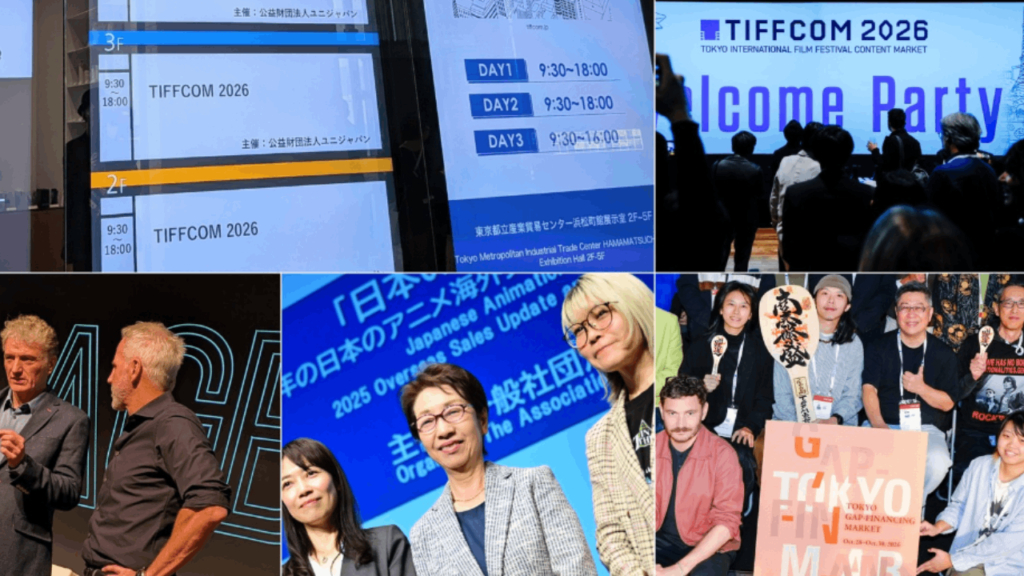
Japan’s film industry is exploring new ways to finance productions as questions grow over the limitations of its long-established production committee system. The model, which brings together multiple companies to jointly finance films and share commercial rights, has helped distribute financial risk across the industry. However, it can also restrict the amount of capital available to individual projects, complicate overseas investment and slow decision-making when several rights holders need to reach an agreement. At TIFFCOM, the content market of the Tokyo International Film Festival, industry representatives examined whether dedicated film funds and institutional financing could help address these challenges while remaining compatible with Japan’s existing market structure.
The production committee system has played an important role in Japanese cinema by allowing companies from different parts of the entertainment business to participate in a film’s financing and commercial exploitation. Broadcasters, distributors, publishers and other businesses can contribute capital and receive rights or revenue opportunities according to their agreements. This spreads the financial exposure of a production rather than placing the entire burden on a single producer or studio. However, the structure can also create limitations. Investment decisions are often linked to the commercial interests of participating companies, potentially restricting the overall budget a project can raise. The division of rights among multiple participants can make international exploitation more complicated, while the need for consensus can delay decisions during production and distribution.
One alternative discussed at TIFFCOM was K2P Film Fund I, established by K2 Pictures, the company led by producer and CEO Kii Muneyuki. The fund closed fundraising in February 2026 at approximately ¥5 billion, equivalent to around $32 million. Its investors include MUFG, the Development Bank of Japan and other financial institutions and companies. Unlike a financing arrangement assembled separately for each film, K2P Film Fund I operates as a blind pool, meaning investors commit capital before the individual projects are selected. The fund aims to support approximately 50 films over seven years, with a greenlight committee responsible for overseeing project approvals. During the TIFFCOM discussion, Kii said that five films had reached theatrical release in 2026.
The structure offers a different approach to managing film investment. By pooling capital for a slate of projects, a fund can distribute exposure across several productions rather than depending on the performance of a single title. It can also give producers access to financing through an established investment vehicle instead of requiring them to assemble a new group of investors for every project. However, the long-term success of such funds will depend on their ability to generate returns and establish a transparent relationship between investors, producers and creators. Kii identified the distribution of revenue to filmmakers, including earnings from streaming and other windows following theatrical releases, as an important question for the future of film funds in Japan.
Another significant development involves the possibility of bringing conventional bank lending more firmly into the country’s film and animation industries. MUFG Bank is conducting a feasibility study commissioned by Japan’s Ministry of Economy, Trade and Industry (METI), following its selection for the project on March 31, 2026. The study, scheduled to run through February 2027, aims to develop valuation methods and completion-guarantee models using real-world industry data. It will also examine the practical process involved in financing, from applications and project assessments to contract preparation.
The initiative addresses a fundamental challenge for banks considering loans to film productions: assessing the financial value and risks of a project. Unlike many conventional businesses, a film’s commercial performance is uncertain, and lenders need reliable ways to evaluate the production before committing capital. Completion guarantees could help address one part of that risk. Such guarantees are designed to ensure that a film is completed and delivered within agreed budgetary and scheduling requirements. They do not guarantee box-office success or protect investors against commercial losses. MUFG’s study is intended to assess whether these mechanisms can work within Japan’s financing environment; it does not mean that a fully operational completion-guarantee system is already available.
The TIFFCOM panel also considered financing practices in the United States and South Korea. In the US, producers can combine presales and distribution agreements with bank loans, while completion guarantees provide lenders with additional protection against the risk of a production not being completed as agreed. South Korea has developed a different approach through public-private support, with government-backed guarantees helping productions secure bank financing. These examples offer potential reference points for Japan, although the country’s existing rights arrangements, regulations and commercial relationships mean that international models cannot simply be adopted without modification.
Attracting overseas investors remains another challenge. Japan’s production committee arrangements can make participation difficult for companies that are not directly involved in the domestic film business. Legal and tax considerations also complicate cross-border investment. Depending on the structure used, overseas participants may face Japanese tax obligations, including potential permanent establishment issues. Fragmented rights ownership, contractual requirements and language barriers can add further complications. These concerns make it important for new financing structures to provide clarity on investor participation, ownership, revenue distribution and decision-making.
The discussion also highlighted the need to consider how creators benefit from new financing arrangements. Raising additional capital will not necessarily improve the position of filmmakers if they have limited participation in the revenue generated by their work. Streaming, television and other post-theatrical windows can provide income long after a film’s cinema release, making it important to establish clear mechanisms for sharing those returns. Fund structures will need to balance investor expectations with the interests of producers and creative talent, while also allowing projects to retain the flexibility required for international distribution and future exploitation.
The TIFFCOM discussion ultimately identified four broad priorities for Japan’s evolving film-financing environment: regulation, capital, creators and cross-border business. These include making investment structures more accessible, combining debt with subsidies and completion guarantees, improving creator returns and addressing the legal and tax hurdles that complicate international participation. Japan’s challenge is not necessarily to replace the production committee system, which continues to serve an important purpose, but to build additional financing routes around it. Dedicated film funds and a more established framework for bank lending could give producers access to a wider pool of capital while retaining the risk-sharing advantages of the existing model. Whether these initiatives can create a more flexible and internationally connected financing ecosystem will depend on how effectively the industry addresses the financial, legal and creative questions now being raised.