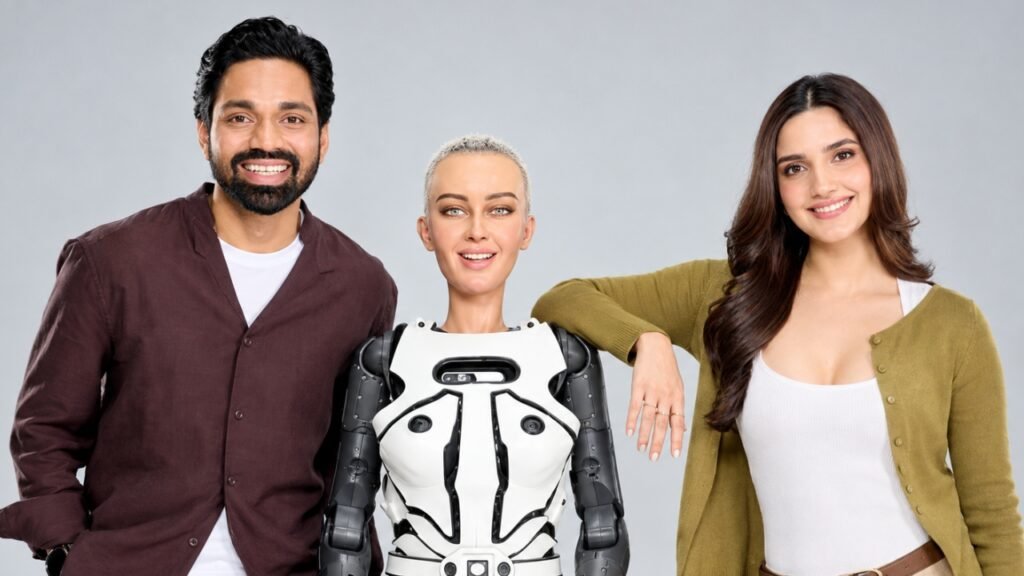
Kannada cinema is giving the idea of a movie robot a very real twist. Lambodhara 2.0, directed by Simple Suni, features JIA, a physical humanoid robot developed by Bengaluru-based Machani Robotics, as a character on screen. The makers are calling it the first time in Indian cinema that a real humanoid robot has played a character instead of being created through CGI, VFX or represented by a human performer in a costume. The film has now wrapped shooting and is heading into post-production.
The biggest surprise is that JIA is not being added after filming. She was physically present on set and performed in real time alongside the human cast. Introducing the robot, Simple Suni put the idea in unusually direct words: “JIA isn’t CGI. JIA isn’t an actor playing a robot. JIA is the actor.” That statement captures what makes Lambodhara 2.0 different from a film that simply uses visual effects to create the appearance of a humanoid machine. JIA is being presented as part of the film’s actual cast and was physically present during the filmmaking process.
The distinction is important to the film’s approach. Rather than creating a digital robot during post-production, the filmmakers had an actual humanoid machine on set, sharing scenes with the human performers. This means JIA’s movements and presence were captured as part of the production itself, making the robot a physical element of the filmmaking process rather than an effect added later.
JIA’s presence also connects directly to what Lambodhara 2.0 wants to explore. The film is described as an AI-driven social thriller rooted in the chaos of Gen Z life and its relationship with social media. Its world brings together artificial intelligence, digital addiction, loneliness, the pressure to stay connected and the constant search for online validation.
That makes the decision to use a real humanoid robot more meaningful within the context of the story. JIA is not simply there to make the film look futuristic or to serve as a technical attraction. Her physical presence fits a story that asks questions about how technology is changing the way people live, communicate and understand themselves. The technology behind the character and the subject of the film therefore meet in the same place, with the production method reflecting the film’s larger technological theme.
The film stars Anil Shetty and Saachi Bindra in the lead roles, with Anil Shetty also producing the project under Mass Productions. The cast has another notable addition in Kunal Kapoor, whose appearance marks his official Kannada cinema debut. The film also features Meghana Gaonkar and Mac D’Souza.
The combination of established performers, new faces and a humanoid robot sharing the screen reflects the film’s interest in bringing different sides of technology and contemporary life together. JIA is not being treated as an element separate from the cast; instead, the robot occupies a place within the film’s ensemble alongside the human performers.
For Machani Robotics, the project takes its Bengaluru-developed technology into an unusual new setting. A robot that would normally be viewed primarily as a piece of advanced engineering is being treated as an on-screen performer. That requires the filmmaking process to accommodate a physical machine rather than simply creating a digital character in post-production.
The physical presence of the robot also creates a direct connection between the technology being developed and the world being depicted in the film. Instead of asking audiences to accept a computer-generated character as a machine, Lambodhara 2.0 is placing an actual humanoid robot in front of the camera and making that physical presence part of the finished film.
The team began shooting in January and has now officially completed filming. With the cameras no longer rolling, Lambodhara 2.0 is moving into post-production, where the footage, performances and technical work will come together.
The completion of filming marks the next stage for a project whose most unusual production element was already present during principal photography. JIA’s participation means that the filmmakers have captured the robot in the same physical production environment as the human cast. The post-production stage will now bring together those performances and the remaining technical elements of the film.
That distinction matters because Indian films have used robots and visual effects before, but Lambodhara 2.0 presents JIA as a real physical performer on set. The approach shifts the conversation from making a robot look real on screen to having the robot actually there, moving and performing in front of the camera. It gives the film’s technological idea a physical presence that audiences can see for themselves on screen.
The concept also creates an unusual relationship between the film’s subject and its filmmaking technique. Lambodhara 2.0 is a story about a generation living alongside rapidly changing technology, while its most unusual “actor” is technology itself. The robot is therefore connected to the film on two levels: as a character within the story and as a real machine participating in the production.
If the makers’ claim holds its place in Indian cinema history, JIA’s screen debut could be remembered not merely as a robot appearance, but as a moment when a machine physically stepped into the cast and shared the frame with human actors.
With filming complete and post-production now underway, Lambodhara 2.0 moves forward with its central technological experiment already captured on camera. Its combination of an AI-driven social thriller, a story rooted in contemporary digital life and a real humanoid robot performing alongside human actors gives the Kannada film a distinctive production identity. The result will ultimately show how effectively that physical experiment translates from the set to the screen.