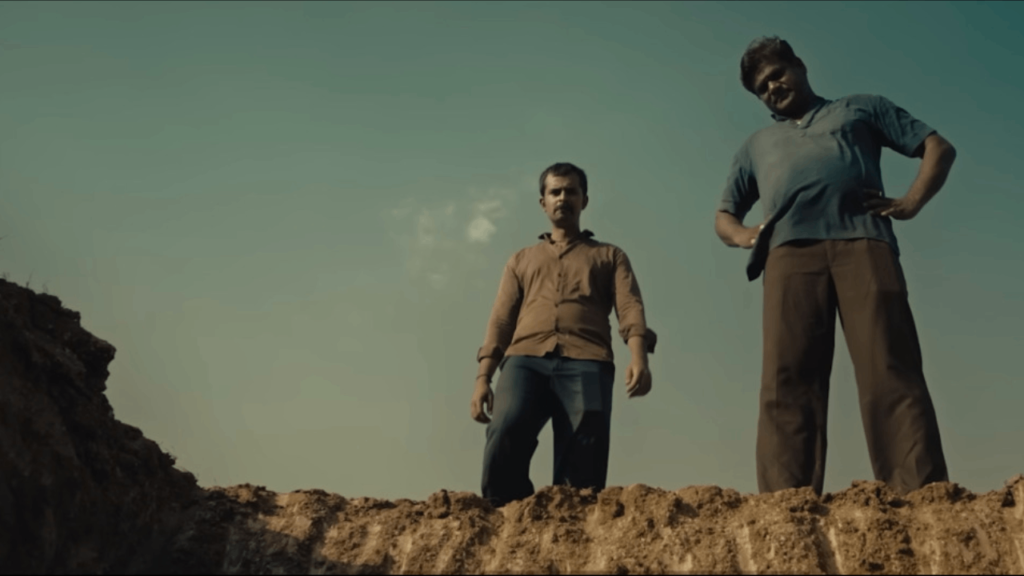
Maaran (meaning “The Hunt”) arrived in theatres on July 31 carrying a distinction few Indian films can claim. Before a single audience member had bought a ticket for its theatrical release, the film had already won the National Film Award for Best Feature Film in Gujarati at the 72nd National Film Awards. It also claimed Best Feature Film at the 15th Chicago South Asian Film Festival. Directed by Abhishek Jain, the filmmaker best known for helping redefine contemporary Gujarati cinema through urban comedies, Maaran marks a deliberate shift into darker, socially conscious storytelling. Critics have largely agreed that the transition has paid off, praising the film as one of the boldest and most uncompromising Gujarati films in recent years.
Maaran unfolds across three interconnected narratives centred on women whose lives become entangled with the same ruthless predator. Birwa, played by Deeksha Joshi, has spent five years in captivity after being trafficked and has developed a deeply complicated attachment to her captor, Ratan, played by Yash Soni. Urmi, portrayed by Prachi Thaker, is a defiant young woman newly forced into the same trafficking network. Meanwhile, Tara, played by Druma Mehta, moves into an affluent Ahmedabad neighbourhood where Ratan works as a night security guard, unaware that she has already become his next target.
Running alongside these stories is Birwa’s sister Purva, played by Tarjanee Bhadla, who begins tracking Ratan after discovering disturbing clues online. Together, these parallel narratives create a film that is less interested in the mechanics of human trafficking than in examining the psychological and social conditions that allow it to flourish—and the painful reality that survival can be just as traumatic as captivity.
Across nearly every review, the consensus is that Maaran fully earns its reputation. Rahul Desai of The Hollywood Reporter India describes it as a potent, well-performed examination of patriarchy—one that is more concerned with the “why” than the “what,” and with exposing the permanence of systemic rot rather than simply depicting violence. Desai argues that Abhishek Jain’s work carries an inherent political charge. In a state where misogyny and moral policing are frequently normalised, he suggests that simply making a film which scrutinises those systems becomes a political statement in itself.
Several other reviewers awarded the film four out of five stars, describing it as a chilling and rigorously honest study of captivity, survival and the even crueller prison awaiting victims after they escape. Critics consistently argue that the National Award feels richly deserved, praising the film’s refusal to offer comforting resolutions while highlighting the confidence with which it tackles deeply uncomfortable subject matter.
What separates Maaran from many films dealing with trafficking is its willingness to linger on a truth that mainstream cinema often avoids. The Hollywood Reporter India points to the film’s central insight: Birwa’s greatest conflict is not her inability to escape, but her reluctance to leave. After years of captivity, she has transformed her prison into something resembling home. Rather than simplifying that contradiction, the film asks audiences to confront it. Birwa has gradually gaslighted herself into believing she occupies the role of a partner, choosing, as Desai memorably puts it, “the devil over the deep sea” of a society that continues to stigmatise survivors as damaged goods.
Critics repeatedly identify this as the film’s greatest achievement. When Birwa finally attempts to return home, Maaran asks the question that society rarely wants to confront: what happens after survival? The answer proves even more devastating than the captivity itself. Instead of safety or healing, Birwa finds whispers, suspicion and slow social ostracisation. Several reviewers argue that this secondary trauma ultimately cuts deeper than the violence that precedes it.
Deeksha Joshi has drawn near-unanimous praise as the emotional and moral centre of the film. The Hollywood Reporter India calls her portrayal “a skilful performance of contradictions and greys,” noting that she completely reframes the familiar damsel-in-distress archetype into something far more psychologically complex. Rather than presenting Birwa simply as a victim, Joshi portrays someone whose survival has fundamentally reshaped her understanding of love, trust and freedom. Other critics describe the performance as devastating, suggesting it lingers long after the film ends. All Tenvow also observed that much of the social media discussion surrounding the film has focused on Joshi’s raw, unglamorous and emotionally fearless performance.
Yash Soni has also earned widespread praise for his portrayal of Ratan. The Hollywood Reporter India describes the character as a fascinating blend of theatricality and cold calculation. Desai particularly highlights moments in which Ratan’s composed city persona recalls the unsettling screen presence of Fahadh Faasil before collapsing into something considerably more brutal. Maintaining those contrasting shades throughout the film demands considerable control, and critics broadly agree that Soni succeeds.
The sections that don’t land with equal force are those involving the film’s broader narrative construction. Rahul Desai of The Hollywood Reporter India argues that the connective tissue between the film’s three narrative strands is weaker than the individual stories themselves, suggesting they often resemble separate films awkwardly stitched together in the editing room. He also raises concerns that Maaran occasionally veers too close to fetishising its male antagonists, granting them moments of tragic introspection and monologues about masculinity that risk generating unintended sympathy rather than sharpening the film’s critique of patriarchy.
Purva’s investigative subplot receives the most consistent criticism across reviews. Although her search for Ratan is clearly designed to build towards the film’s climactic confrontation, critics felt those scenes appear only sporadically and never develop enough momentum to become an equally compelling narrative thread. All Tenvow also pointed out that a handful of dialogue exchanges feel slightly artificial, while noting that the film’s relentlessly bleak tone may prove challenging for viewers expecting a more conventional thriller.
Even with those shortcomings, critics overwhelmingly believe Maaran achieves something rare. Rather than treating trafficking as a sensational crime thriller, it examines the emotional and social consequences that continue long after physical escape. Abhishek Jain demonstrates impressive confidence in handling difficult subject matter, refusing easy answers or convenient emotional release. The film repeatedly asks uncomfortable questions about victimhood, patriarchy and the way society often punishes survivors more harshly than perpetrators.
Maaran also represents an important moment for Gujarati cinema. After the commercial success of films like the Vash franchise, Abhishek Jain turns toward social realism without sacrificing narrative tension. Critics argue that the industry continues to broaden its ambitions, producing films willing to confront difficult issues with honesty and formal confidence. As Bollywood Wallah observed, this is Gujarati cinema at its boldest.
For viewers willing to embrace ambiguity rather than easy catharsis, Maaran is more than simply an effective thriller. It is a thoughtful, deeply unsettling examination of trauma, survival and the invisible systems that sustain violence. The National Award may have arrived before audiences had the chance to see the film, but critics overwhelmingly agree that Maaran more than earns that recognition.
Watch Maaran Trailer
Film Details: Maaran
Director: Abhishek Jain
Writer: Divya Mahendrabhai Thakore
Cast: Yash Soni, Deeksha Joshi, Shruhad Goswami, Tarjanee Bhadla, Prachi Thaker, Druma Mehta, Abhinay Banker
Genre: Social Thriller
Language: Gujarati
Country: India
Runtime: 2 hours 17 minutes
Rating: A
Release Date: 31 July 2026
Awards: National Film Award for Best Feature Film in Gujarati (72nd National Film Awards), Best Feature Film – 15th Chicago South Asian Film Festival
Read More Review Roundups on POF