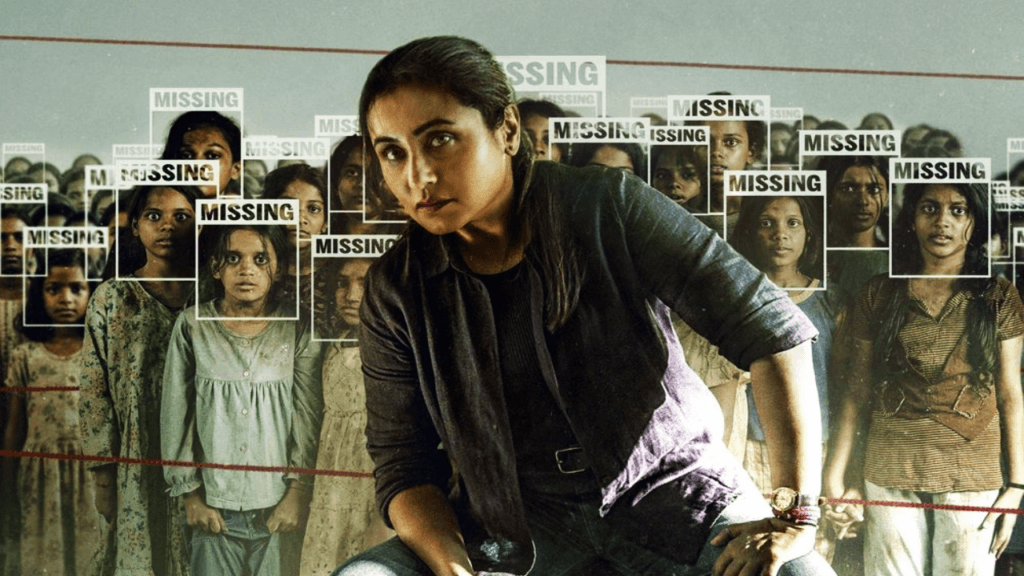
Fourteen days into its theatrical run, Mardaani 3 has collected ₹39.86 crore at the India net box office. On the surface, that number does not scream breakout. It has not dominated headlines, nor has it triggered the kind of opening weekend hysteria that often defines the Hindi trade cycle. But measured against the model it was built on, the film is behaving almost exactly as designed — and that may be the more important story.
The first week closed at ₹26.3 crore. The second week added roughly ₹13.5 crore, marking a drop of just under 49%. In today’s market, that figure is not a warning sign; it is a stability indicator. For a mid-budget urban thriller without mass-market spectacle, a sub-50% second-week decline reflects controlled momentum rather than front-loaded erosion. Many recent tentpole-driven releases have witnessed week-two drops north of 60%, sometimes even 70%, exposing the volatility of hype-driven openings. Mardaani 3 has avoided that pattern.
The elasticity across weekends offers deeper insight. Week two opened with ₹1.85 crore on Friday — identical to the previous Thursday’s number — suggesting that weekday attrition had stabilized. Saturday then surged nearly 89%, followed by a healthy Sunday bump of over 21%. That kind of rebound indicates responsive multiplex audiences returning for weekend viewing. In other words, the film is not simply coasting on early curiosity; it is demonstrating measurable weekend recovery strength. Trade portals often focus on cumulative totals, but elasticity patterns reveal audience retention far more accurately than day-one optics.
The Monday drops also tell a nuanced story. Week one Monday fell nearly 69% from Sunday — a sharp but typical correction after a solid opening weekend. Week two Monday declined 71% from the previous Sunday, again within the expected range for crime thrillers that rely on weekend-heavy footfall. Crucially, however, Tuesday in week two rebounded by over 33%, suggesting that weekday viewership has not entirely evaporated. This rhythm — strong weekend spikes, predictable weekday corrections, and modest midweek stabilization — is consistent with urban adult-skewing performers rather than mass entertainers dependent on opening bursts.
The franchise context adds another layer. Mardaani 2 concluded its run at approximately ₹47.35 crore India net. With ₹39.86 crore already banked in 14 days, Mardaani 3 remains within striking distance of that benchmark. Even if it lands in the ₹50–55 crore lifetime range, it will sit comfortably alongside its predecessor in commercial terms. What matters more, however, is cost discipline.
Trade estimates peg the film’s production budget at roughly ₹42 crore, with print and publicity around ₹10 crore, taking total costs to approximately ₹52 crore. Pre-release digital and satellite sales are reported in the ₹35 crore range, meaning nearly two-thirds of the investment was likely recovered before the first ticket was sold. That reframes the theatrical run entirely. The film does not require a ₹100 crore gross to survive. It needs roughly ₹17 crore in additional recovery after pre-sales to cross its safety threshold.
At ₹39.86 crore net, producer share calculations — assuming an approximate 50% return — would already place theatrical recovery near ₹20 crore. In practical terms, the film appears to have entered surplus territory before the completion of its second week. That is not a dramatic headline, but it is a quiet validation of the model.
This is where Yash Raj Films’ distribution philosophy becomes visible. The release pattern avoided aggressive saturation. There was no attempt to grab excessive screens or chase inflated occupancy optics through oversupply. Instead, the rollout appears calibrated toward multiplex-dominant circuits and prime-time scheduling — the kind of measured deployment that protects week-two holds. Over-expansion often magnifies drop percentages; containment preserves stability.
In the broader Hindi marketplace of 2026, this discipline stands out. The industry currently oscillates between two extremes: high-risk tentpoles with massive marketing spends and volatile drop-offs, and direct-to-OTT releases that bypass theatrical uncertainty entirely. The mid-budget theatrical playbook — insulated by pre-sales, controlled in scale, and reliant on steady audience retention — occupies a narrower but arguably more sustainable lane. Mardaani 3 embodies that third path.
The star factor reinforces the point. Rani Mukerji’s top net performers include films clustered in the ₹40–50 crore range outside legacy hits like Talaash. For a female-led crime thriller franchise to operate consistently in that band in a post-pandemic theatrical reset is not insignificant. It signals dependable franchise equity rather than fleeting spectacle appeal. Longevity, not inflation, defines its commercial logic.
There is also a strategic patience at work. A ₹4 crore opening day did not attempt to mimic tentpole theatrics. Instead, the weekend ramp — ₹6.25 crore on Saturday and ₹7.25 crore on Sunday — reflected organic growth. That pattern mirrors the franchise’s identity: urban, issue-driven, and audience-trust based rather than spectacle-led. The film’s trajectory suggests that YRF is less concerned with topping weekend charts than with finishing runs cleanly.
The second-week behavior reinforces that thesis. A 49% week-to-week drop in the current market is arguably more impressive than a louder ₹20 crore opening followed by collapse. Sustainability in today’s theatrical environment often outperforms volatility in long-term profitability. By limiting downside exposure and securing pre-release revenue streams, the studio has effectively converted theatrical risk into theatrical upside.
What does this mean for the wider industry? It suggests that mid-budget Hindi cinema does not need to compete on the same scale as event films to remain viable. With disciplined cost structures, early risk mitigation through digital and satellite deals, and calibrated distribution strategies, profitability can be engineered before release. The theatrical window then enhances margins rather than determines survival.
Mardaani 3 may not dominate social media discourse, but its 14-day pattern signals something more durable: predictability. In a market defined by erratic swings and front-loaded hype cycles, predictability is currency. The film’s trajectory demonstrates that careful budgeting, measured rollout, and franchise stewardship can still produce stable theatrical returns without spectacle inflation.
Ultimately, the question is not whether ₹40 crore in 14 days is spectacular. The question is whether the model works. Based on current indicators — sub-50% second-week drop, steady weekend elasticity, and recovery math tilted toward safety — the answer appears to be yes. In an era of box office volatility, Mardaani 3 is not chasing noise. It is executing arithmetic. And in 2026, arithmetic may be the most underrated blockbuster strategy of all.
Read More: