Michael reviews have arrived with the kind of reception that immediately reveals a divide between admiration and frustration — not because the film lacks scale or craft, but because it appears to carefully choose what parts of its subject it is willing to confront. With early scores hovering around the low 30s on Rotten Tomatoes, the Michael Jackson biopic has sparked a familiar debate around legacy-driven storytelling: can a film truly capture a cultural icon if it avoids the most complicated aspects of their life? Across major publications, the emerging consensus suggests a film that delivers spectacle and performance, but struggles to engage with the deeper truths of the man at its center.
Directed by Antoine Fuqua and led by Jaafar Jackson, the film traces Jackson’s journey from his early days with the Jackson 5 to his rise as a global solo superstar. Backed by producer Graham King—whose Bohemian Rhapsody set a modern template for music biopics—the narrative leans heavily into Jackson’s artistic evolution, charting his transformation into a once-in-a-generation performer shaped by discipline, ambition, and global adoration. The film introduces key figures from his life, including Quincy Jones and Berry Gordy, while building toward the peak of his fame. Notably, however, it concludes before addressing the most controversial chapters of Jackson’s life, a decision that becomes central to how critics interpret its intent.
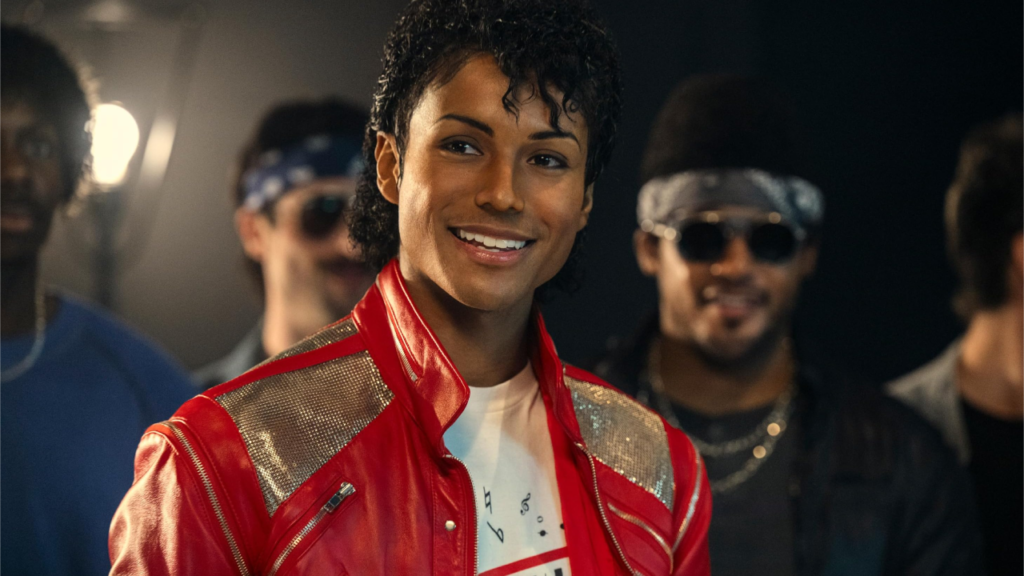
Where the film finds near-universal agreement is in its lead performance. Jaafar Jackson’s portrayal has been widely praised as its most convincing and compelling element. Owen Gleiberman of Variety highlights how Jackson captures “the look, the voice, the electrostatic moves,” while other critics note that his dance style and vocal cadence feel studied to near perfection. Rather than mere imitation, his performance is seen as an embodiment — one that channels both the charisma and fragility that defined Jackson’s presence. In a film where much else divides opinion, this performance stands as the clearest success, anchoring the narrative with authenticity.
Jafaar Jackson is unreal in MICHAEL. I know the voice was assisted, but the demeanor and dance moves and overall presence is really amazing to watch.
— Matthew Belloni (@MattBelloni) April 21, 2026
Yet it is the film’s narrative choices that dominate critical conversation, particularly its decision to present a markedly sanitized version of Jackson’s life. David Ehrlich of IndieWire calls the film “predictably sanitized and surprisingly dull,” arguing that by skirting around the most controversial aspects of Jackson’s life, it ultimately strips the story of its humanity. A similar concern is echoed by critics at Slant Magazine, who describe it as a “sanitized popcorn film,” while coverage reflected in Screen International points to a narrative that feels “disconnected from reality.” The issue, across these responses, is not simply omission, but the emotional cost of that omission — a story that feels incomplete because it refuses to fully engage with its subject.
Some of the harshest responses go even further, questioning whether the film functions as a meaningful narrative at all. Critics at RogerEbert.com describe it as “a filmed playlist in search of a story,” suggesting that it operates more as a sequence of musical highlights than a cohesive film. Reviewers at The Wrap characterize it as a “feature-length publicity” piece that plays like damage control, while critics writing for Rolling Stone note how the film “twists itself into knots” to avoid confronting uncomfortable truths. Taken together, these critiques frame Michael as a project shaped as much by what it avoids as by what it presents.
That sense of incompleteness extends to the screenplay itself, which many critics describe as thin and episodic. IndieWire further notes that the film’s “paper-thin” writing flattens key moments, diluting nuance and emotional impact. Rather than building a layered psychological portrait, the narrative moves from one milestone to another without fully exploring the internal conflicts that defined Jackson’s life. The result is a structure that feels more like a curated timeline than a fully realized character study.
Even within this criticism, however, there is acknowledgment of what the film does achieve. Owen Gleiberman of Variety describes Michael as an “engrossing middle-of-the-road biopic,” suggesting that it succeeds on a conventional level, even if it avoids deeper complexity. Meanwhile, critics at The Hollywood Reporter highlight the film’s musical appeal, calling it “a warm rush of transporting pleasure.” For audiences willing to engage with it as spectacle rather than scrutiny, the film offers moments of genuine enjoyment.
Those moments are most evident in its musical set pieces, which recreate some of Jackson’s most iconic performances with precision and energy. From the staging of “Billie Jean” to the spectacle of “Thriller,” the film leans into the power of performance as its primary storytelling tool. Critics largely agree that these sequences are among its strongest elements, capturing the scale and excitement of Jackson’s artistry. At the same time, they also point out that these moments often come at the expense of deeper narrative exploration, functioning as substitutes rather than complements to character development.
The absence of that deeper exploration becomes especially apparent in how the film handles the darker aspects of Jackson’s life. Critics referencing coverage aligned with The Guardian argue that the film “can’t bring itself to show” the full scope of its subject’s experiences, reducing a complex life into a more simplified and comfortable arc. By positioning figures like Joe Jackson as the primary source of conflict, the narrative avoids engaging with broader contradictions, ultimately limiting its emotional depth.
That limitation is reflected in the film’s overall tone, which critics note tends to oscillate between reverence and sympathy. David Ehrlich of IndieWire observes that the film reduces its subject to extremes of “pity or adoration,” avoiding the kind of complexity that might make him feel more human. Without that tension, the portrayal remains polished but distant, more concerned with preserving an image than interrogating it.
Notably, this divide was already visible before reviews even surfaced. Early industry chatter, amplified by platforms like DiscussingFilm, focused less on how the film would be received and more on what it might leave out. Much of the conversation centered on whether Michael would address the more controversial aspects of Jackson’s life, particularly given its backing by the Jackson estate and its positioning as a large-scale musical biopic. In that sense, the critical response feels less like a surprise and more like a confirmation of those early concerns.
In the end, Michael emerges as a film caught between two impulses: the desire to celebrate an icon and the challenge of confronting his reality. It succeeds in capturing the energy, charisma, and cultural impact of Michael Jackson as a performer, anchored by a compelling central performance and elevated by its music. But in avoiding the contradictions that defined his life, it ultimately limits its own scope, offering a version of the story that feels both impressive and incomplete. Michael recreates the magic of a legend, but sidesteps the truth that defined him — leaving behind a film that is as polished as it is unresolved.
Release Date: 24 April 2026
Director: Antoine Fuqua
Cast: Jaafar Jackson, Colman Domingo, Nia Long, Miles Teller, Laura Harrier
Genre: Biographical drama, musical
Runtime: Approx. 2 hours 20 minutes
Read More Review Roundups on POF