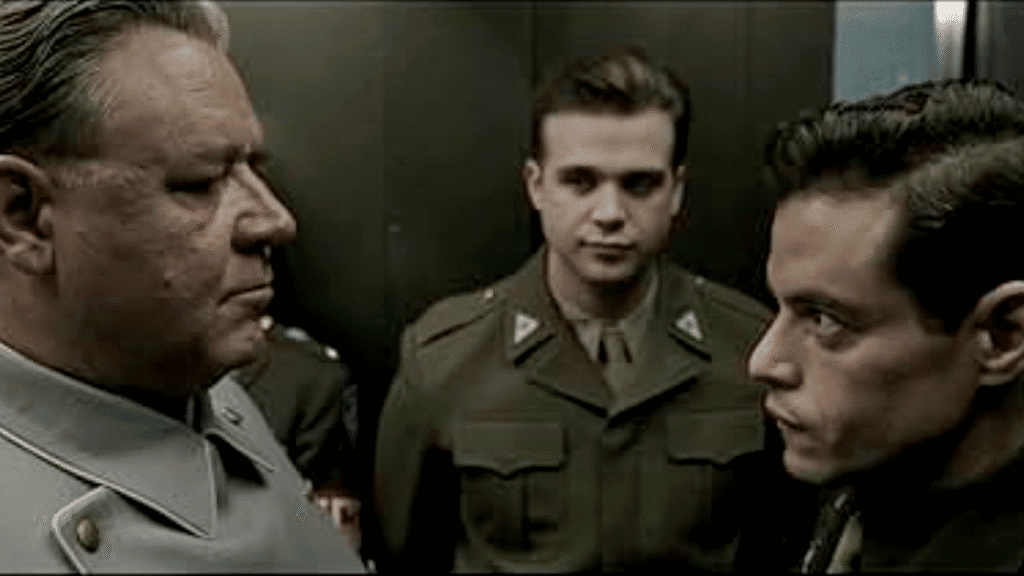
With Nuremberg, director James Vanderbilt brings one of cinema’s most urgent stories to the screen: the landmark war-crime trials that followed the fall of the Nazi regime. Anchored by towering performances from Russell Crowe (as Hermann Göring) and Rami Malek (as U.S. Army psychiatrist Douglas Kelley), the film confronts the machinery of mass atrocity, justice, and memory. Its timing — roughly eighty years after the historical events — lends it a relevance that critics have found compelling, even if the film’s scope and tone have drawn mixed notes.
Critics’ Views: Acclaim Meets Reservations
Most major critics agree on one thing: Russell Crowe delivers a performance of rare intensity and charisma. His portrayal of Göring — charming, monstrous, disturbingly human — forms the centerpiece of a film that frames the post-war tribunal as not just historical reckoning but a battle of wills. Variety observed that Crowe, “portly and imposing … plays Hermann Göring … with implacable self-satisfaction.” Meanwhile, TheWrap described the script’s duel between Kelley and Göring as a “Silence of the Lambs cross-examination,” noting how the ensemble supports the central confrontation.
Yet, critics also sound notes of caution: The Guardian argued that while the subject matter is weighty, the film’s gloss and theatricality at times undercut it, calling the drama “polished, theatrical … emphasising entertainment over depth.” Similarly, Collider judged the film “solid, albeit unremarkable” and suggested that despite Crowe’s brilliance, the storytelling does not always match the ambition. In sum, critics regard Nuremberg as a film of important intentions and standout acting, but divided on whether it consistently delivers on its moral and emotional promise.
Ratings and Audience Pulse
On review aggregator site Rotten Tomatoes, Nuremberg currently holds a 67% critics’ score. On IMDb the film has a user rating of 7.9/10, reflecting more positive reception among online viewers. Social media commentary underscores the duality: many viewers hail Crowe’s depiction of Göring as “terrifyingly magnetic,” while others express frustration that the film sometimes lapses into courtroom-drama tropes rather than fully grappling with its historical stakes.
Creative Team & Historical Foundation
Written and directed by James Vanderbilt, Nuremberg is based on the non-fiction book The Nazi and the Psychiatrist by Jack El-Hai. The film stars Russell Crowe as Hermann Göring and Rami Malek as Douglas Kelley, supported by Michael Shannon, Richard E. Grant, John Slattery, Leo Woodall and others. Cinematographer Dariusz Wolski and composer Brian Tyler furnish the film with a visually formal and somber palette, reinforcing the gravity of its subject. The film’s period setting — the 1946–47 Nuremberg tribunals — gives it a built-in resonance, reminding viewers that the legal and moral frameworks born from these trials still influence how the world reckons with atrocity today.
Performances, Technique and Thematic Depth
Crowe’s turn as Göring has attracted near-universal praise: his command of language (including German), his alternating geniality and menace, his ability to embody ideological evil as seductive power rather than mere caricature. The Washington Post characterised his performance as one of the most chilling depictions of Nazi leadership, noting how “his charm feels like a trap.” Malek, as Kelley, plays the outsider tasked with sorting culpability from pathology — his calm exterior gradually unravelling under Göring’s manipulative brilliance.
Technically, Vanderbilt stages the drama with a refined restraint. He uses wide framing and formal compositions to give the film a sense of austere theatre. Long takes allow performances to breathe, while the score and production design avoid melodrama in favour of psychological tension. Critics say this restraint often serves the subject well; however, some argue that the film’s pacing and polish make it feel more like a revival style courtroom drama than a spontaneous excavation of history.
Nuremberg emerges from the critical conversation as a film of serious ambition: powered by extraordinary lead performances and shaped by formal craft, it strives to remind audiences that the worst chapters of human history are not safely behind us. It invites reflection on how law, memory and ideology interlock — not just historically, but in our own era. That said, critics caution that its theatrical polish and occasional narrative shorthand may limit its emotional impact for some viewers. Even so, the film stands as a stimulant for conversation about how cinema remembers atrocity and keeps the obligations born in the post-war tribunals alive.
Read More: