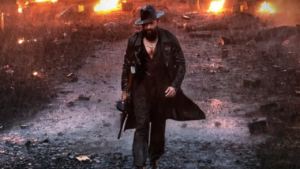
With the final ballots now submitted, the race for the 98th Academy Awards has entered its most suspenseful phase. Oscar voting has officially closed, meaning the outcome of the 2026 awards is already decided—locked away in sealed envelopes that will only be opened on March 15. For the industry, the weeks leading up to the ceremony are now less about campaigning and more about interpretation: reading the signals left behind by the long awards season. And this year, those signals point clearly to a dramatic two-film showdown between Sinners and One Battle After Another.
The closing of final voting marks the end of the intense lobbying that defines modern Oscar campaigns. Academy members submitted their ballots during the final voting window in early March, after months of screenings, Q&A events, advertising campaigns, and guild awards. Once voting closes, campaigning stops entirely. The ballots are handed over to the accounting firm PwC, which tabulates the results and keeps them confidential until Oscar night. From this point onward, narratives and predictions cannot change the outcome—the votes are already cast.
Yet those narratives have been unusually polarized this year, largely because the season produced two dominant contenders with very different kinds of support.
Ryan Coogler’s Sinners entered the Oscars as a historic juggernaut. When nominations were announced on January 22, the film set a new Academy record with 16 nominations, surpassing the long-standing benchmark of 14 nominations previously held by films like Titanic, All About Eve, and La La Land. That record-breaking performance signaled something crucial about the film’s standing inside the Academy: it had support across virtually every branch.
The nominations spanned acting categories, directing, screenplay, music, and a wide array of technical disciplines. In awards terms, that kind of across-the-board recognition is often described as a “coalition film”—a movie that different branches of the Academy feel invested in. Such films frequently perform well under the Oscars’ preferential ballot system used to determine Best Picture.
If nomination strength gave Sinners its initial momentum, the actors’ branch reinforced it later in the season. At the 2026 Actors Awards, formerly known as the Screen Actors Guild Awards, Sinners captured the evening’s top prize for Best Ensemble in a Motion Picture, one of the strongest indicators of industry support. The ceremony also delivered another major surprise: star Michael B. Jordan won Best Actor for his dual performance as twin brothers Smoke and Stack.
Jordan’s victory was particularly notable because he defeated Timothée Chalamet of Marty Supreme, who had been widely viewed as the season’s front-runner. His performance in Sinners required him to portray two characters with distinct physical rhythms and emotional registers, a technical challenge that many actors regard as one of the most demanding feats in screen performance. The win suggested that the film had strong backing within the Academy’s largest voting bloc—the actors branch.
While Sinners surged with nomination strength and actor support, Paul Thomas Anderson’s One Battle After Another built its case through a different pathway: critical prestige and director-driven momentum.
The political thriller dominated much of the critics’ circuit and later achieved a major victory at the BAFTA Awards, where it won Best Film and several craft categories. BAFTA outcomes do not always align with the Oscars, but they often reflect international voting tastes and the preferences of auteur-oriented filmmakers. For One Battle After Another, the BAFTA triumph reinforced its reputation as the most intellectually ambitious film in the race.
Anderson’s position strengthened further when he won the Directors Guild of America Award for Best Director, historically one of the most reliable predictors of the Oscar directing prize. Over the past decades, the DGA winner has matched the eventual Academy Award for Best Director the vast majority of the time. That victory effectively cemented Anderson as the likely favorite in the directing category.
This combination of factors has led many awards analysts to predict a split decision at the Oscars. In this scenario, Sinners—the film with the broadest industry support—would win Best Picture, while Anderson would claim Best Director for One Battle After Another. Such splits are not uncommon in modern Oscar races. Films like Spotlight and Green Book won Best Picture even as their directors lost the directing prize to more auteur-driven competitors.
Underlying all these predictions is the Academy’s unique voting system. Unlike other categories, Best Picture is determined through a preferential ballot. Voters rank nominees in order of preference rather than selecting a single choice. If no film receives a majority of first-place votes, the lowest-ranked film is eliminated and its ballots redistributed according to second choices. The process continues until one film secures more than 50 percent of the vote.
The system rewards consensus more than passion. A film that appears consistently in the top three across many ballots can defeat a rival that inspires intense devotion from some voters but indifference from others. This dynamic may favor Sinners, which many observers view as the race’s most broadly liked film.
That widespread appeal may stem in part from the movie’s unusual genre blend. Sinners is not a traditional Oscar drama but rather a hybrid of Southern Gothic storytelling, supernatural horror, musical elements, and historical allegory about segregation-era America. The film’s distinctive tone allowed it to resonate with multiple branches of the Academy—from actors and composers to cinematographers and costume designers.
Its commercial success has also played a role in the narrative surrounding the film. With approximately $369 million in worldwide box office, Sinners stands out in a field largely dominated by smaller prestige projects. In recent years, the Academy has occasionally gravitated toward films that combine critical acclaim with strong audience engagement, making the movie a rare crossover contender.
Another intriguing element of this year’s race is that both leading films come from the same studio. Warner Bros. backed both Sinners and One Battle After Another, giving the company a commanding presence in the awards conversation. In practical terms, the studio could walk away with the industry’s top honor regardless of which film prevails—a rare situation that underscores its unusually strong awards-season slate.
Beyond studio bragging rights, the outcome could also carry historical significance. A Best Picture win for Sinners would mark a major milestone for Ryan Coogler, who would join a small group of Black filmmakers associated with Best Picture–winning productions. If he were also to claim the directing prize—a less likely but still possible outcome—it would represent another major moment for representation in Academy history.
Despite the dominance of the two leading contenders, Oscar history has occasionally produced surprise outcomes when a consensus candidate emerges quietly from the middle of the ballot rankings. Films like Hamnet or Frankenstein, both widely respected within the industry, remain distant but plausible spoilers in a preferential-ballot scenario.
Still, the central drama of the 2026 race appears to revolve around the contrasting strengths of its two front-runners. One film represents emotional consensus and broad industry support. The other embodies intellectual prestige and directorial acclaim.
Now that voting has closed, however, the battle is no longer unfolding in real time. The Academy’s decision has already been made, quietly recorded on ballots that only a handful of accountants have seen.
For the rest of Hollywood—and for audiences watching around the world—the outcome remains a mystery that will only be revealed when the envelopes open on Oscar night.
Read More:
- Beyond Hype: The 10 Indian Films Defining Anticipation in 2026
- Hollywood Box Office Failures 2025 Explained — What The Year’s Biggest Misses Taught Us
- Why James Cameron’s Films Refuse to Fade — Even When the Box Office Is Done
- Best Santa Claus Movies of All Time, Ranked by Impact and Legacy
- 35 Years Later: From Traps to Triumphs: Where Are the Stars of ‘Home Alone’ Now?