
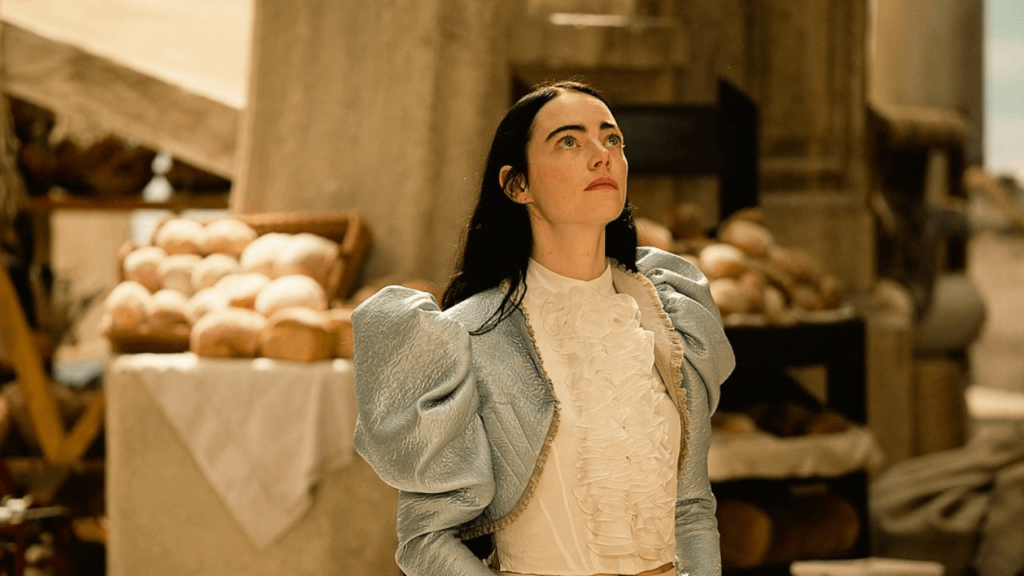
If Bella thinks about killing someone, she says it. If she is intrigued by a dead body on the table and wants to see it cut open, she starts stabbing the body. Things that one only thinks about become her actions. There is something revealing about watching a grown woman with the brain of a baby experience the world this way, because Bella has not yet learnt which thoughts are acceptable, which questions are impolite, and which rules are simply meant to be followed.
Directed by Yorgos Lanthimos and based on the 1992 novel by Alasdair Gray, Poor Things (2023) places female liberation inside a world that looks completely unreal. Yet, beneath its strange colours, enormous sets, exaggerated bodies, and almost fantastical world, the film keeps returning to something very ordinary: the freedom of a woman to decide what she wants for herself.
We journey through with Bella as she discovers what it means to be a woman in the world, and finds out how the world really is as her baby brain slowly develops. At first, she is living with Dr. Godwin Baxter, the man who placed a baby’s brain in her body in order to give her life when she was on the verge of dying, having thrown herself off a bridge as the woman she was up until that point.
Bella however does not know that her brain is still developing like that of a baby.
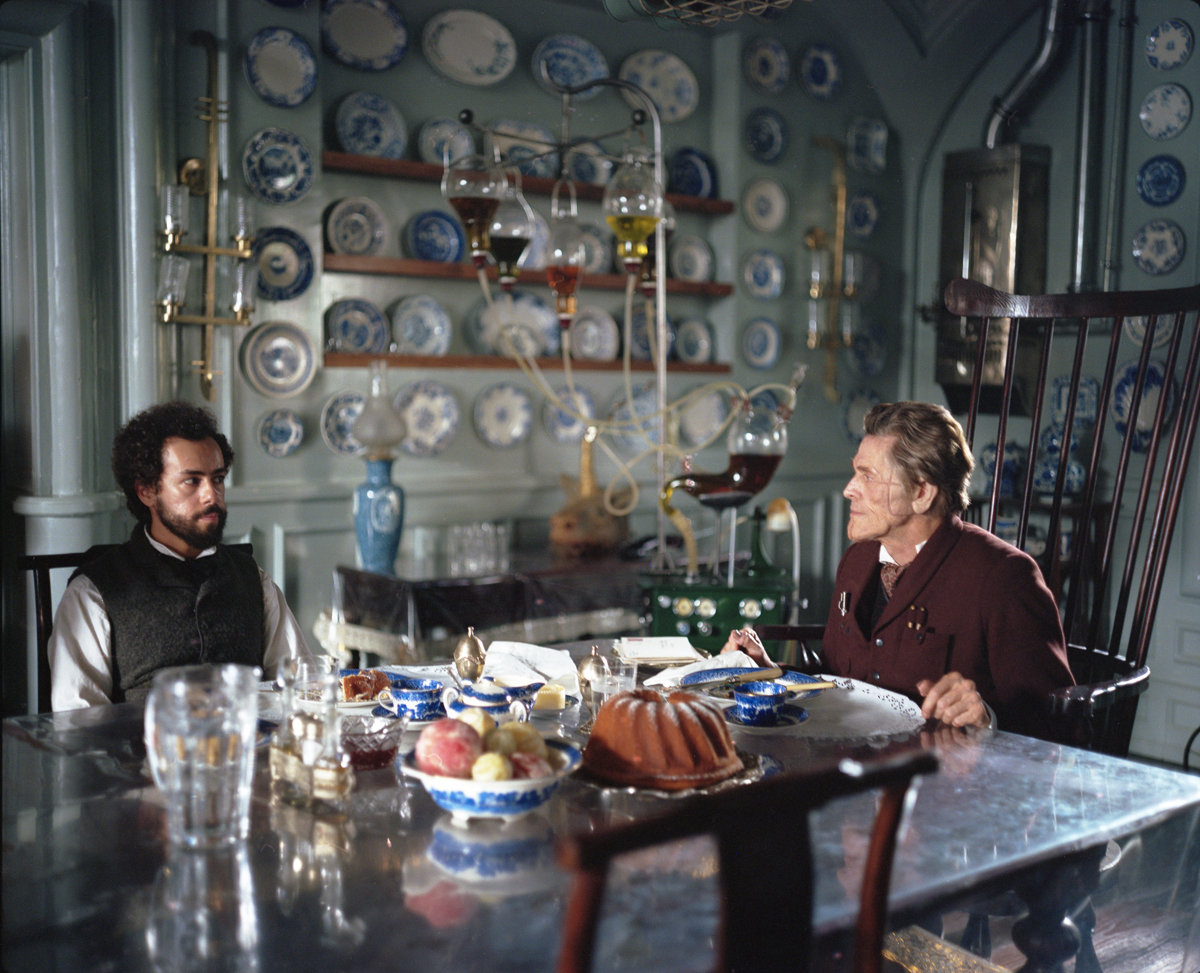
Max McCandles, the man Godwin employs to monitor Bella’s progress, is aware of the condition. However, even then Max agrees to marry Bella when Godwin proposes. When Max says, “I apologize for my own dark thoughts,” after implying that he thought Godwin might have been raising her to be his mistress. Godwin replies, “Not dark at all. Men’s, indeed all sexuality, is basically immoral.” Max immediately says, “Not all, sir.” He instinctively comes to defend the male race with the incessant claim of ‘not all men,’ as if the existence of exceptions is enough to dismiss the larger argument.
And the film gives him an answer without turning it into an explanation. Godwin simply asks whether he wishes to marry Bella or not. There it is. The question itself says enough. And even then, the film gives us another little exclamation when Max proposes to Bella.
Duncan Wedderburn, who initially enters as the man required to draw up the legal agreement of Bella and Max’s unusual marriage, later becomes the one to take Bella away. He tells her, “You are a prisoner and I aim to free you.” The moment he says this, the feeling of how patriarchy works becomes difficult to ignore. A man being the protector and a woman being the protected. What Duncan essentially wants to do is transfer Bella from one prison to another. He calls it freedom because he wants her to surrender herself to him and not to another man. It is not freedom that he is offering her. It is another form of ownership, only one that has been given a nicer name.
:max_bytes(150000):strip_icc()/poor-things-08312379-f2875735996c484e89a07f29db61ebb5.jpg "Poor Things: The World Through a Woman Who Has Not Yet Learned to Obey 2")
Duncan tries to trap Bella constantly throughout their time together, but he does not expect her to question the trap itself. It is outside his belief that a woman would dare to question what a man has already decided for her.
And this is why Bella being different because of her baby brain is not really the point. That is only the gateway through which the film allows us to see things from the point of view of women. A questioning woman is not welcome. A submissive one is. The point to absorb here is that there are no submissive women by nature. They are made submissive by the patriarchy. No woman was born knowing that she had to obey. Not our mothers, not our grandmothers. They were taught by their previous generations.
When Bella encounters the outside world, at first, she is almost nonchalant about what she sees. But when she comes face to face with the reality of that violence later in some grotesque detail through Harry Astley, something changes. Her breakdown from being overwhelmed feels understandable given the condition of her out of sync body and mind. And along with Bella, something inside us also crumbles.
It makes you wonder when it was that we accepted the way of the world as it is. When was it that we stopped questioning the injustice around us every day? When was it that the horrors happening around us became normal? When was it that all of us grew accustomed to no longer being shocked every day? And when was it that discovering kindness in people was something that became a surprise?
Bella is beginning to understand what it means to actually live in the world, rather than simply exist inside the protected space she had known before. And the more she experiences the world, the more she begins to notice the contradictions within it, especially in the people who claim to love or protect her.
When Duncan tells her he loves her and wants to marry her, while also threatening to throw her off the ship if she refuses, Bella asks: “So you wish to marry me or kill me? Is that the proposal?” Even though Duncan says no, all his actions say otherwise. His saying no is only evidence of the fact that he is aware of society, of what you can and cannot say. But who you are is something you can’t escape. And Duncan knows he is a product of patriarchy and someone who enjoys the privileges of it.
But what sort of marriage would it be then? One of imprisonment? One where only Duncan is happy? One where it is not really a party of two anymore because the free consent belongs only to the man?
Her questioning becomes even more confrontational when she enters the world of sex work.
When Bella reveals to Duncan that she slept with someone for money, Duncan, immediately repelled and disgusted by the fact, says, “It is the worst thing women can do.”
Because sex work is treated as an abomination of sorts. But what is actually an abomination is not the free choice of sex work itself. It is trafficking, coercion, and forcing someone into it. Yet society has somehow created an entire hierarchy in which a woman choosing her own sexuality can be treated as something lowly. A woman’s loyalty to one man is considered respectable, while her choice to have sex on her own terms is judged. It is an argument that also exists in something as simple as the word “slut.” We have spent years treating the word as an insult, when its meaning is essentially a woman who has a lot of casual sex. And I fail to understand why that, by itself, is supposed to be bad. If two consenting adults are making their own choices and taking care of their safety, why should the choice of one woman become the concern of everyone else?
In the brothel, Swiney and Bella talk about a woman’s choice in a place like this.
And what Swiney says shocks her. “But some men enjoy that you do not like it.” The surprise on Bella’s face matters because she is still capable of being shocked by things that everyone else has already accepted.

Towards the climax, she meets Alfie, her husband from her past life, who becomes another man trying to entrap her.
When Alfie tells her she will be as happy as she was before, Bella asks: “As I was before when I threw myself from a bridge? Why would you want to keep me here if I do not wish to stay?” Alfie answers, “If one must drown, let it be in the river of love.”
Whose love?
He surely means his own. It is enough that the man loves the woman, even when the woman is repulsed by him to the point of killing herself. Her desire does not matter because his desire has already decided what their relationship should be. And there is something even more disturbing about the fact that this is a repetition of their life. He did this before. He knows that she killed herself. And he is still doing it again.
It takes us back to what Swiney said about men enjoying a woman’s refusal. There is something about ownership that makes even a “no” desirable when the person hearing it believes they are entitled to possess what is refusing them.
Bella finally tells Alfie, “I am not territory.” But Alfie reduces her entire existence to her body: “The root of the problem is between your legs. I will have it off, and it will not distract and divert you anymore. You see, a man spends his life wrangling his sexual compulsions. It’s a curse and yet, in some ways, his life’s work. A woman’s life’s work is children. I intend to rid you of that infernal packet between your legs and plant a seed in you straight after.”
Here, the idea becomes almost brutally simple. A woman is reduced to a machine for producing children. Pleasure belongs to the man alone, while the woman’s sexuality is treated as something dangerous that must be removed, controlled, or redirected towards motherhood.
And this is where Bella says something that is both revolting and strangely satisfying: “In some ways it would be a relief to be rid of my questing self.”
A person who has a habit of questioning, analysing, seeing everything and everyone around them with a skeptical lens has a hard time living in the world of the real. They know of the suffering people go through every day. They know that taking away that suffering is anything but simple. They know that the rich are often the ones most protected by the world as it exists, and that the same people who have the power to change it can also benefit from keeping it unchanged. They know the system is built in ways that keep some people comfortable and others struggling. And they know breaking it down is not easy.
And knowing all this can become a curse in itself.
So Bella’s thought is not a desire to become ignorant. It is only an expression of exhaustion at having seen so much. But she has no intention of abandoning her questing self, and she does not.
That is what makes Poor Things more than a story about a woman discovering sex, travelling the world, or rebelling against men. It is about what happens when a person enters the world without being taught what she is supposed to believe.
Bella questions because she has not yet learnt obedience. She asks because she has not learnt silence. She refuses because she has not been taught that refusal is impolite. She chooses because nobody has yet convinced her that someone else should choose for her.
And I wish society would stop doing it for every woman on the planet.
Poor Things: Watch Trailer
Read More: