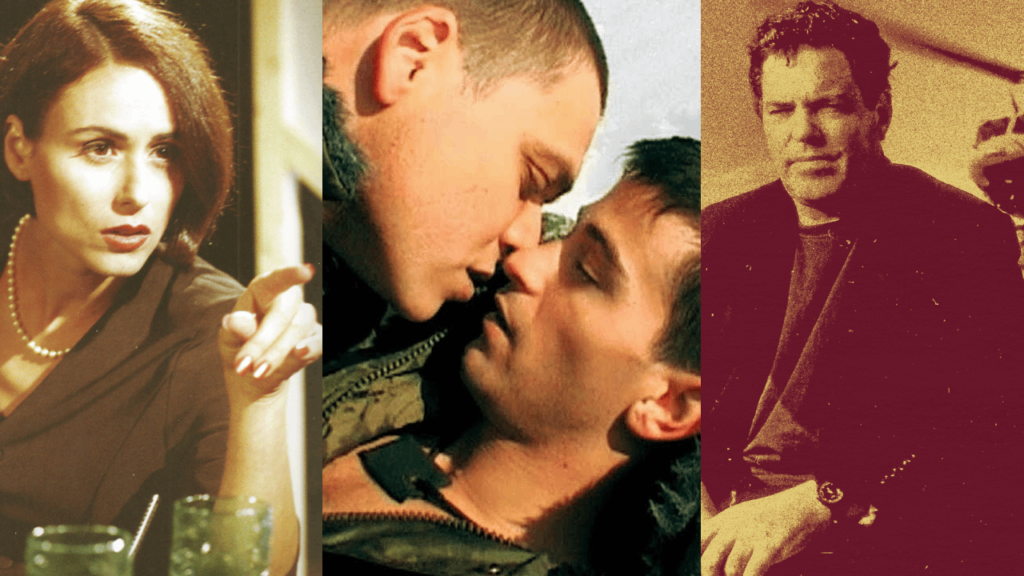
Israeli cinema went through an important change after the 1990s. The decade had already seen filmmakers move away from directly talking about the political events around them and instead look at people, their identities and the communities they came from.

Films such as Sh’Chur, Life According to Agfa, Song of the Siren and Yana’s Friends were looking at questions of immigration, ethnicity, sexuality, identity, and belonging. It was a cinema that was slowly becoming more interested in the person than the country around them. But by the beginning of the 2000s, the country started finding its way back into these stories. War, politics, religion, family, and sexuality returned, but they were not always treated as large subjects. More often, they were seen through people. And that changed the way Israeli cinema began speaking about itself.
One of the clearest changes was the return of political and historical subjects. The politics of Israel had never really left its cinema, but filmmakers were now becoming more comfortable with looking at them directly. Amos Gitai’s Kippur (2000) went back to the Yom Kippur War, but the film was less interested in the war as a historical event and more in what it did to the people inside it. Soldiers are exhausted, frightened and physically pushed to their limits. There is very little distance between the viewer and their experience. The war becomes less about history and more about memory, and what remains with a person after the event itself is over.
Ari Folman’s Waltz with Bashir (2008) took this idea of memory even further. The film uses animation and documentary-like elements to follow an Israeli soldier trying to recover his memories of the First Lebanon War. It is about a war, but it is also about forgetting, guilt and what happens when a person tries to understand something they have spent years avoiding. The film’s international success, including its Oscar nomination, showed something important about Israeli cinema. A story could be completely rooted in one country’s history and still find something universal in it. You did not have to know the war to understand what it meant to live with its memory.

The same movement towards the personal could be seen in the work of filmmakers such as Eytan Fox. After Song of the Siren in 1994, Fox continued looking at sexuality, relationships and identity within Israeli society. Yossi and Jagger (2002) follows a relationship between two Israeli soldiers and brings together two things that are often kept separate, the image of the soldier and the experience of being gay. The Bubble (2006) similarly places love and homosexuality alongside the Israeli-Palestinian conflict. What makes these films interesting is that they do not treat the personal and the political as two different worlds. For the people living inside them, they are often the same world.
Israeli cinema was also finding larger social questions inside very ordinary relationships. Joseph Cedar’s Footnote (2011) is centred on a father and son who are both academics at the Hebrew University of Jerusalem. Their conflict comes from competition, recognition, pride, and the need to be acknowledged. There is no war in the middle of the story. There is no large political event driving it. And yet, there is something very Israeli about the world the film creates. It shows how a country can also be understood through its smaller struggles. Sometimes what a person desires from their family can tell us as much about a society as what happens on its streets.
Religion, marriage, and tradition became another important part of this cinema. Dover Kosashvili’s Late Marriage (2001) follows a Georgian Jewish man who is under pressure from his family to marry according to their expectations. The conflict is simple on the surface: what does he want, and what does his family want for him? But underneath it is a larger question about how much of a person’s life belongs to them and how much is shaped by the community they come from.

This question appeared in different forms in To Take a Wife (2004), Shiva (2008) and Gett: The Trial of Viviane Amsalem (2014), made by Ronit Elkabetz and Shlomi Elkabetz. Their films looked at marriage, divorce, family and the position of women within traditional structures. Rama Burshtein’s Fill the Void (2012) went inside the Haredi community and looked at marriage and relationships through its traditions. These films were not simply introducing communities that had not been seen enough before. They were asking what happens when the individual begins wanting something different from the world they belong to.
That became one of the defining things about Israeli cinema after the 1990s.
The country could no longer be seen through one identity. Mizrahi identity, immigration, religion and different ethnic and cultural communities became part of the larger cinematic picture. Israel was not one experience. It was many experiences existing together, sometimes comfortably and sometimes not. Cinema gave filmmakers a way to sit with these differences instead of trying to resolve them.
The same could be seen in the way Arab-Jewish relations were portrayed. Eran Kolirin’s The Band’s Visit (2007) follows an Egyptian police orchestra that accidentally arrives in a small Israeli town. It could have been a film built entirely around the political relationship between the two countries. Instead, it becomes a film about awkward conversations, loneliness, humour and small connections between strangers. The politics are there, but they do not always have to be spoken. Sometimes two people simply sitting together can tell us what a political conflict has made difficult.

The military also remained an important part of Israeli cinema, but the soldier was changing. Earlier films often placed the soldier at the centre of the national story. Later films began asking what happens when that soldier is simply a person. Talya Lavie’s Zero Motivation (2014) uses black comedy to show female soldiers dealing with boredom, frustration and the absurdity of military life. Samuel Maoz’s Foxtrot (2017) looks at military service through grief, guilt and the consequences of decisions made by soldiers and the state. The soldier is no longer only someone representing the country. He can also be someone who is afraid, confused or morally uncertain. The image becomes more human because it becomes less perfect.
All of this was happening while Israeli cinema was becoming increasingly visible outside Israel. Films such as Waltz with Bashir, The Band’s Visit, Footnote and Foxtrot travelled through international festivals and received recognition abroad. This mattered not only because the films were winning awards. It meant that stories which came from a very particular society were being understood by people who did not necessarily belong to it. Israeli cinema was finding that its specificity could actually be its strength.
The country’s film institutions and festivals also played a role in this growth. The Jerusalem International Film Festival and Haifa International Film Festival continued to give Israeli filmmakers important spaces to show their work. Docaviv, also known as the Tel Aviv International Documentary Film Festival, founded in 1998, strengthened documentary filmmaking and created another space for filmmakers to engage with social and political questions. The Ophir Awards also became an important part of the national film industry. These institutions did not create the change by themselves, but they gave the cinema that was already changing a place to exist.
Of course, the growth did not make the problems of Israeli filmmaking disappear. Making films was still expensive. The domestic audience was limited, while Hollywood and television had a much larger hold over viewers. Public funding remained important, and international partnerships, festivals and television continued to help filmmakers find ways to make and distribute their work. The international success of Israeli cinema opened doors, but it did not suddenly make the industry easy to sustain.
Maybe the biggest change after the 1990s, then, was not that Israeli cinema became more political. It was that filmmakers began to understand that politics could exist inside almost everything. A war could live inside a person’s memory. Religion could live inside a marriage. Sexuality could exist alongside military service. A political conflict could appear in something as small as two strangers sitting across from each other.
This is what gave Israeli cinema after the 1990s its particular character. It came out of a decade that had taught filmmakers to look inward, but it did not stay there. It looked back at the country, its history, and its conflicts, but now through people who were living with them. The cinema became less interested in giving one answer about what Israel was and more interested in asking what it meant to live there.
And maybe that is where its rise really came from. Not from becoming bigger, grander, or more political, but from becoming more willing to look at itself.
Israeli cinema began to understand that a country is not only its wars, governments or history. It is also its families, communities, relationships, memories, and the contradictions people carry within them. Once filmmakers began looking at all of that, there was no longer just one Israeli story to tell. There were countless.
Read More:
- World War II: The Story That Hollywood Never Stops Telling
- How Do Independent Films Survive? The Economics Behind the Movies
- Batwara 1947: How Hindi Cinema Kept Remembering The Scar Of PartitionTHE SEED OF THE SACRED FIG: When Politics Enters the Home
- How a Film Is Born: The Journey from an Idea to the Big Screen